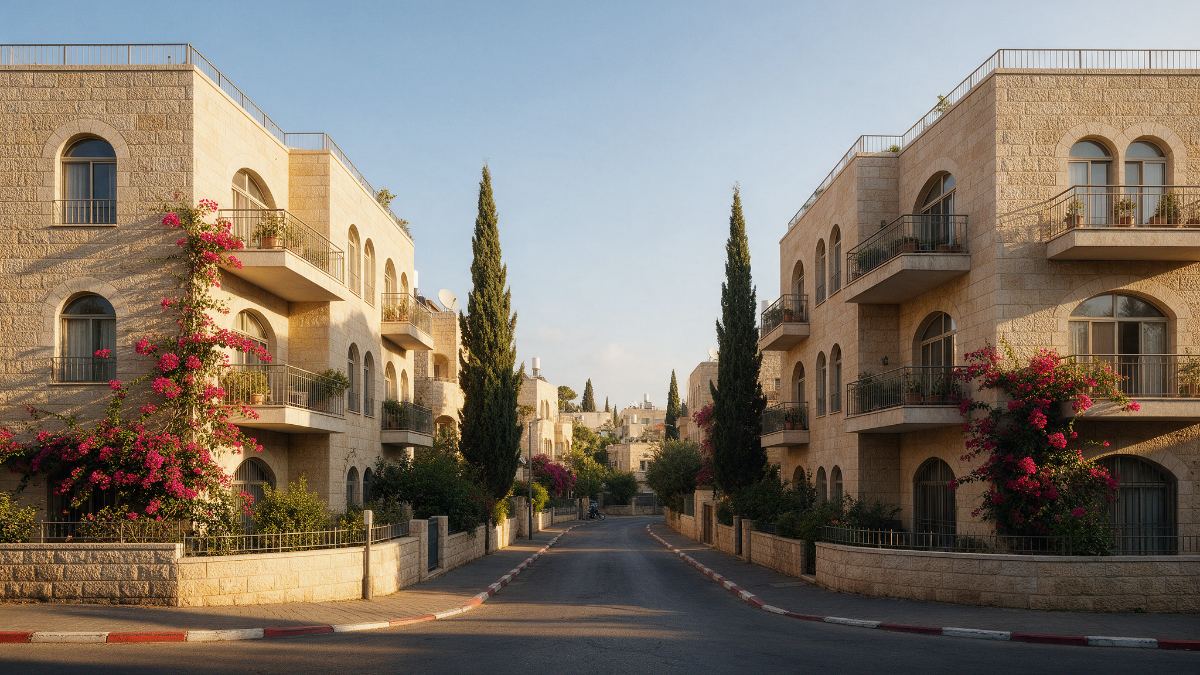
Buying in Nachlaot (Jerusalem): 2026 prices, properties, due diligence
Nachlaot is the lived-in historic core of West Jerusalem: a mosaic of small 1870s-1920s neighbourhoods, low stone houses, inner courtyards and car-free lanes, between Mahane Yehuda market, the light rail on Jaffa Road and Sacher Park. You buy small and expensive here, to live in or to rent to students. This guide gives real prices, what you actually buy, and why the title is subject number one.
The short answer
Nachlaot trades at ₪38,000 to ₪48,000 per m² for resale, based on listings and transactions observed on Madlan and Yad2 in Q3 2026 (the neighbourhood has no official statistical series of its own). Properties are small: a 3-room of 65 m² gross costs ₪2.5M to ₪3.2M, a 2-room ₪1.7M to ₪2.2M. You buy here for the location (Mahane Yehuda market, light rail, city centre on foot) and to rent to students or young professionals, at a gross yield of 3 to 3.5%. Subject number one is the title: undivided ownership, unpermitted extensions and shared courtyards are the rule rather than the exception.
The figures to remember, November 2026
- ₪/m² resale
- 38,000–48,000 Madlan / Yad2, Q3 2026
- 3 rooms, 65 m² gross
- ₪2.5–3.2M by condition and courtyard
- Median size of units sold
- ≈ 60 m² gross, about 650 sq ft
- Gross rental yield
- 3–3.5% long-term, students and young professionals
- Purchase tax, non-resident
- 8% up to ₪6,055,070
- Distance to the Old City
- ≈ 1.5 km 15-20 min on foot, light rail on Jaffa Road
The neighbourhood: thirty small neighbourhoods in one
Nachlaot ("the estates") is not one neighbourhood but some thirty: Mazkeret Moshe, Ohel Moshe, Mishkenot Yisrael, Zichron Tuvia, Batei Broide, Batei Rand, Sukkat Shalom, Knesset Yisrael and more, founded between 1875 and 1925 by Jewish mutual-aid societies, Yemenite, Kurdish, Syrian or Ashkenazi, each around a courtyard and a synagogue. The result is a fabric of one- and two-storey stone houses, two-metre-wide lanes, stairways and inner courtyards, bounded to the north by Agrippas street and Mahane Yehuda market, to the east by Bezalel street and the city centre, to the south by Narkis street and Rehavia, to the west by Sacher Park and the Knesset. Sha’arei Chesed, to the south-west, looks similar but works as a separate religious neighbourhood, and costs more.
It is the best-connected neighbourhood in our selection: the light rail (Red Line) stops at Mahane Yehuda and on Jaffa Road, the central bus station is ten minutes on foot, the Old City twenty. You live here without a car, which is just as well: there is almost no parking. The population mixes long-standing families (often tenants for generations, or owners in undivided shares), students from Bezalel and the Givat Ram campus, young couples, religious residents drawn by a hundred small synagogues, and for fifteen years buyers from abroad taken by the character and by the market, which has changed face (bars, restaurants) without losing its stalls.
The whole area falls under the municipality’s city-centre preservation plan: capped heights, mandatory stone façades, many individually listed buildings. Demolish-and-rebuild is rare; adding a floor is negotiated case by case.
What you buy, and at what price
Four families of property. Historic courtyard houses, one to three ground-floor rooms opening onto a shared courtyard, often vaulted, sometimes with no window on the lane: 40 to 80 m², ₪1.7M to ₪3.5M by condition. Apartments in 1930s-60s buildings on Agrippas, Bezalel and Rama streets, three or four floors without elevator: 2 to 4 rooms, price per m² at the bottom of the range. Whole renovated houses, two floors plus roof terrace, 90 to 140 m², rare, ₪3.5M to ₪6M, bought by foreigners or well-off families. Recent boutique projects (added floors, rebuilds on free plots, 4 to 12 units) at ₪50,000-60,000 per m², with elevator but rarely parking.
| Size | Gross area | Range | What you find |
|---|---|---|---|
| Studio, 2 rooms | 35–50 m² | ₪1.5–2.2M | The bulk of the student rental market; often a former room of a courtyard house. |
| 3 rooms | 60–70 m² | ₪2.5–3.2M | Young couples, investors; courtyard or terrace adds value. |
| 4 rooms | 85–100 m² | ₪3.4–4.6M | Often two units merged; check the permit for the merger. |
| Whole renovated house | 90–140 m² | ₪3.5–6M | Roof terrace, character; rarely more than two on the market per quarter. |
In Nachlaot more than anywhere, the advertised area needs checking: 60 cm stone walls, vaults and "private" courtyards that are not private in law mean a 65 m² gross unit may offer only 48-50 m² of living space, about 520-540 sq ft (see gross vs net square meters). Ask for a dimensioned plan or have it measured.
Who buys in Nachlaot
Investors first, Israeli and foreign: a 2- or 3-room near the market rents without vacancy to students or young professionals, and land value in a central, protected neighbourhood has doubled in twelve years. Some of these investors bought between 2015 and 2022 for tourist lets; since the municipal clampdown and the tourism slump of 2023-2024, many went back to yearly leases and some are selling, which feeds supply in 2025-2026. Young Jerusalem couples, observant or not, who want the centre without Rehavia’s price. Diaspora buyers, American, British and French, after a pied-à-terre with character within walking distance of the Old City and the Kotel: renovated courtyard houses, roof terraces. And neighbourhood families buying out their co-heirs to reunite a house, which is where most of the "undivided share" sales come from.
Worked example: a renovated 3-room, non-resident buyer
| Price | 2,700,000 ₪ |
| Purchase tax (8%, non-resident) | 216,000 ₪ |
| Lawyer (1% + VAT: a longer title file than elsewhere) | ≈ 31,860 ₪ |
| Agency (2% + VAT) | ≈ 63,720 ₪ |
| Surveyor and building inspection (compliance, damp, structure) | ≈ 12,000 ₪ |
| Mortgage broker, bank appraisal, translations, power of attorney | ≈ 20,000 ₪ |
| Total cost | ≈ 3,043,580 ₪ (+ 12.7%) |
| Mortgage at 50% (clean title, appraised) | 1,350,000 ₪ → ≈ ₪7,650 / month over 25 years |
| Cash to plan for | ≈ 1,693,580 ₪ (≈ $455,000 / £355,000) |
Let at ₪7,500 a month to two medical students, the unit yields 3.3% gross, 2.6% net after the owner’s arnona during vacancies, insurance, maintenance and management. The same purchase by a new oleh (only home) would carry about ₪3,600 of purchase tax instead of 216,000 ₪. Brackets in mas rechisha 2026.
Due diligence specific to Nachlaot
- The Tabu: apartment or undivided share? Many Nachlaot houses are registered as a single plot held in undivided shares (mushaa) by several families, with no condominium bylaws or subdivision plan. You then buy "3/24 of the plot with the use of such and such rooms", not a unit. Consequences: hard to finance, co-owners’ pre-emption rights to check, slower resale. Regularisation (condominium registration, tsav batim meshutafim) takes 1 to 3 years and needs everyone’s consent.
- Unpermitted extensions. Rooms added onto the courtyard, converted roofs, mezzanines, enclosed loggias: a sizeable share of the built fabric went up without a heter bniya. The lawyer pulls the permit file from the municipality; whatever is not in it is exposed to a demolition order, especially inside a preservation zone. The price must reflect it.
- The shared courtyard (hatzer meshutefet). Who may use it, who maintains it, who may build on it? Rights of way often cross the "private courtyard" sold in the listing. Have the uses written into the contract.
- Access, parking, deliveries. Pedestrian lanes, no parking: a rented space nearby costs ₪500 to ₪900 a month, and renovation costs 15 to 25% more than elsewhere for lack of machine access.
- Preservation and works. Inside the Lev HaIr perimeter, any change to a façade, roof or volume goes through the preservation committee. A property "with building rights on the roof" is only worth those rights if the listing allows them.
- Damp, structure, utilities. Houses from 1900 on bedrock, vaults, thick walls: have an engineer (mehandes) through before signing, and check the connections (sewage, three-phase electricity), often shared between several units.
In Nachlaot, the zikaron dvarim (binding pre-agreement) signed on the evening of the viewing regularly costs dearly: the title turns out undivided, the extension illegal, and walking away forfeits the deposit. Have the nesach Tabu read before writing anything: see real estate lawyer in Jerusalem.
Rentals and yield
A studio or 2-room rents for ₪4,800 to ₪6,500 a month, a 3-room ₪6,500 to ₪8,500, a renovated house with terrace ₪10,000 to ₪14,000. Tenants are students (Bezalel five minutes away, Hadassah Ein Kerem and Givat Ram by direct bus), young professionals working in the centre and medical residents; leases are yearly, and summer vacancy is real on student lets. Gross yield comes to 3 to 3.5%, the highest of Jerusalem’s central neighbourhoods, but costs weigh: upkeep of old buildings, property management (8 to 10% of rent for an owner abroad), arnona during vacancies.
Short-term rental made the neighbourhood’s reputation and its recent history: between 2015 and 2022, hundreds of courtyard houses were let by the night to market visitors. The municipality now requires a business licence, applies arnona at the commercial rate to apartments let by the night, fines nuisance, and building committees vote bans. A property bought for Airbnb has to stand on its own as a yearly rental. Tax on rental income (exemption up to ₪5,654 a month in 2026, 10% flat rate or real regime) and filing from abroad: see Shekel Guide and buying from abroad.
Frequently asked questions
How much does a 3-room apartment in Nachlaot cost in 2026?
Between ₪2.5M and ₪3.2M (about $695,000 to $890,000) for 60 to 70 m² gross, depending on condition, floor and whether there is a private courtyard or roof. A studio or 2-room of 40-45 m² goes for ₪1.7M to ₪2.2M, a renovated courtyard house of 90-100 m² for ₪3.5M to ₪4.5M. These are prices observed on Madlan and Yad2 in Q3 2026; the Central Bureau of Statistics publishes no series for the neighbourhood itself.
Can I run a short-term rental (Airbnb) in Nachlaot?
The neighbourhood was one of Jerusalem’s hubs for tourist lets in 2015-2022, thanks to the market and the light rail. Since then the municipality has tightened enforcement: a business licence, arnona at the commercial rate for apartments let by the night, fines for nuisance, and building committees increasingly ban the practice. Base your numbers on long-term rental; short-term is an uncertain bonus.
Why do so many Nachlaot properties have a Tabu problem?
Because the neighbourhood was built by mutual-aid societies before the modern land registry: houses split among heirs, plots never subdivided (mushaa), extensions built without permits onto shared courtyards. Many properties are registered as undivided shares of a plot, not as apartments. It is not a deal-breaker, but it lengthens the process and conditions the mortgage.
Can a non-resident get a mortgage on a Nachlaot house?
Yes if the title is clean: the property registered as a condominium unit at the Tabu, with no undivided share and no illegal construction. On a mushaa property or one with an unregularised extension, most banks decline or cap the loan at 30-40% of a cautious appraisal. Plan on a largely cash purchase for that kind of property.
How we work
Every amount, bracket and rate on this page is checked against the official source listed at the bottom and dated. When a schedule or rate changes, the page is updated within days. Our methodology.
Sources
Looking in Nachlaot?
Studios, 2-3 rooms, courtyard houses: an English-speaking agency that knows the neighbourhood lane by lane sends you a selection and tells you, for each property, where the title and the building works stand.