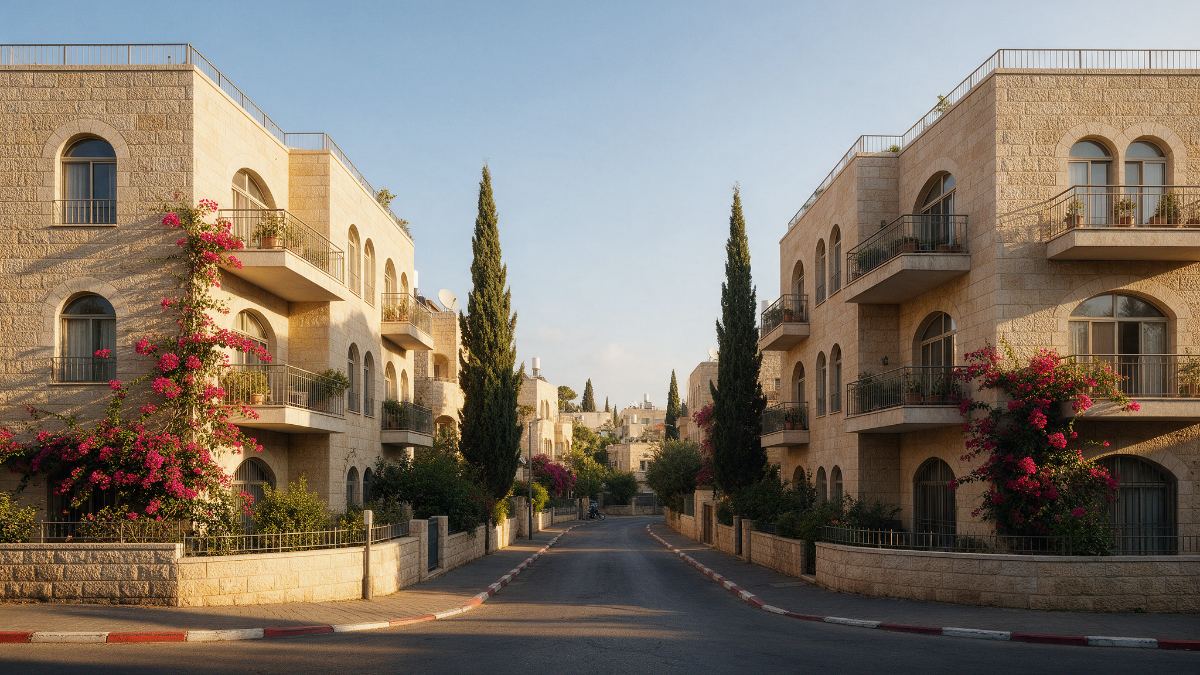
Buying in Katamon (Jerusalem): 2026 prices, properties, due diligence
Old Katamon is, with Baka and the German Colony, the neighbourhood most in demand among diaspora families in Jerusalem: quiet streets, English- and French-speaking synagogues, San Simon park, ten minutes on foot from Emek Refaim. This guide gives real prices by apartment size, what you actually buy, and what the lawyer checks before you sign.
The short answer
Katamon trades at ₪38,000 to ₪50,000 per m² for resale in Old Katamon (CBS and declared transactions, Q3 2026) and ₪50,000 to ₪62,000 per m² in the few new boutique projects. A 4-room apartment of 100 m² gross costs ₪3.8M to ₪5M (about $1.05M to $1.4M). Buyers are mostly observant families from the US, the UK, France and South Africa, living here or holding a second home. Two neighbourhood-specific points: the title (Church land, Minhal leases) and the preservation rules on 1930s buildings.
The figures to remember, November 2026
- ₪/m² resale, Old Katamon
- 38,000–50,000 Q3 2026
- ₪/m² new, boutique projects
- 50,000–62,000 Q3 2026
- 4 rooms, 100 m² gross
- ₪3.8–5M resale, by condition
- Gross rental yield
- 2.5–3% 4 rooms, long-term
- Purchase tax, non-resident
- 8% up to ₪6,055,070
- Distance to the Old City
- ≈ 3 km 25 min on foot to Jaffa Gate
The neighbourhood: Old Katamon and Gonenim
Katamon covers two different realities. Old Katamon (Katamon HaYeshana) was built between 1924 and 1948 by wealthy, mostly Christian Arab families around the Greek Orthodox monastery of San Simon. Its streets, Rachel Imenu, HaPalmach, Kovshei Katamon, HaLamed Hey, Bustenai, Tel Hai, HaGdud HaIvri, line up two- and three-storey villas in dressed stone, converted into small buildings of 4 to 8 apartments, plus a few taller 1950s-70s blocks, often with added floors. San Simon park and its playgrounds are the centre of gravity, ten minutes on foot from Emek Refaim and the German Colony.
To the west and south, Gonenim (the former "Katamonim", Katamon Het, Tet and up) was built in the 1950s-60s to house immigrants: three- and four-storey walk-up blocks, now the target of Jerusalem’s largest concentration of pinui-binui (demolish-and-rebuild) projects. The two areas touch, but neither the prices nor the buyers are the same.
Katamon has no light rail stop: the Red Line runs through the city centre, a 20-25 minute walk, and the planned Blue Line is to run along Emek Refaim on the neighbourhood’s eastern edge, on a route still being argued over. In practice the neighbourhood works on foot and by bus (lines 13, 18, 34 to the centre); the Old City is three kilometres away, the First Station and its restaurants fifteen minutes. Community life is dense: some thirty synagogues within a kilometre, several of them Anglo (Shira Hadasha, Yakar, Ramban, the Shtiblach), religious and secular schools, nurseries, and the shops of HaPalmach street.
What you buy, and at what price
Three families of property. Apartments in 1930s-40s stone buildings: high ceilings, patterned floor tiles, thick walls, often no elevator or parking, shared gardens. This is the core of the market and the most expensive per m². "Arab houses", original villas kept whole or split into two or three units, with garden and courtyard: rare, ₪8M to ₪15M, almost always under preservation. New boutique projects of 6 to 20 units, on rebuilt or raised plots (TAMA 38), with elevator, underground parking and safe room (mamad), at ₪50,000-62,000 per m². In Gonenim, the new pinui-binui towers sell at ₪45,000-55,000 per m², the old blocks at ₪30,000-38,000.
| Size | Gross area | Range | What you find |
|---|---|---|---|
| 3 rooms | 70–80 m² | ₪2.8–3.8M | Pied-à-terre, young couples; often in 1950s-70s blocks. |
| 4 rooms | 95–105 m² | ₪3.8–5M | The family standard; a succah balcony adds value. |
| 5 rooms | 120–140 m² | ₪4.9–6.5M | Villa floors, garden or terrace; rare, sell fast. |
| 4-5 rooms, new | 100–130 m² | ₪5.2–7.5M | Boutique projects, parking included, delivery 2027-2029. |
Price per m² is quoted on gross area: a listed 100 m² is 80 to 85 m² of living space in the US or UK sense, about 860-915 sq ft (see gross vs net square meters). Katamon listings often mention an extra "unit", a studio or room rented separately in the basement or garden: check it is permitted (building permit, separate arnona account) before counting its rent.
Who buys in Katamon
Demand comes first from observant diaspora families: Teaneck, the Five Towns, Hendon and Johannesburg on the Anglo side; Paris, Lyon and Strasbourg on the French side. Some settle for good (aliyah, retirement), others buy a second home used over the holidays and the summer. These apartments occupied a few weeks a year have a name in Jerusalem, dirot refaim ("ghost apartments"); the municipality counts several thousand across the central neighbourhoods, Katamon included. It is not a legal category: tax and arnona (municipal rates) are the same, and the city dropped the idea of a surcharge. But it weighs on buildings that run with absent owners.
Second profile: established Jerusalem families trading up from Gonenim or Kiryat HaYovel, who compete with foreign buyers for 4- and 5-room apartments. Third, more recent profile: buyers of a pinui-binui unit in Gonenim, residents and non-residents alike, drawn by new construction at ₪45,000-55,000 per m² five minutes on foot from Old Katamon, delivered in 3 to 6 years.
Worked example: a resale 4-room, non-resident buyer
| Price | 4,600,000 ₪ |
| Purchase tax (8%, non-resident) | 368,000 ₪ |
| Lawyer (≈ 0.75% + 18% VAT) | ≈ 40,710 ₪ |
| Agency (2% + VAT) | ≈ 108,560 ₪ |
| Mortgage broker, appraisal, bank file, translations, power of attorney | ≈ 24,000 ₪ |
| Total cost | ≈ 5,141,270 ₪ (+ 11.8%) |
| Mortgage at 50% | 2,300,000 ₪ → ≈ ₪13,000 / month over 25 years |
| Cash to plan for | ≈ 2,841,270 ₪ (≈ $765,000 / £600,000) |
The same purchase by a new oleh (only home, within seven years of aliyah) would carry about ₪13,100 of purchase tax instead of 368,000 ₪, and could be financed at 75%. If aliyah is possible within two years, tell your lawyer before signing: the tax return can be filed as a non-resident and corrected later. Brackets in mas rechisha 2026.
Due diligence specific to Katamon
- The title: Tabu, Church or Minhal? Part of Old Katamon stands on land owned by the Greek Orthodox Patriarchate or other Christian institutions, leased long-term to the State or to companies, sometimes on leases ending in the 2050s. Other plots are managed by the Minhal (Israel Land Authority) on 49- or 98-year leases. A property "on Church land" sells 15 to 30% cheaper, finances badly and resells with difficulty. The lawyer reads the nesach Tabu (registry extract) and the lease before any offer.
- Preservation (shimur). Many 1930s-40s buildings are on the municipality’s preservation list: façades, railings, stairwells and sometimes interior volumes are protected. No balcony, enclosed loggia or added floor without the committee’s approval. Check the listing on the city’s planning site before buying with renovation plans.
- Old co-ownerships and common areas. Gardens, cellars, roofs: the allocation often dates from the 1950s, with roof "building rights" attached (or not) to a specific unit. The building bylaws (takanon) and the condominium order (tsav batim meshutafim) have to be read line by line.
- Added floors and units. Converted attics, garden studios, extensions on pillars: ask for the building permit (heter bniya) and the occupancy certificate (tofes 4). An unpermitted extension can sometimes be regularised, with a fine and a betterment levy (hetel hashbaha), and sometimes not.
- Pinui-binui in Gonenim. If you buy an old apartment in a block slated for demolition, check where the project stands: occupants’ signatures (a majority is required), plan filed, permit issued. From agreement in principle to delivery, count 6 to 12 years. Details in buying off-plan from a developer.
Never sign a zikaron dvarim (binding pre-agreement) in Katamon before a lawyer has read the title: this is the Jerusalem neighbourhood where surprises about who owns the land are most frequent. See real estate lawyer in Jerusalem.
Rentals and yield
A resale 4-room rents for ₪8,000 to ₪11,000 a month on a yearly lease, a 3-room ₪6,500 to ₪8,500, a renovated 5-room ₪11,000 to ₪15,000. Against the prices, gross yield comes to 2.5 to 3%, among the lowest in the city: you buy Katamon to live in or to hold, not for the rent. Short-term letting to holiday visitors works, at ₪500-900 a night for a 4-room, but depends on the building bylaws and on the neighbours’ tolerance; the municipality has stepped up enforcement on apartments let by the night without a licence. For a pure investor, Arnona or Kiryat HaYovel offer 3 to 3.5% with new stock.
Tax on rental income (exemption up to ₪5,654 a month in 2026, 10% flat rate or real regime): see the tax guide on Shekel Guide.
Frequently asked questions
What is the difference between Old Katamon and the Katamonim (Gonenim)?
Old Katamon is the historic 1920s-40s neighbourhood of stone villas and quiet streets around San Simon: ₪38,000 to ₪50,000 per m² for resale. Gonenim (formerly the Katamonim, Katamon Het, Tet and so on) is the 1950s-60s public housing to the west and south, now undergoing large-scale pinui-binui: ₪30,000 to ₪38,000 per m² in the old blocks, ₪45,000 to ₪55,000 per m² in the new towers.
What is a "dirat refaim" and should I worry about it?
The phrase ("ghost apartment") describes homes owned by residents abroad and used a few weeks a year. Katamon, Rehavia and Talbieh have thousands of them. For a buyer it mainly means buildings where some neighbours are absent: check that the vaad bayit (building committee) functions, that fees are paid and that voted works are funded. There is no extra tax on them.
How much does a 4-room apartment in Katamon cost in 2026?
Between ₪3.8M and ₪5M (about $1.05M to $1.4M) for 95 to 105 m² gross in a resale building, depending on floor, elevator, parking and condition. In a new boutique project, expect ₪5M to ₪6.2M for the same area, parking included but often without a storage room.
Can a non-resident get a mortgage on a Katamon apartment?
Yes, usually up to 50% of the price, 70 to 75% if you are an Israeli citizen or making aliyah. On a 4-room apartment at ₪4.6M that means a ₪2.3M loan and a payment of about ₪13,000 a month over 25 years at November 2026 rates. The bank’s appraiser (shamai) looks at the title: a property on Church land or with an unregularised Tabu entry can be declined.
How we work
Every amount, bracket and rate on this page is checked against the official source listed at the bottom and dated. When a schedule or rate changes, the page is updated within days. Our methodology.
Sources
Looking in Katamon?
Tell us the size, budget and timeline: an English-speaking agency that works Old Katamon and Gonenim every day sends you a selection, including off-market properties.