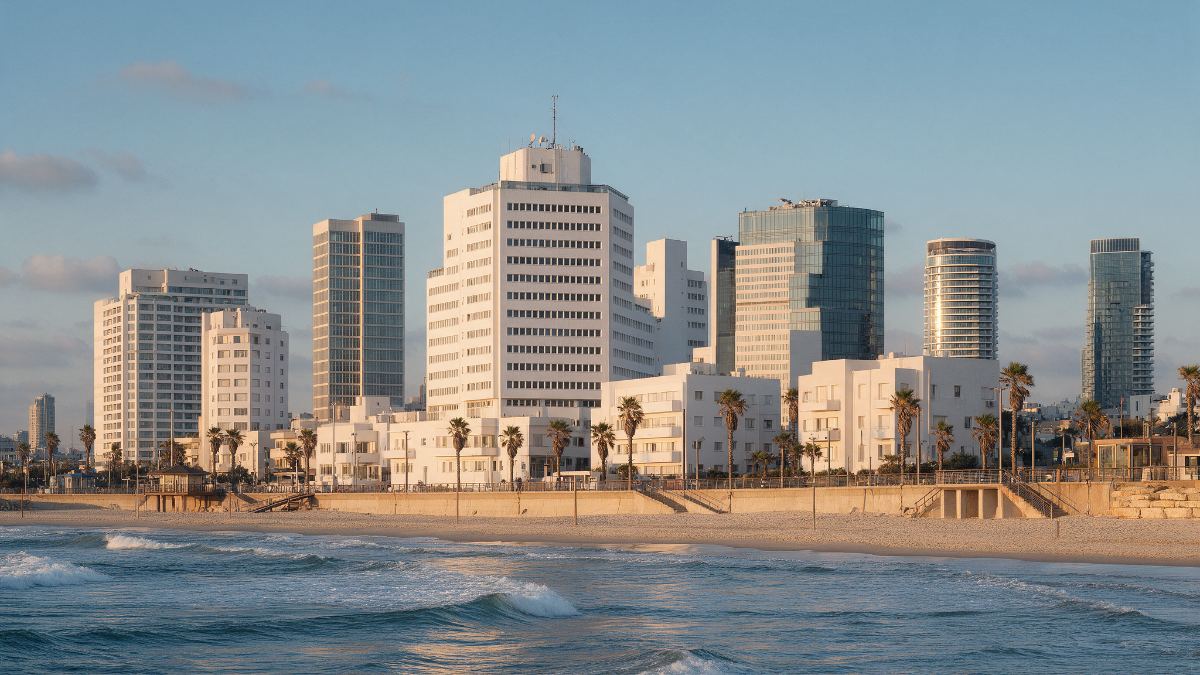
New Developments in Tel Aviv: Sde Dov, the Rova’im Plans, New-Build Prices, What to Check
In Tel Aviv, new builds have become the norm: 72% of purchases in the second quarter of 2026 were new homes, a record. They come from three sources, the former Sde Dov airport, the densification of older neighbourhoods under the rova’im plans, and urban renewal in the south and east, at prices that can double from one street to the next. Here is where the city is building, what new builds cost, how to read a 20/80 offer under the 2025–2026 rules, and what to check on a specific project.
The short answer
New construction in Tel Aviv comes from Sde Dov (a 16,000-home plan delivered in waves into the early 2030s), the rova’im plans densifying the Old North and the centre, and pinui-binui in the south and east. New builds trade at roughly ₪50,000 to more than ₪100,000 per m² and made up 72% of purchases in Q2 2026, yet 9,725 new homes were still unsold at the end of July, mostly at the top end, where developers negotiate. 20/80 deals still exist, restricted by the Bank of Israel until the end of 2026. TAMA 38 expired on 18 May 2026; only rova’im 3 and 4 keep an equivalent mechanism. Before signing: a permit actually issued, the Sale Law guarantee, a written delivery date, parking in the contract, and the technical specification.
Key figures, November 2026
- New builds’ share of purchases (Q2 2026)
- 72%
- Unsold new homes (end-July 2026)
- 9,725
- New build, observed ₪ per gross m²
- ≈ 50,000–100,000+
- Homes planned in Sde Dov
- 16,000
- Transactions with financing incentives (Dec 2025)
- 37%
- Developer balloon loans, cap per bank
- 10% to end-2026
Where Tel Aviv is building
Tel Aviv has almost no free land left, with one exception: Sde Dov. The rest of the new supply comes from densifying existing neighbourhoods, under quarter plans that set heights, building rights and parking ratios. For a buyer, the area determines the price, the building type (a 40-storey tower or a six-storey building plus a roof floor) and, above all, the wait.
| Area | What is being built | Public plans and figures | Deliveries |
|---|---|---|---|
| Sde Dov (north-west, former airport) | A new seafront neighbourhood: 5–10 storey buildings on main streets, towers of up to 40 storeys along the arteries | 16,000-home plan (including 6,900 affordable rental, senior and student units); Israel Land Authority tenders for 7,159 homes in 2024, about 6,700 marketed in early 2025 | South (Eshkol plan) under construction, delivering first; central and northern lots: 6–9 years to keys estimated |
| Old North and centre-north (rova’im 3 and 4) | Extra floors and rebuilds building by building; 6 storeys plus a roof floor in the UNESCO White City zone, 7 plus roof on some arteries | Potential of ≈ 8,000 additional homes (rova 3) and ≈ 5,100 (rova 4) | Roughly 2–4 years of works per building once permitted (observed) |
| Historic centre and centre-east (rova’im 5 and 6) | Densification around Rothschild, Allenby, Kerem HaTeimanim and out to the Ayalon | Plan for ≈ 4,200 homes raised to ≈ 5,000; filed late 2025, final approval pending | Not before the end of the decade for new permits |
| South and east: Yad Eliyahu, Neve Shaanan, Hatikva, Kiryat Shalom, Shapira, Jaffa Daled | Block-scale pinui-binui, towers near the Red Line | The Tel Aviv District accounts for nearly half of the country’s urban renewal starts (CBS, 2024–2025) | 3 to 6 years depending on permit stage |
| Towers and large plots: Park Tzameret, the HaHagana station area, the north-east (Neve Sharett, Ramat HaHayal) | Residential towers with services, mixed office-residential schemes | Private projects case by case | Staggered deliveries 2026–2031 |
The light rail shapes the map: the Red Line (Bat Yam – Jaffa – centre – Petah Tikva) has run since 2023, the Purple and Green lines are under construction, and the Sde Dov plan extends Ibn Gvirol Street north alongside the future Green Line. Projects in served neighbourhoods sell better, but streets under works weigh on deliveries and site access.
New vs resale prices
Prices are per gross m² and, for new builds, include 18% VAT. In towers, the share of common areas (lobby, pool, gym) can reach 10–12% of the area you are billed for. The resale ranges match our Tel Aviv city guide; the new-build ranges are orders of magnitude observed in 2025–2026, anchored on price points published by the business press, not official statistics.
| Area | Resale | New | Published reference points |
|---|---|---|---|
| Neve Tzedek, Rothschild, Park Tzameret, seafront | 70,000–90,000 | 90,000+ | Luxury towers and residences; some top-end apartments exceed ₪30M. |
| Sde Dov | — | 55,000–100,000 | One large project launched at ₪49,000/m² in 2025 (≈ ₪54,000–55,000 targeted average), against ≈ ₪80,000 on average for its neighbours and over ₪100,000 for some; one project cut its average by ₪6,000/m² in early 2026. |
| Old North, Bavli | 55,000–70,000 | 65,000–90,000 | A new building on Weizmann Street listed at ₪67,500/m² in 2026, about ₪10,000 less than in 2024. |
| Ramat Aviv, north-east (Neve Sharett, Ramat HaHayal) | 50,000–65,000 | 50,000–75,000 | A renewal project on Bnei Ephraim Street at ≈ ₪43,000/m² before VAT, i.e. ≈ ₪50,700 including VAT. |
| Florentin, Shapira, Kiryat Shalom, Jaffa | 40,000–60,000 | 55,000–75,000 | Urban renewal and small schemes; in Jaffa the gap depends heavily on the street and the title. |
| Yad Eliyahu, Hatikva, Neve Shaanan | 38,000–48,000 | 50,000–60,000 | Pinui-binui along the Red Line; the entry price for new builds in the city. |
Why are new builds so expensive? Land first: Sde Dov lots sold at record prices in 2021–2022 (over ₪2.5M of land per home on average, up to ₪3.3M), before falling more than 40% in the 2025 tenders, to around ₪1.9M per home. Projects bought at the peak have little room to cut; those from 2025 do. Construction next: according to the Real Estate Appraisers Association, building in central Tel Aviv cost about ₪12,700 per m² before VAT for a mid-rise in June 2026, up 6.9% year on year on a weighted basis, against 0.8% in Jerusalem. And parking: where it is sold separately, budget ₪250,000–450,000 per space. For Tel Aviv against other cities, see prices city by city; for the choice between the two, new or resale.
The new-build market in 2026: strong volume, stuck at the top
Since 2024, Tel Aviv buyers have swung towards new builds, for the mamad after the war and for developers’ financing offers. In Q2 2026, 72% of purchases were new homes, with more than 1,200 new units sold, 50% more than in Q1; over May–July, 1,157 new-home sales out of 1,730 transactions. Stock nonetheless remains high: 9,725 unsold new homes at the end of July 2026, roughly two years of sales at the current pace (our calculation).
The market is split in two. Mid-market urban renewal projects sell. The top end is stuck: several large luxury projects sold a handful of units a year in 2025, developers have doubled agent commissions (from 1% to 2% of the price, sometimes more), one large northern project offered club members 30% off on about fifty units, and the listed prices of several towers have fallen. Discounts rarely come as an official list-price cut; they are negotiated. For a foreign buyer, this is the segment where negotiating pays most.
20/80 and 10/90 plans, and the Bank of Israel rules
Tel Aviv is where financing incentives are most widespread: 37% of transactions included one in December 2025, up from 26% the month before, typically a 20/80 with a developer loan and a capped indexed balance. The framework changed in March 2025, with a temporary directive from the Supervisor of Banks in force until the end of 2026:
- developer-subsidised balloon loans (repaid in one go at delivery, with the developer paying the interest) are capped at 10% of each bank’s mortgages;
- where a large share of a project’s sales (at least 25%) carry deferral of at least 40% of the price, the bank’s credit to the developer is risk-weighted at 150% instead of 100%;
- since February 2026, every mortgage is limited to 30 years, with at least a third at a fixed rate and repayments capped at 50% of disposable income.
20/80 remains legal but rationed: developers keep it for part of their units and compensate with other perks. To compare two offers, work out the final indexed price. Since Amendment 9 to the Sale Law (contracts signed from 7 July 2022), the 20% paid at signing is never indexed, at most half of each later payment can be (40% of the price at most), and indexation stops at the contractual delivery date. In Sde Dov, where northern lots are years from delivery, an indexation waiver is often worth more than a free kitchen. To our knowledge the directive had not been extended beyond the end of 2026 as of 7 November 2026: check the rules before signing in 2027. The guarantee, delays (nothing in the first month, then 100% of comparable rent for months 2–4, 125% for months 5–10, 150% after that) and the warranty period are covered in buying off-plan from a developer.
Rova’im, pinui-binui and the end of TAMA 38
TAMA 38 expired nationwide on 18 May 2026: no permit application can be filed under it any more. Tel Aviv had in effect replaced it with its own quarter plans, rova’im 3 and 4, approved in 2018, which continue independently of TAMA 38. Elsewhere in the city there is no longer a building-by-building renewal track in force: renewal goes through pinui-binui or future plans.
- Rova 3 (from the sea to Ibn Gvirol, from the Yarkon to Bograshov): up to 6 storeys plus a roof floor in the UNESCO zone, 7 plus roof on Dizengoff and Ben Yehuda north of Arlozorov; potential of about 8,000 additional homes.
- Rova 4 (from Ibn Gvirol to the Ayalon, from the Yarkon to Shaul HaMelech): 2–3 extra floors depending on the street; about 5,100 homes expected.
- Rova’im 5 and 6 (historic centre and centre-east): a plan for about 4,200 homes, raised to about 5,000 after a building-percentage limit was lifted, filed with the district committee in late 2025, final approval pending in 2026.
- Pinui-binui: Yad Eliyahu, Neve Shaanan, Hatikva, Kiryat Shalom, Shapira, Jaffa Daled. The Tel Aviv District accounted for 49% of the country’s urban renewal starts between July 2024 and June 2025.
Two practical consequences. A new unit from these schemes usually costs 10–20% less than a conventional new build in the same neighbourhood, with a mamad, lift and often parking; the wait depends on the permit stage. And an old building “with a signed project” only deserves a premium if the permit has been issued, or at least properly applied for: in the rova’im, the municipality may also levy a betterment levy on the potential uplift. The full mechanism is in pinui-binui and TAMA 38.
Public programmes: Dira BeHanacha, affordable rental
The Dira BeHanacha programme (main track: Mechir Matara) sells new homes by lottery at up to 25% below market price, with a cap on the discount per home. It is limited to Israeli citizens who have not owned a home for three years (couples, families, singles aged 35 and over, eligibility certificate required), with resale barred for 5 years after the occupancy certificate (tofes 4) or 7 years after the lottery. Foreign nationals and non-residents are excluded; a new oleh can register if they meet the conditions. Each lottery’s list of localities and projects is published by the Ministry of Construction and Housing: check whether Tel Aviv is on it before counting on it.
In a city where public land sells at top prices, the state and the municipality have bet mainly on affordable rental: the Sde Dov plan reserves 6,900 of its 16,000 homes for reduced-rent rental, senior and student housing, and the municipality runs lotteries for below-market rental apartments on five-year leases. That is not a purchase, but for a young oleh settling in Tel Aviv it can be a step before buying.
What to check on a specific Tel Aviv project
The general checklist is in the off-plan guide and in the risks of buying off-plan. In Tel Aviv, seven points matter most.
- Permit stage. Approved plan, excavation permit, full permit: in Sde Dov, excavating below the water table alone can take 18 months. Check the plan on mavat / iplan and the permit with the municipality.
- The Sale Law guarantee. Accompanying bank (liyvi bankai), voucher book, a copy of a guarantee already issued. In renewal projects run by mid-sized developers, this is the first test of soundness.
- The delivery date. A precise date, not a period. It stops indexation and triggers delay compensation.
- Parking. Included, attached (hatzmada) or sold separately, with its number in the contract. Recent plans for the centre cut the ratio of spaces per home: a space promised “for use” is worth nothing on resale.
- Land and registration. Sde Dov is sold by the Israel Land Authority: you receive a leasehold right, and final registration waits for the condominium to be registered. In rebuilt older buildings, check that the building is registered as a condominium (bayit meshutaf).
- Tower service charges. Pool, concierge, security and gym all weigh on the monthly vaad bayit; ask for the management company’s projected budget before signing, especially if you plan to rent out.
- Intended use. Short-term rental is increasingly restricted (higher arnona, building bylaws): buy on long-term rental value. See short-term rentals and rental yield.
The city-specific legal checks (unregistered buildings, Jaffa, parking) are covered in real estate lawyer in Tel Aviv.
Buying new in Tel Aviv by status
Purchase tax is due within 60 days of signing, on the contract price. On a new 4-room apartment at 5,200,000 ₪:
Resident, only home
155,538 ₪- 0% up to ₪1,978,745, then 3.5% and 5%.
- Financing up to 75%.
Non-resident or investor
416,000 ₪- 8% up to ₪6,055,070, 10% above.
- Financing usually capped at 50%.
New oleh
16,106 ₪- 0.5% above ₪1,978,745, until 15 January 2028.
- Purchase from one year before to seven years after aliyah.
In Tel Aviv the 10% threshold for non-residents (₪6,055,070) comes quickly in new builds: a 4-room unit in Sde Dov or the Old North often exceeds it. A non-resident who becomes resident within two years can have the purchase reclassified. Run your price through the purchase tax calculator; the rules are in purchase tax for non-residents and buying as an oleh.
Full budget: a new 4-room apartment in east Tel Aviv
| Contract price (18% VAT included) | 5,200,000 ₪ |
| Paid at signing (20%), never indexed | 1,040,000 ₪ |
| Purchase tax (8%), due within 60 days | 416,000 ₪ |
| Your lawyer (≈ 0.5% + VAT) | 30,680 ₪ |
| Developer’s lawyer (legal cap ≈ ₪5,900 + VAT) | 6,490 ₪ |
| Estimated indexation over 3 years | + 192,872 ₪ |
| Broker, valuation, bank fees, translations, power of attorney | ≈ 15,000 ₪ |
| Total cost | ≈ 5,861,042 ₪ |
| Mortgage at 50% of the contract price | 2,600,000 ₪ |
| Equity needed (of which 1,456,000 ₪ in the first two months) | ≈ 3,261,042 ₪ (≈ $1,032,000) |
The same home in the Old North would cost ₪6.2–8.5M and push part of a non-resident’s price into the 10% bracket; in Sde Dov, add years of waiting. Indexation (192,872 ₪ here) stays on you: the bank lends on the contract price. An oleh who signs pays 16,106 ₪ in tax and can borrow 75%. Test your numbers with the mortgage calculator; for tax on rental income and reporting at home, see Shekel Guide.
Frequently asked questions
How much does a new apartment cost in Tel Aviv in 2026?
Depending on the neighbourhood, from about ₪50,000 to more than ₪100,000 per gross m² (observed orders of magnitude): around ₪50,000–60,000 in renewal projects in the east and north-east, ₪55,000–100,000 in Sde Dov depending on the project, ₪65,000–90,000 in the Old North and Bavli, more in the luxury towers of the centre and the seafront. The city’s average 4-room apartment sold for about ₪5.2M in Q2 2026, new and resale combined.
When will the Sde Dov homes be delivered?
In waves. The southern part of the neighbourhood (the Eshkol plan, approved in 2021) has been under construction for several years and delivers first. For the central and northern lots sold by the Israel Land Authority in 2024–2025, industry estimates put keys 6 to 9 years away, partly because of excavation below the water table. Insist on a written delivery date in the contract.
Are 20/80 offers still available in Tel Aviv?
Yes: in December 2025, 37% of the city’s transactions included a developer financing incentive. But until the end of 2026, the Bank of Israel caps developer-subsidised balloon loans at 10% of each bank’s mortgage lending and makes it dearer to finance projects sold heavily on deferred payment. Developers therefore top up with consumer-club discounts, doubled agent commissions or indexation waivers.
Can a foreigner buy a new apartment in Tel Aviv?
Yes, with no nationality restriction, and with Sale Law protection on every payment. A foreign buyer pays 8% purchase tax from the first shekel (10% above ₪6,055,070) within 60 days of signing, and banks usually finance 50% of the price at most. The state’s discounted-price programmes are closed to them.
Does TAMA 38 still exist in Tel Aviv?
Not for new applications: TAMA 38 expired nationwide on 18 May 2026. In Tel Aviv, only the rova’im 3 and 4 plans (north and centre-north) still allow adding floors or rebuilding building by building; elsewhere, renewal goes through block-scale pinui-binui. A “signed” project with no permit application filed before 18 May 2026 has lost its legal basis.
How much does a parking space cost in a new Tel Aviv building?
When it is not included, ₪250,000 to ₪450,000 per space depending on the neighbourhood, according to the ranges observed in our city guide. Recent plans limit the number of spaces per home in the centre: check that the space appears in the contract with its number.
How we work
Every amount, bracket and rate on this page is checked against the official source listed at the bottom and dated. When a schedule or rate changes, the page is updated within days. Our methodology.
Sources
- Globes – Tel Aviv: 72% of purchases new in Q2 2026, average 4-room ≈ ₪5.2M, ≈ 9,500 unsold new homes, 17 August 2026
- Globes – Tel Aviv leads in home sales (May–July 2026 sales, 9,725 unsold new homes at end-July 2026), 10 September 2026
- Ynet – Tel Aviv’s luxury housing market is stuck: luxury project sales, prices per m², agent commissions, 37% of transactions with financing incentives (Dec 2025), 12 May 2026
- Globes – Sde Dov: launch price of ₪49,000/m², neighbouring projects ≈ ₪80,000/m² on average, 6–9 years to occupancy, 5 June 2025
- Globes – Sde Dov land prices down over 40% (2025 tenders vs 2021–2022), 20 February 2025
- Globes – 16,000 homes approved for Sde Dov, including 6,900 affordable rental, senior and student units (district committee, 2018)
- Globes – ILA issues tender for over 7,000 Sde Dov homes (7,159 units), 1 September 2024
- Globes – Tel Aviv set to approve 5,000 new homes for city center (rova’im 5 and 6), 28 May 2026
- Merkaz HaNadlan – rova’im 3 and 4 plans: boundaries, building rights, ≈ 8,000 and 5,100 additional homes
- Merkaz HaNadlan – TAMA 38 expired on 18 May 2026; in Tel Aviv only the rova’im 3 and 4 plan continues
- Globes – Central Tel Aviv home construction costs up 15.4% (Real Estate Appraisers Association, June 2026), 6 July 2026
- Times of Israel – Central bank moves to limit financing offers on new homes (10% cap, until end-2026), 23 March 2025
- Globes – Bank of Israel toughens mortgage equity requirements, 10 February 2026
- Ministry of Construction and Housing – Dira BeHanacha: eligibility, lotteries, projects
- Tel Aviv-Yafo Municipality – planning, plans and permits
Get the Tel Aviv new-build projects that fit your budget
Partner developers active in Tel Aviv, chosen on their bank guarantees and delivery record: tell us the neighbourhood, your budget, your timeline and your status (resident, non-resident, planning aliyah). You receive current projects with real prices, payment schedules, permit stage, parking and delivery date.