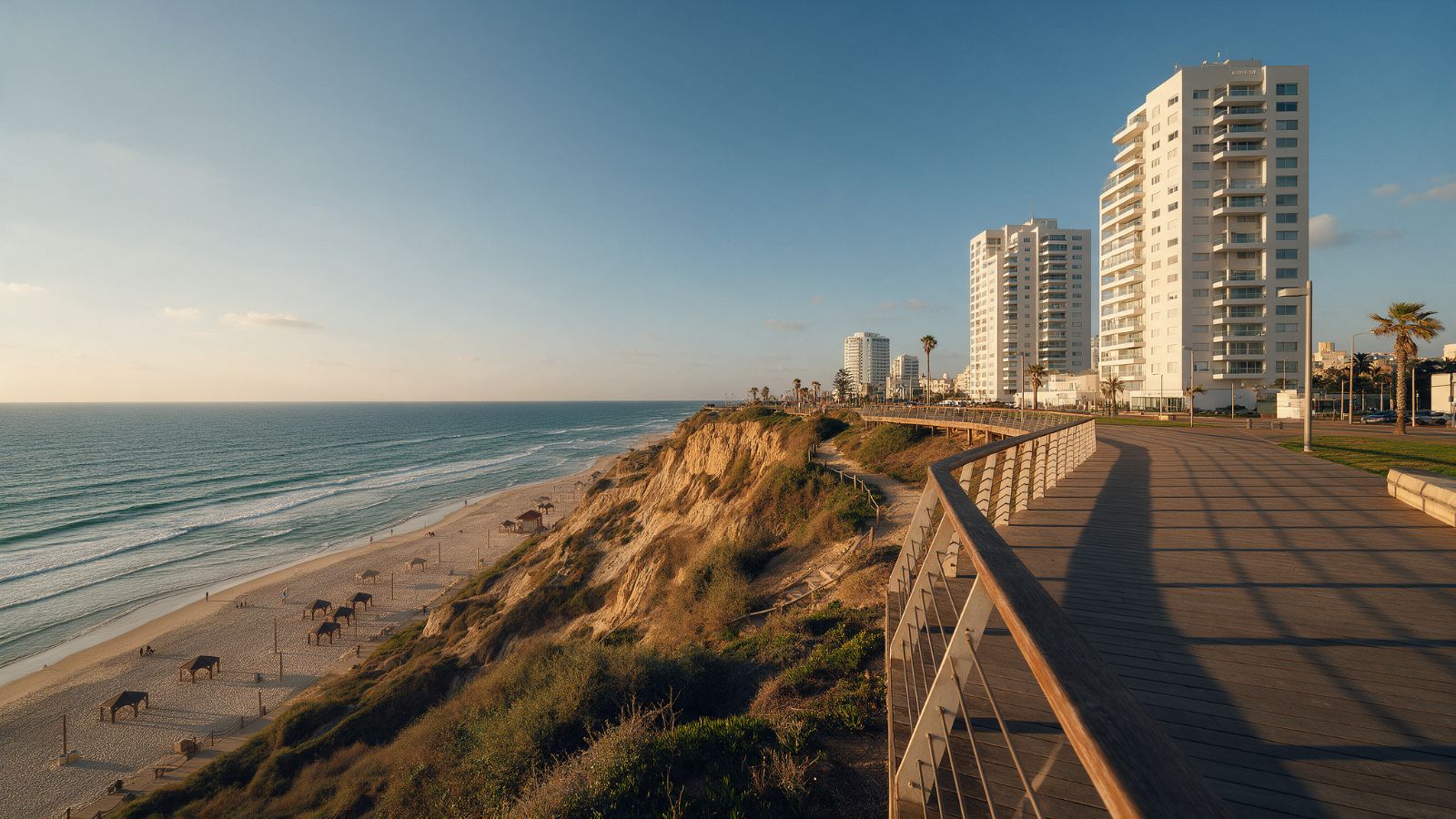
New developments in Netanya: where the city is building, new-build prices, what to check before you sign
Netanya is the coastal city where an English-speaking buyer finds the most new-build: the last phases of Agamim and Ir Yamim, towers on the southern seafront, planned districts to the east and south-east, and an urban renewal drive that is gradually replacing the 1960s blocks of the centre and Kiryat Nordau. Supply is plentiful, sales are slowing and developers are negotiating. This guide covers where the city is building, at what price, what the 2025–2026 rules changed for 20/80 deals, and what to check on a specific Netanya project before you sign.
The short answer
Netanya’s new-build is concentrated in the south (the last phases of Agamim and Ir Yamim, Poleg, Neve Oz), in planned districts to the east and south-east that take over after 2028, and in pinui-binui projects in the centre and Kiryat Nordau. New-build costs ₪28,000–34,000 per m² in Agamim and up to ₪45,000 per m² in the sea-facing towers, against ₪22,000–36,000 for resale. With about 3,517 unsold new homes at the end of July 2026 and sales falling, buyers have the upper hand: discounts, free parking or 20/80 schedules are negotiable. The Bank of Israel does, however, ration developer-subsidised loans until the end of 2026, and the government’s discounted-housing lotteries are closed to non-residents.
Key figures, November 2026
- New-build, Agamim
- ₪28–34k/m²
- New-build, Ir Yamim and seafront
- ₪38–45k/m²
- Unsold new homes (end-July 2026)
- ≈ 3,517
- New-home sales, May–July 2026
- ≈ 180 (−20%)
- Developer-subsidised loans
- max 10% per bank, to end-2026
- TAMA 38
- ended (18 May 2026)
Where Netanya is building: areas and plans
Netanya still has land, which is rare on the central coast. The plans approved over the past decade form three rings: the south, where building is winding down; the east and south-east, where it is starting; and the old centre, where blocks are torn down and rebuilt. The table maps each area; price ranges come from our Netanya city guide and published deals.
| Area | What is being built | Timeline | Observed new-build ₪/m² |
|---|---|---|---|
| Agamim (south-east) | 6–17 storey buildings, underground parking, parks around the Agam HaBachurim lake and the iris reserve; the city’s largest stock | Final phases, deliveries to 2028 | 28,000–34,000 |
| Ir Yamim and southern seafront | 16–30 storey towers, the last plots of the neighbourhood and densified blocks nearby (for example four 16–23 storey towers 600 m from the sea, plan approved March 2025) | Staggered deliveries to 2028–2029 | 38,000–45,000 |
| Poleg, Ramat Poleg | Mixed residential-office schemes between Route 2 and the sea, low-rise buildings in Ramat Poleg | Ongoing | 30,000–40,000 |
| Neve Oz (south-west, between Ben Zvi and Ben Gurion) | Plan for 1,960 homes (1,215 added in 2019), 9–20 storey buildings, ground-floor retail | Phased marketing | ≈ 28,000–33,000 (neighbouring areas) |
| East (east of Amalia, Neot Ganim and Kiryat HaSharon) | Plan approved in late 2020 for about 3,500 homes, 20–28 storey towers, including 700 small units and 400 senior-living units | Mostly after 2028 | ≈ 30,000–36,000 (Kiryat HaSharon) |
| South-east (south of Kiryat HaSharon, Ilanot stream) | About 1,606 homes, an 18-hectare metropolitan park, 360,000 m² of employment space and a medical centre | Long term | not yet marketed |
| City centre, Kiryat Nordau, Ramat Yadin | Urban renewal: about 70 projects in Merkaz HaIr North, 27 in Merkaz HaIr Darom; Kiryat Nordau plan for 4,000 additional homes; city-centre policy for 6,300 homes | 5–15 years depending on the block | 28,000–33,000 |
Two takeaways. First, the south is late in its cycle: the best Ir Yamim plots sold long ago, and what remains is either very expensive (open sea views) or second-row. Second, the east and south-east will be the next wave, probably with lower entry prices than Agamim, but with shops, schools and transport arriving after the residents. Plans can be looked up by name or number on the Planning Administration’s public portal (mavat).
New-build vs resale prices
New-build in Netanya costs 20–30% more than resale in the same neighbourhood, and most of the gap is what you get: a lift, parking, a mamad (reinforced safe room), often a pool and gym, and 18% VAT already included in the price. The gap narrows once you price in the upkeep of a 1970s building with no shelter.
| Neighbourhood | Resale | New-build | What the premium buys |
|---|---|---|---|
| Ir Yamim | 32,000–38,000 | 38,000–45,000 | High floor, view, pool; high service charges |
| Agamim | 23,800–28,300 (resales of recent buildings) | 28,000–34,000 | Entry-level new-build: 4-room under ₪3m |
| Kiryat HaSharon | 25,000–30,000 | 30,000–36,000 | Established family area, schools and synagogues |
| Nof Galim | 26,000–32,000 | 32,000–38,000 | Northern sea views, cheaper than the south |
| Kiryat Nordau, Dora, Ramat Yadin | 22,000–27,000 | 28,000–33,000 | Pinui-binui new-build in an older area |
Israeli prices per m² are quoted on gross area: walls, balcony and sometimes a share of common areas. Tower brochures happily blend these; only the technical specification (mifrat techni) is binding (see gross vs net area). The full comparison is in new or second-hand in Israel.
Netanya’s new-build market in 2026: stock, sales, discounts
According to Central Bureau of Statistics data reported by Bizportal, Netanya had about 3,517 new homes for sale at the end of July 2026, against about 180 sales in May–July, 20% fewer than in the previous three months. At that pace the stock would take years to clear. The average price of a home in Netanya, new and resale combined, was about ₪2.73 million in the first half of 2026. Agamim prices slipped 1–3% over the year, after rising about 28% over five years.
For buyers this means three levers, from most to least common: end-of-project discounts (3–7% observed on the last units), extras (parking, storage, kitchen or air conditioning thrown in; put a shekel value on each) and the payment schedule (20/80, indexation waivers). Bulk sales to investors reported in Netanya in 2026, at average prices about 12% below the city average, suggest the list price is not the market price. Always compare the final indexed, turnkey price.
20/80, 10/90 and the Bank of Israel rules
Deferred payment schedules were Netanya developers’ main sales tool in 2024–2025: 20% at signing, 80% on delivery, often with a balloon loan whose interest the developer paid. The Bank of Israel responded in two steps. A temporary 2025 directive makes banks hold more capital on projects where more than a quarter of contracts defer a large part of the price to delivery, and caps developer-subsidised balloon loans at 10% of each bank’s mortgage lending; the February 2026 directive kept that cap, now measured quarterly, until the end of 2026. In Netanya and the Sharon, the share of developer sales with a financing offer fell from about two-thirds in March 2025 to 20% in May 2025, before rebounding nationally in the autumn.
What it means for you: a plain 20/80 (with no subsidised loan) still exists, but loans whose interest the developer pays have become scarce and rationed. No extension beyond December 2026 had been announced as of this page’s date, so ask the bank at signing whether the product counts toward the quota. On the contract side, national rules apply: the 20% paid at signing is never indexed, at most half of each later payment can be (40% of the price at most), indexation stops at the contractual delivery date, and every payment above 7% of the price is covered by a Sale Law guarantee. The details, with an indexation calculation, are in buying off-plan from a developer.
Pinui-binui and the end of TAMA 38: new-build in the centre and north
In central and northern Netanya, new-build comes from urban renewal. The city made a clear choice in 2023: no extension of TAMA 38 (building-by-building reinforcement and extra floors), arguing the potential was limited to a few dozen buildings, and priority for pinui-binui, which demolishes whole blocks and rebuilds them as 10–26 storey towers. TAMA 38 has since ended nationwide, on 18 May 2026; for a single building there remains the Shaked alternative (amendment 139 to the Planning and Building Law), which processes plan and permit in parallel but had not yet produced a single permit nationally by mid-2026.
The active areas: Merkaz HaIr North (about 70 projects), Merkaz HaIr Darom (27), the seafront hotel strip (27), Neot Herzl, and Kiryat Nordau, covered by a master plan for 4,000 additional homes. An outside buyer purchases the developer’s units in such a project: a standard off-plan contract with a Sale Law guarantee, but a less certain timetable than on vacant land, since existing owners must be rehoused first. Allow 8–15 years from a block’s declaration to delivery, and only buy once the permit is issued. The full mechanics are in pinui-binui and TAMA 38.
Dira BeHanacha and Mechir Matara: who qualifies
Dira BeHanacha (“discounted apartment”) is the national programme that sells new homes below market price by lottery. Under the Mechir Matara (“target price”) track, the discount is 25% of market price, capped at ₪500,000 per apartment since the Israel Land Council decision of June 2023 (previously 20%, capped at ₪300,000). The main conditions:
- Israeli citizenship and “homeless” status as defined by the Ministry of Housing; upgraders can only join follow-up lotteries.
- A couple, a family with a child under 21, or a single person aged 35 or over.
- An eligibility certificate requested online before registering; in the 2026 lottery up to half of the units were reserved for military reservists.
- No resale for 5 years after the occupancy certificate (Form 4), or 7 years after the lottery, whichever comes first; renting out is allowed.
Foreigners and non-residents are not eligible. A buyer living in the US, UK, Canada, South Africa or Australia pays market price. An oleh who has become a citizen can register if they meet the conditions. Netanya was not among the localities in the summer 2026 lottery (7,922 homes in 19 localities); the list changes with each round and is published on the ministry’s site.
What to check on a Netanya project
The national checks (guarantee, technical specification, indexation) are in the off-plan guide. These are the ones that weigh most in Netanya.
- The permit, not just the plan. An approved plan in the east or south-east says nothing about when the building permit will come. Ask for the permit number (heter bniya) and check it with Netanya’s local planning committee; look the plan up on mavat. A project sold “subject to permit” shifts the whole timetable.
- The guarantee and bank financing. A book of payment vouchers (shovarim) issued by the project bank, a Sale Law guarantee on every payment above 7%, and the name of the bank financing the project (liyvi bankai). On bulk sales and small projects, check whether it is a bank guarantee or an insurance policy.
- A delivery date, not a quarter. Delay compensation runs from the contractual date; “during the second half of the year” pushes it back by months.
- The seafront. The Coastal Environment Protection Law bars construction within 100 m of the shoreline in principle, and Netanya’s cliff is eroding: a ₪190 million programme of 12 breakwaters protecting the central cliff was completed in 2026. For a cliff-top tower, your lawyer checks the plan’s setback provisions and the geotechnical studies.
- Parking and storage. In Netanya they are often sold separately (₪100,000–200,000 for a parking space). Insist on their numbers in the contract and a turnkey price.
- Tower service charges. Pool, gym, concierge, fast lifts: ask for the estimated vaad bayit (building committee) charges and the planned management company. On a rental, these eat into the yield.
- The Hebrew specification. English brochures are a sales tool; the Hebrew contract and specification are binding. Have them translated or reviewed by a lawyer who reads legal Hebrew.
- Land status. Much of the new districts sit on public land: you buy a long lease from the Israel Land Authority, registered after the condominium is registered, often years after delivery. Your lawyer registers a cautionary note (hearat azhara) at signing.
The city-specific legal checks (local committee, arnona debts, betterment levy, tower contracts) are covered in real estate lawyer in Netanya.
Full budget: a future oleh in Agamim
The most common Netanya case: a family that signs off-plan before making aliyah and moves in on delivery. The oleh purchase tax rate applies to a purchase made up to one year before aliyah, so the date that counts is the signing date.
| Contract price (18% VAT included) | 2,900,000 ₪ |
| Maximum legal indexation: 40% of the price × (1.0767 − 1) | + 88,967 ₪ |
| Purchase tax, oleh rate (0% up to ₪1,978,745, then 0.5%) | 4,606 ₪ |
| Your lawyer (0.7% + VAT) | 23,954 ₪ |
| Developer’s lawyer, legal cap (≈ ₪5,900 + VAT) | 6,490 ₪ |
| Mortgage broker, valuation, bank fees, insurance | 15,000 ₪ |
| Translations, power of attorney, apostille, transfers | 5,000 ₪ |
| Total cost | 3,044,017 ₪ (+5%) |
| Mortgage at 75% of price, drawn on delivery (assumed average rate 4.8%, 25 years) | 2,175,000 ₪ → ≈ 12,463 ₪ / month |
| Equity needed, of which 580,000 ₪ at signing | 869,017 ₪ (≈ $275,000) |
Without aliyah, the same purchase would cost 232,000 ₪ in purchase tax at the 8% non-resident rate, with financing capped at 50%; for a resident buying their only home, 40,538 ₪. The tax is due within 60 days of signing and is assessed at the non-resident rate if aliyah has not happened yet; the difference is reclaimed from the Tax Authority afterwards. Run your own numbers with the purchase tax calculator, and see buying as a new immigrant and mortgages for olim. Buying from abroad with no aliyah plans: mortgages for non-residents; for tax once you own (rental income, reporting at home), Shekel Guide.
For comparison: the same budget buys a larger new 4-room in Ashdod (see new developments in Ashdod), or a well-located resale 4-room in Kiryat HaSharon. The other new-build city guides: Tel Aviv and Jerusalem.
Frequently asked questions
How much does a new apartment in Netanya cost in 2026?
Roughly ₪28,000–34,000 per gross m² in Agamim, ₪30,000–38,000 in Poleg and Kiryat HaSharon, and ₪38,000–45,000 in the Ir Yamim and seafront towers. A new 4-room apartment (3 bedrooms) typically runs ₪2.8–3 million in Agamim and ₪3–4.2 million in Ir Yamim. These are observed ranges from developer price lists and reported deals; parking is sometimes extra.
Are Netanya developers still offering 20/80 deals?
Yes, but less than before 2025. Until the end of 2026 the Bank of Israel caps developer-subsidised balloon loans at 10% of each bank’s mortgage lending, and makes banks hold more capital on projects where too many buyers defer most of the price to delivery. In Netanya and the Sharon, the share of developer sales with a financing offer fell from about two-thirds in March 2025 to 20% in May 2025. Plain 20/80 schedules without a subsidised loan remain common, especially on the last units of a project.
Can a foreign buyer join Dira BeHanacha in Netanya?
Not as a non-resident. The programme is for Israeli citizens without a home (couples, families, singles from age 35) holding a Ministry of Housing eligibility certificate. An oleh who has become a citizen can register if they meet the conditions. Netanya was not among the localities in the summer 2026 lottery; the list changes with each round.
Does TAMA 38 still exist in Netanya?
No. Netanya declined to extend TAMA 38 beyond 2023, and the scheme ended nationwide on 18 May 2026. Renewal now runs through pinui-binui (demolition and rebuilding of whole blocks, notably in Kiryat Nordau, Ramat Yadin and the centre) and, for single buildings, the “Shaked alternative” (amendment 139 to the Planning and Building Law), which is still little used.
Which delivery date should I believe for a Netanya project?
The contractual one, plus a buffer. Since 2023, delays of 6–12 months have been common on large Israeli projects. For contracts signed since July 2022, nothing is owed for the first month of delay; the developer then owes the rent of a comparable apartment for months 2–4, 125% of it for months 5–10 and 150% from month 11. Ask for an exact date, not a quarter, and for a building permit that has already been issued.
How we work
Every amount, bracket and rate on this page is checked against the official source listed at the bottom and dated. When a schedule or rate changes, the page is updated within days. Our methodology.
Sources
- Bizportal, 13 October 2026 – Netanya: about 3,517 new homes for sale at end-July 2026 (CBS), about 180 sales in May–July, average price ≈ ₪2.73m in H1
- Bizportal – Agamim neighbourhood: ₪22,000–25,000 per m² on average, recent deals at ₪23,800–28,300 per m²
- Globes, 9 July 2025 – new-home sales fall after restrictions; Netanya and the Sharon: share of sales with financing offers down from about 66.6% (March) to 20% (May)
- Globes, 10 February 2026 – Bank of Israel directive: developer-subsidised and balloon loans limited to 10% of mortgages until end-2026
- Nadlan Center, 23 March 2025 – draft Bank of Israel directive on developer financing offers (extra capital above 25% deferred-payment contracts)
- Nadlan Center, May 2026 – TAMA 38 expired nationwide on 18 May 2026; cities without a replacement plan
- Nadlan Center, 2023 – Netanya does not extend TAMA 38 and points single buildings to the Shaked alternative
- Nadlan Center, 10 April 2025 – Merkaz HaIr Darom: 27 renewal projects; 70 in Merkaz HaIr North, 27 on the hotel strip
- Globes, 2019 – Neve Oz: 1,215 homes added, 1,960 in total, 9–20 storey buildings
- Nadlan Center, 16 November 2020 – approved plan for about 3,500 homes in east Netanya (Israel Land Authority)
- Jerusalem Post – new south-east Netanya district: 1,606 homes, 18-hectare metropolitan park, medical centre, employment zone
- Nadlan Center, 18 December 2019 – Netanya city-centre policy document: about 6,300 homes on 780 dunams
- Globes, 2017 – Kiryat Nordau renewal plan: 4,000 additional homes
- Nadlan Center, 13 June 2023 – Mechir Matara: discount raised to 25% of market price, capped at ₪500,000 per apartment
- Ministry of Construction and Housing – Dira BeHanacha: eligibility and lotteries
- Ministry of Environmental Protection, 2026 – completion of 12 breakwaters protecting the central Netanya cliff (₪190m)
- Planning Administration – plans and permits lookup (iplan / mavat)
Get the Netanya new developments that fit your budget
Tell us the area (Agamim, Ir Yamim, Poleg, Kiryat HaSharon, the centre…), your budget and timing. We pass it to partner developers, vetted on their guarantees and delivery record, who send real prices, payment schedules and delivery dates.