Real Estate Lawyer in Netanya: Fees, Local Checks, English Speakers
Netanya is where a real estate lawyer spends most of their week on developer contracts: thousands of new apartments in the southern towers, a sandstone cliff that keeps retreating, an urban-renewal regime where TAMA 38 ended earlier than anywhere else, and a steady flow of buyers who sign from New York, London or Johannesburg before they make aliyah. Here is what a lawyer checks on top in Netanya, what they charge, and how to find an English-speaking lawyer who works for you alone.
The short answer
In Netanya, a real estate lawyer charges 0.5 to 1% of the price + 18% VAT, i.e. 12,500 ₪ to 25,000 ₪ before VAT on a ₪2.5M apartment, often a flat fee under ₪2M. What they check on top here: developer contracts in the Ir Yamim, Agamim, Poleg and Shirat HaYam towers (Sale Law guarantee, capped indexation, late-delivery compensation, parking), hotel-zoned buildings where an “apartment” is not legally a home, the cliff and the Coastal Law for seafront properties, an urban-renewal regime where TAMA 38 expired in October 2023 and compensation is capped at 12 m², the pinui-binui complexes of Neot Shaked, Givat HaIrusim and Kiryat Nordau, and the tax status of buyers who often sign before making aliyah. On ₪2.8M, purchase tax runs from 4,106 ₪ (oleh) to 224,000 ₪ (non-resident).
The figures to remember, November 2026
- Typical ₪/m² in Netanya
- 22,000–45,000
- Lawyer at 0.5–1% on ₪2.5M
- 12,500 ₪–25,000 ₪ + VAT
- Developer’s lawyer, cap
- 0.5% or 5,915 ₪ + VAT
- End of TAMA 38 in Netanya
- October 2023
- Mas rechisha, non-resident, ₪2.8M
- 224,000 ₪
- Mas rechisha, oleh, ₪2.8M
- ≈ 4,106 ₪
What the lawyer checks on top in Netanya
The base is the same across Israel: land registry extract (nesach Tabu), liens, permits, debts, condominium, the seller’s tax status, all covered on the page the real estate lawyer’s role. In Netanya, seven topics come up in almost every file.
- New towers sold off-plan. Ir Yamim (started in 2006, about 4,500 homes and 3,150 hotel rooms), Agamim in the south-east, Poleg, and Shirat HaYam, the new 27-tower, 1,842-unit neighborhood on the south-western cliff whose first lots the Israel Land Authority sold in 2023: Netanya has one of the largest new-build pipelines on the coast. Each contract runs 60 to 120 pages, and that is where the lawyer’s time goes (more below).
- Hotel zoning and “vacation apartments”. Parts of the seafront, including the Ir Yamim hotel area, are zoned for tourism. A unit sold in a hotel-zoned building can come with an obligation to place it in a hotel rental pool for part of the year, an operator you do not choose, and a ban on living there year-round. The lawyer reads the land use (yeud) in the plan and the building’s by-laws before you pay the price of a home.
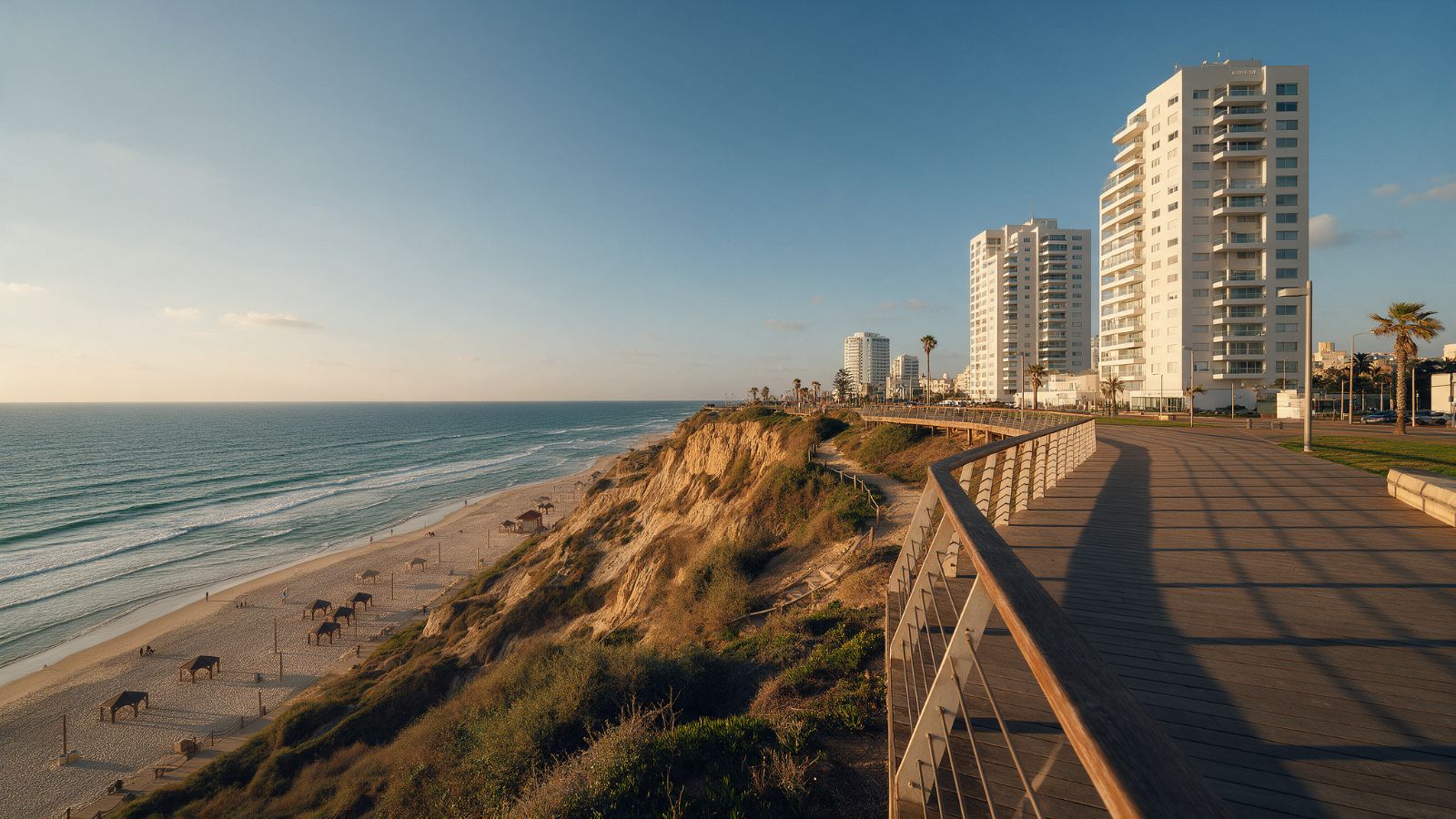
- The cliff and the Coastal Law. Netanya sits on a sandstone cliff 40 metres or more high, and it is retreating: a partial collapse near the promenade in April 2023, falls on the Hefer boundary after the December 2025 storm. The government cliff-protection company is building breakwaters, but needs exceed funding. Since 2004, the Coastal Environment Protection Law imposes a building setback and a dedicated committee for new seafront plans; plans approved before 2004 remain valid. The lawyer checks the applicable plan, the building lines on the cliff side, any orders or restrictions, and tells you when you need an engineer’s report.
- Urban renewal with its own rules. Netanya chose not to extend TAMA 38, which expired there in October 2023, two and a half years before the national end date of 18 May 2026. In October 2024 the district appeals committee confirmed that an expired TAMA 38 permit cannot be renewed in Netanya. The city also caps renewal compensation at 12 m² per apartment, plus 12 m² of balcony, for units of at least 60 m². For a buyer of an older apartment, “the building is about to be renewed” has to be checked document by document: permit issued or not, compensation in line with the policy, developer and guarantees.
- Pinui-binui complexes. The municipality prepared a renewal plan for Kiryat Nordau allowing 4,000 additional homes, the first of four neighborhood plans (with Neot Shaked, Dora and the city centre). In March 2024 the Urban Renewal Authority designated two Netanya complexes: Ben Zvi Street in Neot Shaked (392 homes demolished, 1,558 built) and Zalman Shneor Street in Givat HaIrusim (168 demolished, 672 built). If you buy an older apartment in such a building, the lawyer checks the signature rate (at least 67% for a designation), where the plan stands, what you will receive, and what the seller has already signed away. The mechanics are on the page pinui-binui and TAMA 38.
- State land in new neighborhoods. Netanya’s land is a mix of private, municipal and public plots; part of the new neighborhoods is built on land sold by the Israel Land Authority (Minhal), such as Shirat HaYam. Your right is then a long lease, recorded first with the developer and the Minhal, and at the Tabu only once the condominium is registered, sometimes years after you get the keys. The lawyer checks who registers what, and when.
- Short-term rentals and tower charges. By-laws in recent towers increasingly ban short-term rentals, and charges (vaad bayit, plus a management company chosen by the developer) often exceed ₪1,000 a month. If your numbers rely on summer lets, the lawyer reads the by-laws before you sign.
The developer contract, clause by clause, in Netanya
In the southern neighborhoods most overseas buyers buy off-plan. The rules are national, but Netanya is where you see them applied most often, and worked around. At a minimum, your lawyer checks:
- The final building permit, not just an approval in principle from the local committee; without a permit, the developer cannot ask you for more than a guarantee covers.
- The Sale Law guarantee (bank guarantee or insurance policy) on every amount paid beyond 7% of the price, handed over at the time of payment.
- Indexation to the madad tshumot habniya (construction cost index). For contracts signed since July 2022 (Amendment 9), the 20% paid at signing is never indexed, at most half of each later payment is, i.e. 40% of the price at most, and indexation stops at the contractual delivery date.
- The delivery date and late-delivery compensation, set by law: nothing for the first month, then 100% of the rent of a comparable apartment for months 2 to 4, 125% for months 5 to 10, and 150% from month 11. A clause that moves the starting point or caps the compensation is a point to negotiate.
- The payment schedule: 20/80 or 10/90 offers, common since 2025 in a market with plenty of unsold stock. They lower the upfront payment, but the whole balance has to be financed at delivery. Since 2025 the Bank of Israel has restricted balloon loans and loans whose interest the developer pays; the final directives of February 2026 cap them at 10% of each bank’s quarterly mortgage approvals until the end of 2026. The lawyer checks who pays what if the promised financing is no longer available.
- The technical specification (mifrat techni), annexed and detailed; the gross area and the share of common areas; the price of parking and storage (often outside the advertised price); the terms for reselling before delivery.
The developer also charges you for its own lawyer, who handles registration: the law caps this at 0.5% of the price or 5,915 ₪ + VAT, whichever is lower, for prices up to ₪4,642,750 (no cap above that), plus a management fee of up to ₪300. That lawyer does not represent you. The full contract is explained on the page buying off-plan from a developer; neighborhoods and new-build prices are on new developments in Netanya.
City hall and the local committee: what the lawyer pulls
Three local offices matter in a Netanya purchase, and the lawyer deals with them for you.
- The local planning committee (va’ada mekomit le-tichnun u-bniya, Netanya): the building file (tik binyan), the permit, the approved drawings, the occupancy certificate (tofes 4) and any recorded violations. This is where a closed-in balcony, a rooftop room or an apartment split in two without a permit shows up, all common in older stock in Kiryat Nordau, Dora and the centre. Plans in force and in preparation can also be read on iplan and Mavat.
- The municipality: the no-debt certificate (ishur iriya) the Tabu requires for the transfer, covering arnona (property tax), water and municipal charges. The seller must produce it; your lawyer does not release the balance without it.
- The betterment levy (heitel hashbacha): 50% of the increase in value created by a new plan, owed by the owner on sale or when a permit is used. Where a renewal plan has been approved, it can be significant; the seller pays it, but an unpaid levy blocks the transfer.
The transfer is recorded at the Netanya Tabu office, or at the Minhal for State land. How long a new apartment takes to be registered depends mostly on how fast the developer registers the condominium.
Fees in Netanya
| Property | Price | Fee | Note |
|---|---|---|---|
| 3-room second-hand, Kiryat Nordau or Dora | ₪1.7M | Flat ₪8,000–12,000 | Permit and additions to check; possible renewal project. |
| 4-room second-hand, Kiryat HaSharon | ₪2.6M | ₪13,000–19,500 (0.5–0.75%) | Standard file, recent condominium. |
| 4-room off-plan, Agamim | ₪2.9M | Flat ₪14,000–20,000 | + capped developer’s lawyer, who does not represent you. |
| 4–5 rooms in a tower, Ir Yamim or seafront | ₪3.4–4.5M | ₪17,000–27,000 (≈ 0.5–0.6%) | Land use, tower by-laws, parking. |
| Power of attorney and remote purchase | — | + ₪1,500–4,000 | Template, consular coordination, translations. |
The engagement letter (heskem sachar tircha) should spell out what is included: due diligence, negotiation, the caution note (hearat azhara), the mas rechisha filing and final registration. On a new apartment, ask whether follow-up until Tabu registration, sometimes years after delivery, is covered. The full budget (agency 2% + VAT on resale, mortgage broker, appraisal) is on every fee of a purchase.
Purchase tax on ₪2.8M: resident, non-resident, oleh
| Resident, only home (0% up to ₪1,978,745, 3.5%, then 5%) | 35,538 ₪ |
| Non-resident or additional home (8%) | 224,000 ₪ |
| New oleh, only home (0% then 0.5%) | 4,106 ₪ |
| Gap non-resident / oleh | 219,894 ₪ |
Netanya is where the aliyah date weighs most on a file: many overseas buyers sign off-plan as non-residents and move before delivery. The oleh brackets apply to a purchase made from one year before to seven years after aliyah, and the date that counts is the signing, not the delivery. A non-resident who moves to Israel within two years of buying can apply to recover the gap. The lawyer chooses the declared status with you and files within 30 days. Details on mas rechisha 2026 and buying as a new immigrant; test your own price on the calculator. For US or UK tax on an Israeli property (FBAR, rental income, treaties), see Shekel Guide.
Neighborhoods and typical files
| Neighborhood | What people buy | The lawyer’s point of attention |
|---|---|---|
| Ir Yamim | Seafront towers, ₪38,000–45,000/m² new | Hotel zoning, tower by-laws, charges, parking registered separately. |
| Shirat HaYam | New towers on the cliff, Minhal land | Off-plan contract, Minhal lease, cliff retreat. |
| Agamim, Poleg | Most of the new-build under ₪3M for 4 rooms, ₪28,000–38,000/m² | 20/80 schedule, indexation, delivery date. |
| Seafront, Nitza, city centre | Pieds-à-terre, 1960s–90s buildings | Unpermitted additions, Coastal Law, short-term rental by-laws. |
| Kiryat HaSharon, Ramat Poleg | Families, 4–5 rooms from the 2000s–2010s | Standard file; check extensions on villas. |
| Nof Galim | North, on the cliff, old and new with sea views | Cliff, seafront plans. |
| Kiryat Nordau, Dora, Neot Shaked | Entry prices, ₪22,000–27,000/m² second-hand | Pinui-binui, end of TAMA 38, 12 m² cap, betterment levy. |
Detailed prices by neighborhood and a full budget for a new 4-room in Ir Yamim are on the page buying an apartment in Netanya.
Finding an independent English-speaking lawyer in Netanya
Netanya has a deep pool of lawyers who trained abroad before being admitted to the Israeli bar, and Israeli firms with an English-speaking partner who handles Anglo buyers. Language is not the test: what matters is that the lawyer works for you alone. Four habits.
- Check admission on the Israel Bar Association register (israelbar.org.il). A lawyer admitted only in New York or England and Wales cannot sign your contract or file your purchase tax.
- Insist on independence. Not the developer’s lawyer, not the one the agency “provides”, not a firm acting for the seller in the same deal.
- Ask for recent comparable files: off-plan contracts in Ir Yamim or Agamim, renewal buildings in Kiryat Nordau, Minhal land.
- Get a written quote before any work starts, stating what is covered up to final registration.
Questions to ask: how many Netanya developer contracts have you handled this year? Who in the firm will run my file in English? Is follow-up until Tabu registration included? How do you handle remote signing? Which trust account (chesbon nemanut) holds the deposit?
Red flags: a lawyer recommended by the seller or the developer; pressure to sign a zikaron dvarim “to lock the apartment”; a percentage fee with no cap and no engagement letter; bank details sent or changed by plain email (wire fraud); vague answers on the permit or the guarantee. The full list is on how to choose your real estate lawyer, and remote signing on power of attorney and remote purchase.
Frequently asked questions
How much does a real estate lawyer cost in Netanya?
0.5 to 1% of the price + 18% VAT, as everywhere in Israel. On a ₪2.5M apartment that is ₪12,500 to ₪25,000 before VAT, or ₪14,750 to ₪29,500 with VAT. For second-hand apartments under ₪2M in Kiryat Nordau or Dora, many firms quote a flat ₪8,000 to ₪12,000 before VAT. Off-plan, add the developer’s lawyer fee, capped at 0.5% of the price or ₪5,915 before VAT, whichever is lower, for prices up to ₪4,642,750.
Is the developer’s lawyer enough when buying new in Ir Yamim or Agamim?
No. The developer’s lawyer registers your rights and handles the final registration, but represents the developer. They will not negotiate indexation, the delivery date or the price of parking. Your own lawyer reads the contract, checks the permit and the Sale Law guarantee, and usually obtains changes to the annexes: technical specification, payment schedule, late-delivery terms, resale before delivery.
Can I still buy an apartment “with TAMA 38” in Netanya?
Netanya chose not to extend TAMA 38, which expired there in October 2023, well before the national end date of 18 May 2026. In October 2024 the Central District appeals committee confirmed that an expired TAMA 38 permit in Netanya cannot be renewed. A listing “with TAMA 38” is only worth something if the permit was issued and is still valid; otherwise renewal goes through pinui-binui or a neighborhood plan.
Is it risky to buy near Netanya’s cliff?
The sandstone cliff is retreating under sea erosion and heavy rain: a partial collapse near the promenade in April 2023, and falls on the Hefer boundary in December 2025. A government company protects the cliff with breakwaters, but funding falls short of needs. The lawyer checks the applicable plan, the building lines and any restrictions; for the ground itself, they will send you to an engineer. Banks lend normally on permitted buildings.
Can I buy in Netanya without flying in?
Yes, and most overseas buyers do. You sign a power of attorney (yipui koach) at an Israeli consulate, or before a notary with an apostille, and your lawyer signs for you. Budget ₪1,500 to ₪4,000 extra for the POA and translations, and two to three weeks of consular lead time. Everything else runs by email and video call.
How we work
Every amount, bracket and rate on this page is checked against the official source listed at the bottom and dated. When a schedule or rate changes, the page is updated within days. Our methodology.
Sources
- Bizportal – developer’s lawyer fee cap: 0.5% or ₪5,915 + VAT up to ₪4,642,750 (6 August 2026)
- Merkaz HaNadlan – Netanya refuses to renew a TAMA 38 permit after the October 2023 expiry (30 October 2024)
- Merkaz HaNadlan – Netanya caps urban-renewal compensation at 12 m² per apartment
- Jerusalem Post – Urban Renewal Authority designates pinui-binui complexes in Neot Shaked and Givat HaIrusim (21 March 2024)
- Globes – Shirat HaYam: 1,842 units in 27 towers on the cliff, Israel Land Authority tender (28 August 2023)
- Times of Israel – coastal cliff partially collapses at the Netanya promenade (21 April 2023)
- Ynet – Israel’s coastal cliffs need nearly ₪1 billion of protection (7 August 2025)
- Globes – the 2004 Coastal Environment Law and seafront projects (8 September 2024)
- Globes – Bank of Israel caps developer-subsidised loans at 10% of mortgages until end-2026 (February 2026)
- Planning Administration – iplan and Mavat plan search
- Netanya Municipality – planning and engineering
- Israel Bar Association – register of lawyers
An English-speaking real estate lawyer in Netanya
Real estate specialists admitted to the Israeli bar, independent of Netanya’s developers and agencies, used to off-plan contracts, urban renewal and buyers who sign from the US, the UK, Canada, South Africa or Australia. Tell us the neighborhood, the type of property (new, second-hand, pinui-binui) and your status.