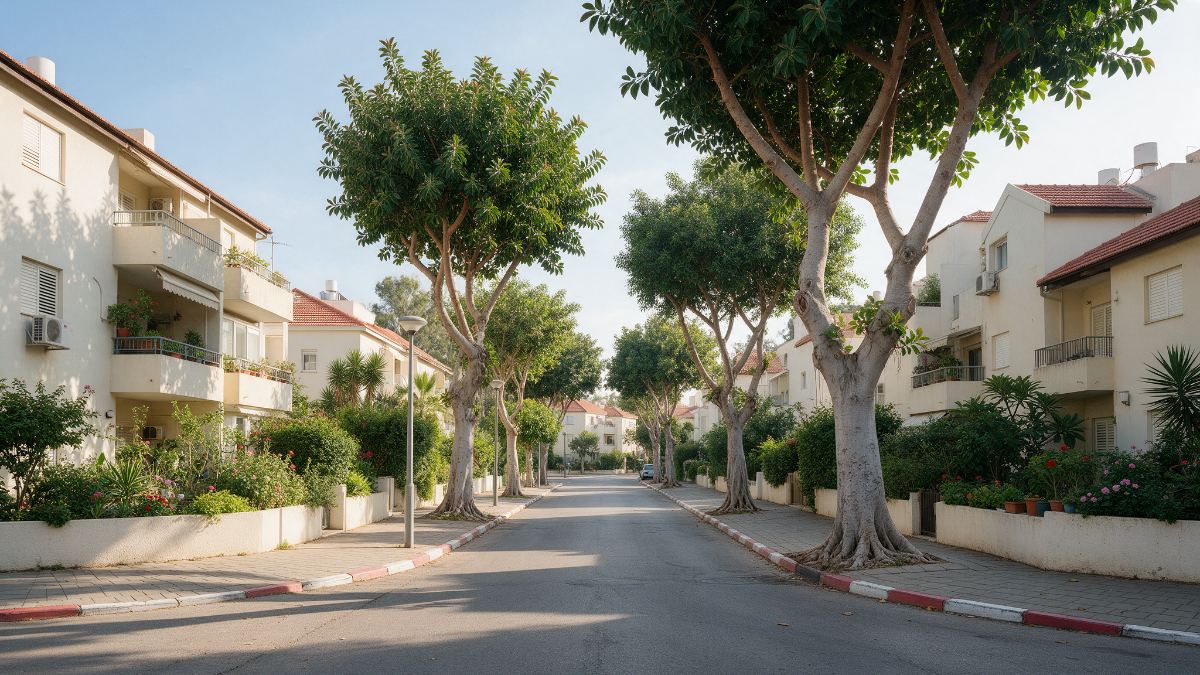
Real Estate Lawyer in Raanana: Fees, Local Checks, English Speakers
Raanana looks like the easiest city in Israel for an English-speaking buyer: an Anglo community forty years deep, lawyers and agents who work in English, leafy streets of cottages. The files are not that simple. Half the houses have been extended at some point, often without a permit; TAMA 38 is gone and the city has its own renewal rules; Ahuza Street is being replanned; and a resale in Neve Zemer is often bought before the building is even registered. Here is what a Raanana lawyer checks, what they charge, and how to pick one who works for you.
The short answer
In Raanana, a real estate lawyer charges 0.5 to 1% + 18% VAT, which on a typical ₪3.6M four-room means ₪18,000 to ₪36,000 before VAT; most firms quote a flat fee on apartments and charge more for cottages. What they check on top here: extensions without a permit, gardens and parking attached rather than owned, deals signed under TAMA 38 (expired 18 May 2026) and the city’s own demolish-and-rebuild track, the Ahuza Street permit freeze, Neve Zemer resales before condominium registration, Kfar Batya off-plan contracts, and the betterment levy and arnona. On ₪3.6M, purchase tax runs from ₪8,106 (oleh) to ₪288,000 (non-resident). Finding a lawyer who works in English is easy here; finding one who is independent of the deal takes a few questions.
The figures to remember, November 2026
- Most transactions (Oct 2026)
- ₪31,000–35,000/m²
- Lawyer at 0.5–1% on ₪3.6M
- ₪18,000–₪36,000 + VAT
- Developer’s lawyer (cap, off-plan)
- ≈ ₪5,900 + VAT
- Mas rechisha, non-resident, ₪3.6M
- ₪288,000
- Mas rechisha, oleh, ₪3.6M
- ≈ ₪8,106
- TAMA 38 closed to new applications
- 18 May 2026
What the lawyer checks on top in Raanana
The base is the same everywhere: land registry extract (nesach Tabu), the seller’s mortgage and liens, permits, debts, condominium documents, the seller’s tax position. It is described on the page the real estate lawyer’s role. Raanana adds eight topics of its own, and the first two come up in almost every house sale.
- Cottages and extensions without a permit. Founded in 1922 by an association of New York Jews, Raanana stayed a city of cottages, villas and small buildings for decades, and owners have added roof rooms, closed pergolas, turned basements into living space or a separate unit, and pushed walls into the garden. The lawyer pulls the building file (tik binyan) from the municipal engineering department and compares the approved plans with the house as it stands. An unpermitted addition can mean a fine or a demolition order, a bank appraiser who values only the permitted area (and lends less), and a buyer who will ask the same questions when you resell. The contract then provides for legalization at the seller’s cost, a price reduction, or a specific indemnity.
- Garden apartments and attachments. In a condominium (bayit meshutaf), the garden of a ground-floor apartment, the roof of a penthouse, a parking space or a storage room are often “attached” (hatzmada) to the unit by the condominium by-laws rather than owned outright, and sometimes they are only used by custom. The lawyer checks the registered by-laws (takanon) and the condominium plan at the Tabu: what is actually attached to the apartment you are buying, and what the neighbors could contest. In a cottage complex, the same question applies to the shared driveway and the gardens.
- TAMA 38 after 18 May 2026. Raanana had more than 300 approved TAMA 38 projects by 2022. The national plan closed to new permit applications on 18 May 2026: a building whose application was filed before that date can still go ahead under TAMA 38, a building that only had owners’ signatures cannot. A listing that says “TAMA 38 signed” therefore needs checking: has a permit been applied for, granted, or nothing at all? Has the developer moved the project to the local track? What has the seller already given away (roof rights, parking) in the agreement?
- Raanana’s own renewal track. To replace TAMA 38, Raanana promoted a citywide building-renewal plan (RA/10/10 B): demolition and rebuilding only, no reinforcement with added floors, for buildings permitted before 1992, with a planning review after each 500 units. Approved for deposit in 2023, it was presented by the municipality in November 2025 as one of its two main renewal tracks, alongside the master plan RA/3000; the city’s general height limit is 9.5 storeys, with site-specific plans going higher. For a buyer in an older building in Kiryat Ganim, the center or the east, the lawyer reads the renewal agreement if there is one: majority reached, developer chosen, guarantees, relocation rent during works, what the new apartment will be.
- The Ahuza Street plan and the permit freeze. In January 2025 the city presented a plan for about 480 dunams along Ahuza Street: 5,300 homes in total, about 2,900 of them new, buildings of up to 16 storeys near the future metro station, with a notice under sections 77–78 of the Planning and Building Law to restrict permits while the plan is prepared. If you are buying an older property on or near Ahuza in order to extend it, the lawyer checks what can still be permitted; if you are buying in a building the plan targets, what renewal could look like and when. The October 2026 master-plan update points to 13–15 storeys on Ahuza and lower heights in the historic center.
- Neve Zemer resales before registration. Neve Zemer’s towers have been delivered in waves since 2019, and in many of them the condominium is not yet registered at the Tabu. A resale is then a transfer of rights recorded with the developer (and, depending on the land, with the Israel Land Authority), not a Tabu transfer. The lawyer checks the developer’s rights confirmation, that the seller has paid in full, that the parking and storage you are paying for appear in the developer’s records, and that the developer will sign the transfer. The tower by-laws and service charges (often ₪800 to ₪1,500 a month) are read before you sign, not after.
- New-build: the last Neve Zemer blocks and Kfar Batya. Raanana’s new supply comes from the remaining Neve Zemer blocks (deliveries through 2028–2030) and from Kfar Batya, a new neighborhood approved in summer 2026 with about 2,200 homes, about 500 assisted-living units, commerce and a hotel. On an off-plan contract, the lawyer checks the Sale Law guarantee for each payment, the indexed share (never the 20% paid at signing, at most 40% of the price, and none after the contractual delivery date) and the delay compensation, which starts after the first month. Until the end of 2026, Bank of Israel rules also cap balloon and developer-subsidized loans at 10% of each bank’s mortgages. The clause-by-clause detail is on buying off-plan from a developer.
- Aliyah timing and the tax side of an Anglo buyer. Raanana is a city of olim and future olim, and the date of the contract against the date of aliyah decides the purchase tax: the oleh scale applies from one year before to seven years after aliyah. The lawyer aligns the signing with your plans. For US buyers the bank will also ask for FATCA documentation, and the US or UK tax side of an Israeli home (reporting, rental income, a future sale) belongs with a tax adviser; the money-and-tax side is covered on our sister site Shekel Guide.
The local committee and the municipality: what the lawyer pulls
Raanana has its own local planning and building committee (va’ada mekomit), which issues permits, keeps the building files and recommends plans to the Central District committee. Most of what makes a Raanana file different sits there and at the municipal tax department, not at the Tabu.
| Document or check | Where | Why it matters in Raanana |
|---|---|---|
| Building file (tik binyan) and approved plans | Municipal engineering department | Extensions without permit in cottages and garden apartments; what the bank will value. |
| Plans in force and in preparation | Mavat / iplan planning portals, local committee | Renewal track RA/10/10 B, Ahuza plan and 77–78 notice, master-plan update, Kfar Batya. |
| Betterment levy (heitel hashbacha) | Local committee assessment | 50% of the value created by a plan; due on sale or on a permit that uses new rights. Usually the seller’s on a sale, the buyer’s if you build later. |
| Arnona and water debts | Municipal tax department | Debts follow the property in practice: the transfer cannot be registered without clearance. |
| Municipal certificate for the Tabu (ishur iriya) | Municipality | Confirms that arnona, betterment levy and other municipal debts are paid; required to register your ownership. |
| Enforcement files | Local committee, courts | Pending demolition orders or fines on an unpermitted addition. |
A common mistake is to treat the betterment levy as a technicality. When a new plan increases the building rights on a cottage plot, the levy on that gain can reach six figures; the contract has to say who pays what, and the lawyer asks the committee for an assessment if the seller has not.
Fees in Raanana
| Property | Price | Fee | Note |
|---|---|---|---|
| 3 rooms, resale, Kiryat Ganim | ₪2.6M | Flat ₪12,000–18,000 | Renewal agreement to read if the building has signed one. |
| 4 rooms, resale, center or Lev HaPark | ₪3.6M | ₪18,000–28,000 (0.5–0.8%) | Often a flat fee; attachments and permits to check. |
| 5 rooms, Neve Zemer resale, condo not yet registered | ₪4.4M | ₪20,000–30,000 | Transfer at the developer; parking and storage records. |
| Cottage with extensions, west or north | ₪8.5M | Flat ₪35,000–50,000 (≈ 0.4–0.6%) | Permit file review, sometimes with an architect (billed separately). |
| Off-plan, Neve Zemer or Kfar Batya | ₪4.5M | Flat ₪18,000–28,000 | + developer’s lawyer capped ≈ ₪5,900 + VAT, who does not represent you. |
| Power of attorney and remote purchase | — | + ₪1,500–4,000 | Consulate or notary and apostille, translations. |
On a cheaper property (a small apartment, a parking space, a storage unit), ask for a flat fee rather than a percentage. The selection criteria are on how to choose your real estate lawyer, and the full budget (agency 2% + VAT, mortgage broker, appraisal) on closing costs in Israel.
Purchase tax on ₪3.6M: resident, non-resident, oleh
| Resident, only home (0% up to ₪1,978,745, 3.5%, then 5%) | ₪75,538 |
| Non-resident or additional home (8%) | ₪288,000 |
| New oleh, only home (0% then 0.5%) | ₪8,106 |
| Gap non-resident / resident | ₪212,462 |
| Gap non-resident / oleh | ₪279,894 |
A non-resident who becomes a resident within two years can ask to be reclassified as “only home” and recover the difference with the regular scale; the oleh scale itself needs the status at signing or within the following year. Worked cases are on mas rechisha 2026, the oleh file on buying as a new immigrant, and your own price on the calculator.
Neighborhoods and typical files
| Neighborhood | What people buy | The lawyer’s point of attention |
|---|---|---|
| City center, Ahuza Street | 1990s–2020s buildings, 38,000–50,000/m² | Ahuza plan and permit freeze; older buildings in the renewal track. |
| Neve Zemer | Towers delivered since 2019, 40,000–48,000/m² | Condo not yet registered, developer transfer, by-laws and charges. |
| Lev HaPark | 2000s–2010s buildings by the park, 35,000–42,000/m² | Garden and roof attachments, parking registration. |
| West, north-west | Cottages and small buildings, 34,000–42,000/m² for apartments | Extensions without permit, betterment levy, houses sold for the land. |
| Kiryat Ganim | 1960s–80s buildings, 30,000–36,000/m² | TAMA 38 deals that never reached a permit; local renewal agreements. |
| East, station area | 1980s–2000s buildings, 32,000–38,000/m² | Condominium documents, renewal potential, Route 4 noise and plans. |
| Kfar Batya (approved 2026) | Off-plan only in the coming years | Developer contract, delivery date, indexation, guarantees. |
The full picture by neighborhood, with a worked budget for a non-resident and an oleh, is on the page buying property in Raanana. Nearby: Herzliya for the sea, Netanya for cheaper new builds, and the Netanya-specific checks on real estate lawyer in Netanya.
Finding an independent English-speaking lawyer in Raanana
Raanana has one of the deepest pools of English-speaking lawyers outside Jerusalem: many trained in the US, the UK or South Africa before being admitted to the Israeli bar, plus Israeli-born lawyers who have worked with Anglo clients for years. The city also draws French olim (135 of the 314 olim who settled in Raanana between January and July 2025 came from France, 69 from North America), so several firms work in French as well. Language is rarely the problem. Independence and specialization are.
Start from the Israel Bar Association register to confirm that the lawyer is admitted in Israel (a US attorney who is not admitted cannot sign your contract or file your tax declaration), then ask these questions before you sign an engagement letter:
- Do you have any link with the agency, the seller or the developer? A lawyer recommended by the agency that showed you the house, or paid by referral, is not independent. On off-plan, the developer’s lawyer represents the developer.
- How many cottage or garden-apartment files have you handled in Raanana this year? You want someone who reads building files every week and knows when to call an architect.
- Will you pull the building file, the betterment-levy position and the arnona clearance before I sign? Not after.
- If the building has a renewal or TAMA 38 agreement, will you read it and tell me where the permit stands?
- Is your fee flat, what does it include, and what is billed separately? Registration, power of attorney, translations, an architect’s opinion.
- Who does the work, and how fast? A 48-hour first report is a reasonable standard in a market where good properties go quickly.
Red flags: “everyone in Raanana has an extension, it’s fine”; pressure to sign a zikaron dvarim (memorandum of understanding) before the Tabu extract has been read; a fee with no written letter; a lawyer who cannot show recent Raanana files; the suggestion that the developer’s lawyer “will handle everything” on an off-plan purchase. The full checklist is on how to choose your real estate lawyer, and the remote procedure on power of attorney and remote purchase. For buyers in the US or the UK: buying from the USA and buying from the UK.
Frequently asked questions
How much does a real estate lawyer cost in Raanana?
The usual 0.5 to 1% of the price + 18% VAT. On a ₪3.6M four-room, that is ₪18,000 to ₪36,000 before VAT. In practice most Raanana firms quote a flat fee on apartments (typically ₪15,000 to ₪25,000 before VAT on a ₪3–4M resale) and price cottages higher, because comparing the permit plans with the house takes real time. These are indicative ranges: always ask for a written engagement letter (heskem sachar tircha) listing what is included.
The cottage I like has an extension without a permit. Should I walk away?
Not necessarily, but do not sign before the lawyer has the building file. An unpermitted extension (a roof room, a closed pergola, a basement turned into a unit) can mean a fine, a demolition order, a bank that values only the permitted area, and trouble at resale. The usual outcomes are a price reduction, a legalization at the seller’s cost before signing, or a contract clause that makes the seller liable. Some extensions can never be legalized under the plan in force; the lawyer, with an architect if needed, tells you which.
TAMA 38 ended in May 2026. What happens to a Raanana building that had signed a TAMA 38 deal?
The national TAMA 38 plan expired for new permit applications on 18 May 2026. A project whose permit application was filed before that date can go on under TAMA 38; one that only had signatures cannot. In Raanana the replacement is the city’s own building-renewal track (plan RA/10/10 B), which allows demolition and rebuilding only, not reinforcement with added floors. If a listing says “TAMA 38 signed”, the lawyer checks where the permit stands and whether the project has been re-planned under the local track.
I am buying from the US. Does the contract have to be in Hebrew?
The contract and the land registry documents are in Hebrew, and the Hebrew version is the one that binds. A good English-speaking lawyer explains every clause in English, sends a written summary or a working translation, and negotiates in Hebrew with the seller’s lawyer. You can sign through a power of attorney at an Israeli consulate in the US, UK, Canada or South Africa, or before a local notary with an apostille.
What purchase tax will I pay on a ₪3.6M apartment in Raanana?
A resident buying their only home pays about ₪75,500; a non-resident or a buyer of an additional home pays ₪288,000 (8%); a new oleh buying an only home pays about ₪8,100. A non-resident who moves to Israel within two years of the purchase can ask to be reclassified and recover part of the gap. The lawyer files the declaration within 30 days of signing.
How we work
Every amount, bracket and rate on this page is checked against the official source listed at the bottom and dated. When a schedule or rate changes, the page is updated within days. Our methodology.
Sources
- Merkaz HaNadlan – TAMA 38 expired for good on 18 May 2026; replacement plans by city
- Merkaz HaNadlan – TAMA 38 in Raanana: more than 300 approved projects by 2022, demolition-rebuild projects in Kiryat Sharet and the center
- Merkaz HaNadlan – Raanana building-renewal plan approved for deposit: about 400 buildings, up to 13,000 new units, demolition and rebuilding only (June 2023)
- Globes Real Estate (ice.co.il) – Raanana renewal plan RA/10/10 B recommended for deposit, buildings permitted up to 1992, review after 500 units (March 2024)
- Merkaz HaNadlan – Raanana’s 9.5-storey height limit and the RA/1010B and RA/3000 renewal tracks (November 2025)
- Merkaz HaNadlan – Ahuza Street plan: 5,300 units, notice under sections 77–78 to freeze permits (January 2025)
- Bizportal – Raanana master plan update, Kfar Batya neighborhood (≈ 2,200 units), most deals at ₪31,000–35,000/m² (October 2026)
- Merkaz HaNadlan – Raanana population: about 85,000 (CBS) or 100,000 (municipal register), target 130,000–135,000 (October 2026)
- Ynetnews – where new immigrants settled, January–July 2025 (Aliyah and Integration Ministry data): Raanana 314 olim, 135 from France, 69 from North America
- Globes – Bank of Israel mortgage rules, developer balloon and subsidized loans capped at 10% of a bank’s mortgages until the end of 2026 (February 2026)
- Merkaz HaNadlan – betterment levy (heitel hashbacha): 50% of the planning gain
- Israel Tax Authority – 2026 mas rechisha brackets
- Israel Bar Association – register of lawyers
- Raanana Municipality – engineering department, building files and planning
An English-speaking real estate lawyer in Raanana
Real estate specialists admitted to the Israeli bar, independent of Raanana’s agencies and developers, used to cottage permits, renewal agreements, Neve Zemer resales and buyers who are still in New York, London or Johannesburg. Tell us the neighborhood, the type of property and your status (resident, non-resident, aliyah planned).