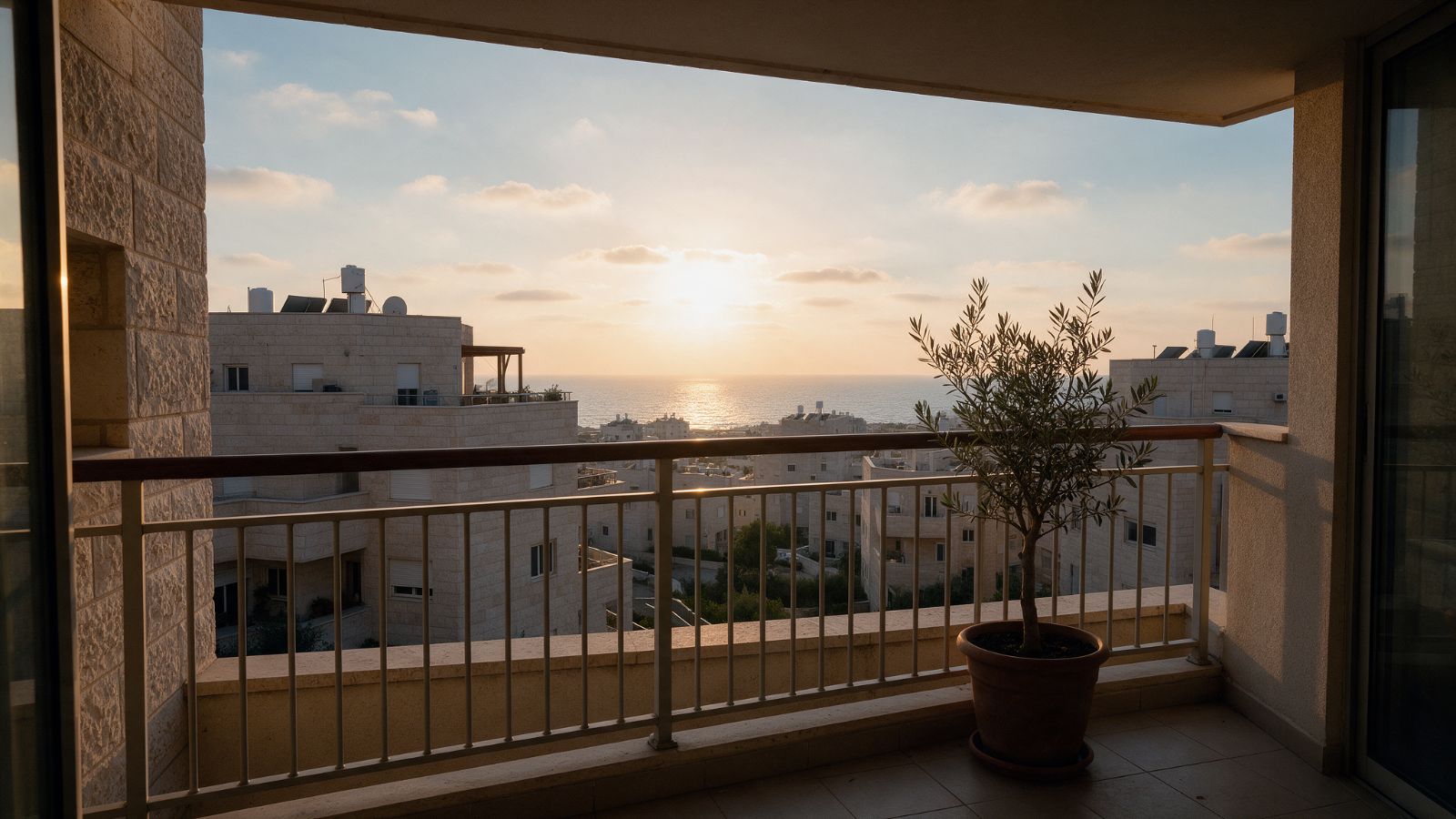
Church land in Jerusalem: buying in Talbiyeh, Rehavia or Nayot in 2026
Some of the most sought-after streets in Jerusalem sit on land that the apartment owners do not own. In Talbiyeh, Nayot and parts of Rehavia, the ground belongs to a private company that bought it from the Greek Orthodox Church, and the leases that residents hold run out in the early 2050s. Here is what that means for price, financing and resale, where things stand after the October 2026 High Court hearing, and how to check a property before you make an offer.
The short answer
About 500 dunams of Talbiyeh, Nayot and parts of Rehavia, with more than 1,000 homes, stand on land the Greek Orthodox Patriarchate leased to KKL-JNF for 99 years in 1951-52. Owners there hold a lease, not the land, and the leases end in 2051-52. The church has since sold its rights to private investors, the latest a group led by Extell for about ₪750 million. Apartments on this land sell about 10% below comparable freehold homes when more than 40 years remain and about 30% below when 40 years or less remain, and they are harder to finance. On 28 October 2026 the High Court pressed KKL to negotiate an extension. Before any offer, have a lawyer read the land registry extract (nesach Tabu) and the lease.
The figures to remember, November 2026
- Area concerned
- ≈ 500 dunams central Jerusalem
- Homes on the land
- 1,000–1,300 by source
- Lease end
- 2051–2052 99-year leases
- Discount vs freehold
- 10–30% Globes, 2025
- Last sale of the land
- ≈ ₪750M 2023–24
- High Court hearing
- 28 Oct 2026 case still open
How the land came to be leased
In the late Ottoman and Mandate periods, Christian institutions bought large plots outside the Old City walls. The Greek Orthodox Patriarchate held much of what became Talbiyeh, Nayot and the area around the Monastery of the Cross. After 1948 the young State wanted to build there without buying the land, and the church needed income. The answer was three agreements, signed in 1951 and 1952, leasing the land to KKL-JNF (Keren Kayemeth LeIsrael) for 99 years.
Homes were then built and sold as long sub-leases. A buyer in Talbiyeh therefore holds a lease registered through KKL, which the Israel Land Authority administers, while the ownership of the ground stays with someone else. That someone changed. The Patriarchate sold its rights to private investment partnerships in 2011 and 2016, and in 2023 a group led by US developer Gary Barnett (Extell) agreed to acquire them through Karkaot Yerushalayim 2022 Ltd. for about ₪750 million; the company says the deal closed in early 2024.
Which neighbourhoods
The large block covers Talbiyeh (around Disraeli street), Nayot and parts of Rehavia, with hotels, public institutions, open spaces and part of the Great Synagogue complex. Other church bodies own smaller plots elsewhere: parts of Baka, plots in Rehavia linked to the Ratisbonne Monastery, and an area of Rasko where the land was sold to a developer in 2013. Appraisers have counted about 3,000 apartments in Jerusalem on land owned, or formerly owned, by churches.
The street is not enough to know. Two buildings on the same block can have different owners under them. The only reliable answer is in the property’s land registry extract and lease, which is why the lawyer reads them before an offer, not after.
Where things stand in November 2026
- Three 99-year leases from the Patriarchate to KKL-JNF.
- The church sells its rights to private investment partnerships.
- KKL’s real estate arm tells more than 1,000 households it has decided in principle to extend the leases.
- An Extell-led group buys the rights for about ₪750 million.
- Reports of talks on a 50-year extension; 204 residents, hotels and an institution petition the High Court.
- The court does not rule but presses KKL, which admits no negotiation has taken place since July 2025, and asks for an update on concrete progress.
The legal question is who pays for, and how long lasts, the extension. The original agreements include a process to set both if the parties cannot agree. KKL says it has no legal duty to extend but is working toward a solution; the petitioners argue that it can, and should, renew. Until there is a signed extension, every sale in the area prices in that uncertainty.
The effect on price
The discount grows as the end of the lease gets closer. A study reported by Globes in June 2025 measured it across central Jerusalem:
| Situation | Price gap |
|---|---|
| More than 40 years left on the lease | ≈ −10% |
| 40 years or less left | ≈ −30% |
| Average loss of value | −10 to −15% |
| Average price per m², church land | under ₪40,000 |
| Average price per m², comparable freehold | close to ₪50,000 |
In 2014 both categories sold at about ₪29,000 per m². The gap opened as the 2050s came into view, and the same study found that the probability of a sale fell by about 20% from 2020. The Talbiyeh and Nayot leases now have about 25 years left, which puts them in the steepest part of the curve.
Mortgage and resale
A bank lends against a property it can sell if the borrower stops paying. When the lease ends within the life of a 25- or 30-year mortgage, that guarantee shrinks. In practice banks lend less, on worse terms, or decline, and the bank appraiser (shamai) values the property with the remaining term in mind. A buyer from abroad, already limited to about 50% financing on a normal flat, is the most exposed: get a mortgage pre-approval (ishur ekroni) on this specific property before signing, not a general one.
Resale follows the same logic. Your future buyer will face the same banks and a shorter lease. That is why appraisers have long advised either avoiding these properties or buying only with a discount large enough to absorb a future buyout or extension cost.
Worked example: is the discount enough?
| Comparable freehold flat nearby (₪50,000/m²) | ₪5,000,000 |
| Asking price on church land (₪40,000/m²) | ₪4,000,000 |
| Discount | ₪1,000,000 (−20%) |
| Reference buyout cost seen in earlier deals (26% of value) | ≈ ₪1,300,000 |
| Price + buyout | ≈ ₪5,300,000 |
In two deals reported in 2019-20, developers sold full ownership to residents for about 26% of the apartment’s value. If you had to do the same here, the church-land flat would cost more than the freehold one. The discount only works if you expect a cheaper extension, or if you plan to hold the flat for a shorter period and accept the resale risk. Purchase tax (mas rechisha) is due on the price you pay, at the usual rates.
Checks before an offer
- Read the land registry extract (nesach Tabu). It shows whether you buy a freehold or a lease, and who owns the land. Your lawyer orders it online for a few dozen shekels.
- Read the lease itself. End date, renewal clause, who holds the principal lease (KKL, the Israel Land Authority, a company), and any fees due on transfer.
- Price the remaining term. Compare with freehold sales on the same street, not the neighbourhood average, and apply the Globes ranges above.
- Get a property-specific pre-approval. Ask the bank, or a mortgage broker (yoets mashkanta), whether it will lend on this lease and at what loan-to-value.
- Ignore promised building rights. On leased land, unused rights and expansions may belong to the landowner, not to you. Do not pay for them.
- Sign nothing first. No zikaron dvarim (binding pre-agreement) before steps 1 to 4. See the full process in how to buy property in Israel.
Elsewhere in Jerusalem, most homes are on land managed by the Israel Land Authority under long renewable leases, which banks treat as normal. The problem described here is specific to land owned by churches or private companies. A Jerusalem lawyer knows the difference at a glance: see real estate lawyer in Jerusalem. Prices by neighbourhood are on the Rehavia and Katamon pages, and the tax on the purchase in the purchase tax calculator.
Frequently asked questions
What is church land in Jerusalem?
Land owned, or formerly owned, by Christian institutions, mainly the Greek Orthodox Patriarchate, on which homes were built under long leases. The best-known block, about 500 dunams of Talbiyeh, Nayot and parts of Rehavia, was leased to KKL-JNF for 99 years in 1951-52. Residents hold sub-leases through KKL, administered by the Israel Land Authority, and the leases end around 2051-52.
Who owns the land now?
Not the church. The Patriarchate sold its rights to private investment partnerships in 2011 and 2016. In 2023 a group led by US developer Gary Barnett (Extell) agreed to buy them through Karkaot Yerushalayim 2022 Ltd. for about ₪750 million; the company says the purchase closed in early 2024. KKL still holds the principal leases.
Will residents lose their apartments in 2051?
Nobody can promise the outcome, but eviction is not the scenario anyone expects. The original agreements give KKL a way to extend, with a process to set the length and the cost if the parties cannot agree. The open questions are how long the extension will be and who pays for it. On 28 October 2026 the High Court asked KKL to report concrete progress in negotiations.
How much cheaper is an apartment on church land?
A study reported by Globes in June 2025 found an average loss of value of 10 to 15%: about 10% below comparable homes when more than 40 years remain on the lease, about 30% when 40 years or less remain. Church-land apartments averaged under ₪40,000 per m² against close to ₪50,000 for comparable freehold homes. Older reports put the gap at 25 to 30%.
Can I get a mortgage on a church-land apartment?
Sometimes, on worse terms. Banks are reluctant to lend against a lease that ends within the life of the loan, and the bank appraiser (shamai) values the property with the remaining term in mind. A non-resident who can borrow 50% on a freehold flat should plan for less, or for a refusal, and get a mortgage pre-approval (ishur ekroni) on this specific property before signing.
How we work
Every amount, bracket and rate on this page is checked against the official source listed at the bottom and dated. When a schedule or rate changes, the page is updated within days. Our methodology.
Sources
- Jerusalem Post – High Court presses KKL over Jerusalem church land lease dispute (29 Oct 2026)
- Globes – Demand plunges for church-owned apartments in Jerusalem (12 Jun 2025)
- Times of Israel – Jerusalemites on leased land fume over secret talks (3 Jul 2025)
- Israel Land Authority – leases and registration of rights
- Kol Zchut – land rights, Tabu and leasehold
Have the title checked before you make an offer
An English-speaking Jerusalem real estate lawyer reads the Tabu extract and the lease, tells you who owns the land, when the lease ends and what that does to the price, before you sign anything.