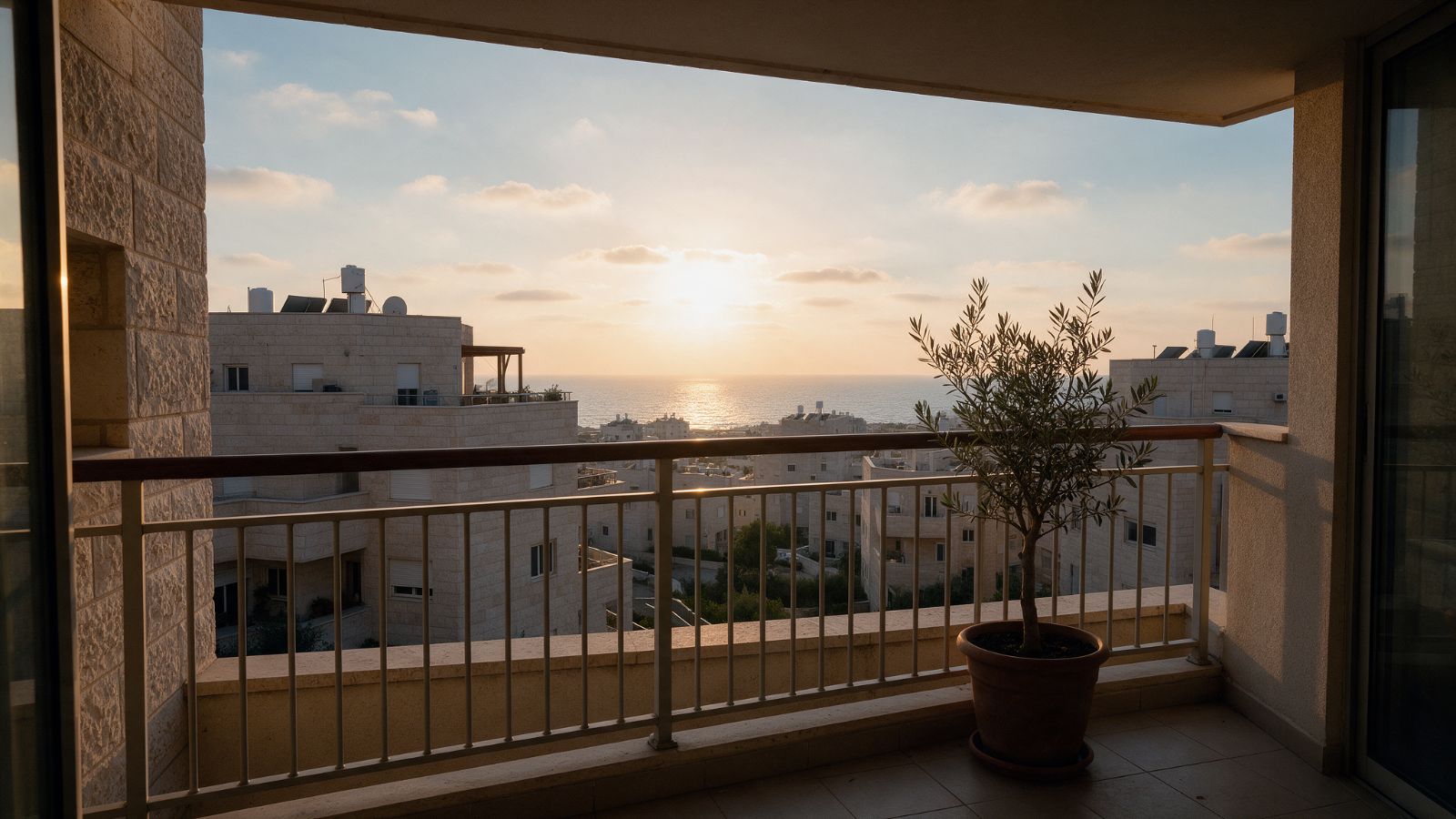
What is a mamad (safe room) and do I need one when buying in Israel?
The word is in every Israeli listing, sometimes as a selling point, sometimes by its absence. Since 2023 it has become a price factor in its own right. Here is exactly what a mamad is, what the law says, how to check that a room really is one, and what its absence does to a property’s value.
The short answer
A mamad (merchav mugan dirati, apartment protected space) is a reinforced-concrete room built into the home to withstand missiles and shrapnel: 9 m² minimum, walls of 20 to 25 cm, a 30 cm ceiling, blast-resistant door and window. It is mandatory in every new home whose permit dates from 1992 or later, not in older buildings. The result, as of November 2026: 55 to 60% of Israeli homes have none, up to 70% in the Tel Aviv, Jerusalem and Haifa districts. Nothing obliges a buyer to insist on one, but since 2023 its absence has meant a 5 to 10% discount at resale and rents ₪1,700 to ₪3,000 a month lower in the centre of the country. Adding one costs ₪100,000 to 200,000.
The figures to remember, November 2026
- Mandatory since
- 1992
- Minimum floor area
- 9 m²
- Homes without a mamad
- 55–60%
- Discount with no protection
- 5–10%
- Adding one to a resale
- ₪100–200k
Definition and standards
The legal basis is the Civil Defence Law of 1951 and its 1990 shelter regulations, amended after the 1991 Gulf War. Since 1992, every housing unit granted a building permit must include its own protected space. The duty is not retroactive: a building permitted in 1991 has no obligation to have one. The technical standards are set by the Home Front Command (Pikud HaOref), which approves plans and inspects sites.
A compliant mamad follows precise rules: at least 9 m² net (5 m² by special approval), 2.5 m ceiling height, 1.6 m width, external walls of 25 cm reinforced concrete and internal walls of 20 cm, floor and ceiling slabs of 30 cm, poured in one piece with no column or beam running through. The steel door, certified to Israeli Standard 4422, weighs 80 to 150 kg and opens inward; the blast window sits 1.5 m above the floor, with no bars because it doubles as an escape route, and has a steel shutter. Since May 2010 the ventilation includes blast valves and a filter against chemical and biological agents (Standard 4570), with a shelf life of about ten years. Three sockets, a phone point and protected lighting complete the kit. The maximum size is 12 m², plus a 3 m² bathroom.
In practice the mamad is a bedroom like any other, a little cooler in summer, counted in the listing’s room count and in the gross floor area. A new “4-room” apartment is three bedrooms, one of them the mamad, plus the living room.
Mamad, mamak, miklat: the four levels of protection
When a listing does not say “mamad”, ask which protected space serves the apartment. They are never equivalent.
| Type | Where | Time to reach | Buildings concerned | Effect on price |
|---|---|---|---|---|
| Mamad (merchav mugan dirati) | Inside the apartment | Seconds | Permits from 1992 on, TAMA 38, pinui-binui | Market reference |
| Mamak (merchav mugan komati) | Shared landing on the floor | 10–60 s | Apartment blocks, sometimes added in renovation | Slight gap to a mamad |
| Miklat (building shelter) | Shared basement | 30 s – 5 min | Buildings from the 1950s to 1991 | 5–10% discount |
| None (stairwell, public shelter) | Outside the building or stairwell | Up to several minutes | Small older buildings, townhouses | Largest discount, especially south and north |
Estimates published between 2021 and 2025 agree: about 800,000 homes out of more than two million have a mamad, so 55 to 60% do not. The share is worse where the housing stock is old: around 70% of apartments without a mamad in the Tel Aviv district, 71% in Jerusalem, 77% in Haifa. It is one reason for the popularity of buying new from a developer and of urban-renewal projects since 2023.
Checking that a room is a real mamad
A bedroom with thick walls is not a mamad. Three documents settle it, and your lawyer asks for them in the due diligence.
- The tofes 4 (completion and occupancy certificate): it states the type of protected space in the home. The wording “interior room” means there is no mamad.
- The building permit and its plans: the room must appear as a mamad, with the concrete thicknesses. A mamad built without a permit is illegal and can be hit with a demolition order.
- The on-site inspection: steel door with the Standard 4422 plate and Home Front Command stamp, blast window at 1.5 m, steel shutter, two ventilation ports, filter unit with its replacement date, no holes drilled through the walls. Check the city’s warning time on the Home Front Command app too: 30 seconds in Ashkelon, 45 in Ashdod, 90 in the centre.
Off-plan, the mamad is guaranteed by the permit standards, but check its actual floor area in the contract: some developers sell the legal minimum of 9 m², others 12 m². The rest of the checks are in pitfalls and checklist before signing, and the lawyer’s role in the real estate lawyer in Israel.
What the mamad does to the price
Before 2023 the mamad was a convenience with little price impact. Since then it has become a sorting criterion: in the second quarter of 2025, about 60% of resale transactions involved protected homes. On the rental side, field data published in August 2025 showed an average gap of about ₪3,000 a month in Tel Aviv and ₪1,700 to 2,500 in other central cities between an apartment with a mamad and one without. On sales, agencies see a 5 to 10% discount for a home with no protection at all, steeper in Ashdod, Ashkelon or Haifa than in Tel Aviv.
| Item | With mamad (2008 building) | No mamad, basement miklat (1986 building) |
|---|---|---|
| Asking price | ₪2,000,000 | ₪1,820,000 (−9%) |
| Expected rent | ₪6,200 / month | ₪5,300 / month |
| Adding a mamad | — | Not possible alone (6 floors); TAMA 38 uncertain |
| Gross yield | 3.7% | 3.5% |
The reading is simple: the price gap roughly offsets the rent gap, but liquidity is not the same. A home with no protection sells more slowly and to a narrower pool of buyers, which matters to an investor comparing rental yields by city. For a given budget, the price table by city shows where a home with a mamad remains within reach.
Adding a mamad to an older building
There are three routes. The first is collective: in a TAMA 38 or pinui-binui project, the developer adds a mamad to every apartment, often on the façade, in exchange for extra building rights. It is free for the owners, but limited to buildings from before 1980 and concentrated in the centre, where the deal pays for the developer. The second is individual: building an adjoining mamad, in concrete poured on site (₪100,000 to 200,000) or as a prefabricated module (₪113,000 to 140,000). It needs Home Front Command approval, given within 14 days, and in principle a building permit; a temporary order exempted buildings of up to two floors from the permit between October 2023 and October 2024, and its renewal is decided year by year. The third is a halfway house: reinforcing an existing room with steel plates, cheaper but without the protection of a real mamad, and without the resale value.
For a buyer the question comes before signing, not after: a 1985 building with no renovation project filed will probably not have a mamad for ten years. What a new build offers over a resale, mamad included, and the steps of a purchase are in the site’s guides.
Frequently asked questions
Can the mamad be used as a bedroom or office?
Yes, and that is the normal use: the mamad counts as one of the “rooms” in a listing (a new 4-room apartment almost always has its mamad as a bedroom). It keeps its constraints: window 1.5 m above the floor, a heavy blast door opening inward, no drilling through the walls for air-conditioning without the pre-cast sleeve. Many families make it the children’s room.
Do banks or insurers require a mamad?
No. No bank makes a mashkanta conditional on a mamad, and property insurance does not ask for one either. The shamai (appraiser) does note it in the report and may reflect it in the value, which affects the loan amount: in 2025-2026 a home with no protection at all sells 5 to 10% below a comparable one with a mamad.
How can I tell in two minutes whether an apartment has a real mamad?
Look at the door: a real mamad has a steel door weighing 80 to 150 kg, with a compliance plate for Israeli Standard 4422 and the Home Front Command (Pikud HaOref) stamp, opening inward. Then the blast window with its steel shutter, and two ventilation ports. A bedroom with a heavy door but no plate is a reinforced “protected room”, not a mamad.
Can a pre-1992 building get a mamad?
Yes, in three ways: a TAMA 38 or pinui-binui project, where the developer adds a mamad to every apartment in exchange for building rights; an individual build, ₪100,000 to 200,000, subject to Home Front Command approval and usually a permit; or a shared mamak (floor-level protected space), cheaper per home. Buildings from 1980 to 1992 are the worst placed: too recent for TAMA 38, too old to have a mamad.
How we work
Every amount, bracket and rate on this page is checked against the official source listed at the bottom and dated. When a schedule or rate changes, the page is updated within days. Our methodology.
Sources
Want a home delivered with a compliant mamad?
Every new development has one. Tell us the city, the number of rooms and your budget: a developer or new-build advisor sends you the available projects, with payment schedule and delivery date.