Buying an apartment in Haifa: 2026 prices by neighbourhood, from the Carmel to Hadar
Haifa is the one big Israeli city on the sea where a family budget still buys a family apartment. The average apartment costs about ₪1.8 million, roughly 40% of the Tel Aviv average, and a 4-room flat on the Carmel costs what a 2-room does in central Tel Aviv. The Technion, the University of Haifa, Rambam hospital and the MATAM high-tech park keep the rental market busy, and the city took in more new immigrants in 2025 than anywhere except Netanya and Tel Aviv. This guide gives the real ranges by neighbourhood, what is being built, the security and air-quality questions to ask, and what the purchase costs you as a non-resident, an oleh or a resident.
Haifa in four figures
An average apartment costs ₪1,800,000 (≈ $570,000, CBS, Q1 2026), +6.9% in a year; the square metre runs from about ₪13,000 in Hadar to ₪36,000 for new builds on the Carmel; gross rental yields are 3 to 4%; and Haifa is Israel’s third city with about 297,000 residents (2024) at the heart of a metropolitan area of a million. On a 4-room apartment at ₪2,800,000 in Ahuza, a non-resident pays ₪224,000 of purchase tax, a resident buying their only home ₪35,538, and a new immigrant ₪4,106.
Prices by neighbourhood (observed ranges, 2026)
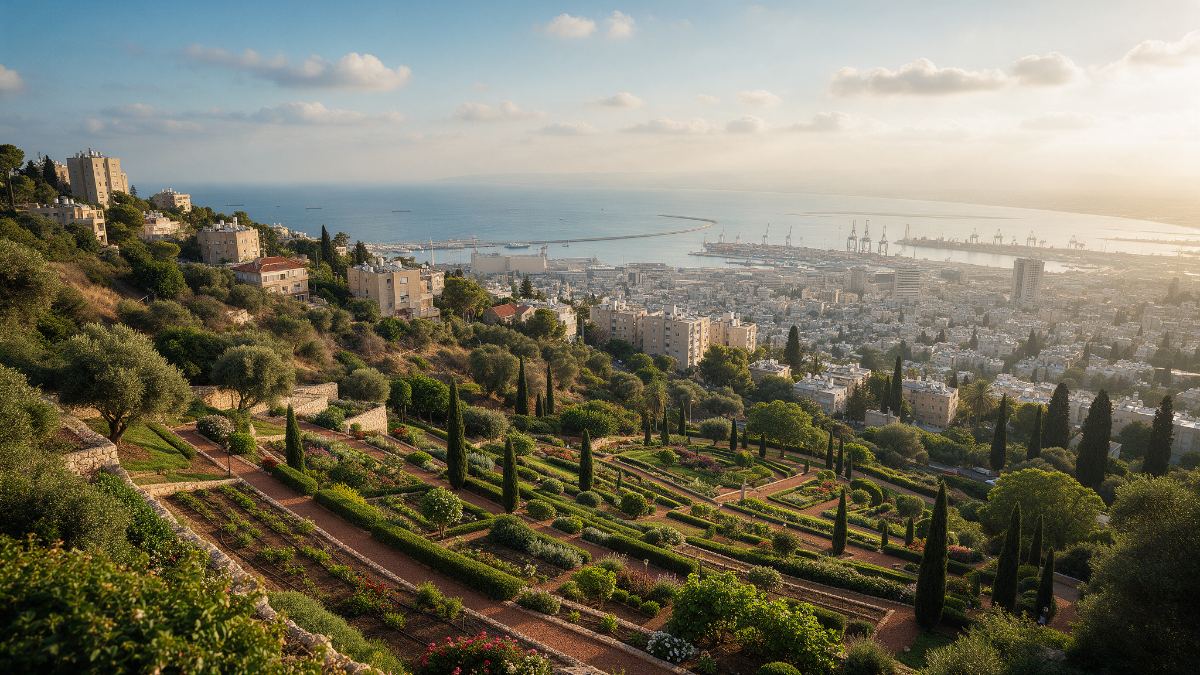
Haifa climbs Mount Carmel in three tiers, and the price climbs with it. At the bottom are the port, the downtown, the German Colony, Bat Galim and Kiryat Eliezer along the sea; in the middle, Hadar HaCarmel and Neve Shaanan; at the top, the central Carmel, Ahuza and Denya, with cleaner air, views over the bay and the best-known schools. The second factor is the age of the building. Much of the city was built between the 1930s and the 1970s, and an apartment without an elevator or a safe room can trade at a third less than a renovated one on the same street.
| Neighbourhood | ₪/m² resale | ₪/m² new | Profile |
|---|---|---|---|
| Central Carmel, Ahuza, Denya | 24,000–32,000 | 30,000–36,000 | The top of the city: views of the bay, the Technion and the university nearby, schools and hospitals. Ahuza’s core traded at about ₪28,000 per m² in early 2026, up from ₪24,000 in 2023. Denya’s large apartments and villas lead the city’s ₪4M+ deals. |
| German Colony, downtown, port, Wadi Nisnas | 16,000–22,000 | 22,000–28,000 | The lower city in transition: restored Templer houses, offices and start-ups near the port, the train and the Metronit. Small units, strong rental demand, huge spread by condition. |
| Neve Shaanan, Ramat Alon, Yizre’elia | 16,000–20,000 | 26,000–30,000 | Family and student district next to the Technion; national-religious and Russian-speaking communities. Average 4-room about ₪1.56M in H1 2026, below the city average. |
| Kiryat Eliezer, Bat Galim | 15,000–21,000 | 25,000–30,000 | Down by the sea and Rambam hospital: a promenade and beach in Bat Galim, older blocks and a large renewal plan in Kiryat Eliezer. |
| Hadar HaCarmel | 13,000–18,000 | 22,000–24,000 | The cheapest way into the city: median ₪15,800 per m² and ₪900,000 per deal over the 12 months to July 2026, about 200 deals. Buildings from after 2010 sell at about ₪22,800 per m². |
Two reading notes. Israeli prices per m² are quoted on gross area (walls, balcony and a share of the common parts): a 4-room advertised at 100 m² is roughly 80–85 m² of usable space, about 860–915 sq ft, and the gap is larger in Haifa’s thick-walled older buildings (see gross vs net square meters). And a “4-room” apartment in Israel means three bedrooms plus a living room. Haifa against the other cities: Israel real estate prices city by city.
Who buys where, and why
Haifa has never been an Anglo capital the way Raanana, Modiin or Beit Shemesh are, and that is part of its appeal. English speakers here are typically academics, doctors and engineers who came for the Technion, the University of Haifa, Rambam or the tech companies of MATAM and the port, and families who wanted a real city by the sea without Tel Aviv prices. The Anglo families who settle tend to choose Ahuza and the central Carmel (schools, parks, a diverse religious mix) or Neve Shaanan (young national-religious families, playgrounds, cafés). The municipality has a staff contact for English-speaking olim, and the wider absorption infrastructure was built for the large Russian-speaking community that arrived in the 1990s and keeps arriving: Haifa received 1,201 new immigrants in 2025, the third-highest number after Netanya and Tel Aviv.
Four buyer profiles cover most of the market. The family settling for good: a 4-room in Ahuza, the central Carmel or Neve Shaanan, between ₪1.6M and ₪3M depending on the hill tier, financed at 75% if you are an oleh or resident. The professional relocating for work: a 3-4 room within reach of the cable car to the Technion or the Metronit to MATAM. The investor, often living in the centre of the country or abroad: a 2-3 room in Neve Shaanan, Hadar or the downtown, let to students or young workers. Children buying for parents: a 3-room with an elevator and a safe room near a clinic and public transport, roughly ₪1.2M to ₪1.6M.
For a buyer in the US, the UK, Canada or South Africa, the arithmetic is simple: the price of a 3-room in north Tel Aviv buys a 4-room on the Carmel with a view of the bay. The mechanics of buying without living in Israel are in buying property in Israel from abroad, with country specifics in buying from the USA and buying from the UK.
New builds and urban renewal
Haifa has little free land, so most new homes come from urban renewal. In pinui-binui (evacuation and rebuilding), blocks from the 1950s-70s are demolished and replaced by towers, with the original owners rehoused in new apartments; Kiryat Eliezer, Neve David, Hadar and Neve Shaanan are the main areas. In 2025 Haifa issued pinui-binui permits for roughly as many units as Tel Aviv (901), according to the Government Authority for Urban Renewal. The other route, building renewal under TAMA 38 (seismic strengthening plus extra floors), has stalled since the national plan expired: Haifa received 27 permit requests in 2025 against 139 in 2024, an 81% drop and the sharpest in any big city, even though 39 buildings were still permitted during the year. Alongside renewal, there are smaller new-build projects in Ahuza, Ramat Alon, Neve Shaanan and towers near the port and the German Colony.
The market for new apartments has slowed: about 270 new units sold between November 2025 and January 2026, 37% fewer than in the previous three months. For a buyer that means room to negotiate. The rules are national: the Sale Law requires a bank guarantee for every payment, at most 40% of the price can be indexed to the construction cost index (madad tshumot habniya), 20/80 payment schedules exist in Haifa too, and delays of 6 to 12 months are common, with compensation owed from the second month past the contractual date. A new apartment in a pinui-binui project typically costs 10 to 20% less than a comparable conventional new build, but its delivery date depends on residents’ signatures and permits. The full mechanics are in buying off-plan from a developer and pinui-binui and TAMA 38.
Buying an old apartment in a building that has “signed” for pinui-binui is the classic Haifa bet: you pay ₪15,000-18,000 per m² today and receive a new, larger apartment with an elevator, a safe room and parking a few years later. But a signed agreement, an approved plan and a building permit are three different stages, often years apart. Ask your lawyer to check the status with the municipality before you price in the upside.
Buying in Haifa by status
Non-resident
tax 8%- Financing 50% as a rule.
- On ₪2,800,000: mas rechisha ₪224,000.
- Loan up to ₪1,400,000, payment ≈ ₪7,901 over 25 years.
Resident, only home
tax 0 → 5%- Financing up to 75%.
- On ₪2,800,000: mas rechisha ₪35,538.
- Loan up to ₪2,100,000, payment ≈ ₪11,852 over 25 years.
New immigrant (oleh)
tax ≈ 0.15%- Financing up to 75%.
- On ₪2,800,000: mas rechisha ₪4,106.
- Saving of ₪219,894 compared with a non-resident.
Haifa is the big city where the first bracket matters most. The average price, ₪1,800,000, sits below the ₪1,978,745 threshold, so most apartments in the city carry no purchase tax at all for a resident buying their only home or for an oleh. A non-resident pays 8% from the first shekel. The oleh schedule applies to a purchase signed from one year before aliyah to seven years after it, until 15 January 2028; a non-resident who becomes resident within two years of buying is reclassified as an only-home buyer and can claim back the difference. Brackets and worked cases are in the purchase tax in 2026; the aliyah side is in buying as a new immigrant.
Breakdown by bracket
| Bracket | Rate | Tax |
|---|
Brackets of 16 January 2025, frozen until 15 January 2028 (Arrangements Law). A non-resident is taxed as an additional-home buyer unless they become an Israeli resident within two years of the purchase. Payment is due within 60 days of signing.
Full budget: a 4-room resale apartment in Ahuza
| Price | ₪2,800,000 |
| Mas rechisha (8%) | ₪224,000 |
| Buyer’s lawyer (0.5 to 1% + 18% VAT) | ≈ ₪20,000 |
| Agency fee (2% + VAT) | ≈ ₪66,000 |
| Mortgage broker, appraiser (shamai), bank fees, insurance | ≈ ₪18,000 |
| Translations, power of attorney, apostille, wires | ≈ ₪6,000 |
| Total cost | ≈ ₪3,134,000 (+ 11.9%) |
| Mortgage at 50% | ₪1,400,000 → ≈ ₪7,901 / month over 25 years |
| Cash to plan for | ≈ ₪1,734,000 (≈ $549,000) |
The same apartment bought by an oleh would carry ₪4,106 of tax instead of ₪224,000, with 75% financing: the cash requirement drops by more than half. There is no notary in Israel: the buyer’s lawyer checks the title, drafts the contract and registers the purchase. In Haifa specifically, budget for the building as well as the apartment. In older stock, the owners share the cost of a new elevator, façade repairs or waterproofing, and a full renovation of a 1960s flat can run ₪100,000 to ₪250,000. Ask the vaad bayit (building committee) what has already been voted. Run your own numbers with the purchase tax calculator and the mortgage calculator.
Transport, schools, security, air: the Haifa realities
Getting around a city built on a mountain. Haifa has transport no other Israeli city has: the Carmelit, an underground funicular from downtown through Hadar to the central Carmel; the Rakavlit cable car, open since April 2022, which climbs 4.4 km from the HaMifratz central bus station to the Technion and the University of Haifa in about 19 minutes; and the Metronit bus rapid transit lines along the bay. The coastal railway reaches Tel Aviv in about an hour and continues to Ben Gurion airport. In practice, distance to a Carmelit, cable-car or Metronit stop is worth checking as much as the floor plan.
Schools and campuses. The Technion and the University of Haifa are the city’s economic engines, with Rambam, Carmel and Bnei Zion hospitals. The best-known schools (the Reali school and the Leo Baeck Education Center among them) sit on the Carmel and in Ahuza, which partly explains the premium of the upper tier. Olim children are absorbed in municipal schools with Hebrew ulpan classes.
Security. Haifa is about 35 km from the Lebanese border. Hezbollah rockets reached the city and the Krayot in 2024, and in June 2025 Iranian missiles hit the Bazan refinery complex in the bay, killing three workers and shutting the refineries for months. A mamad has been mandatory in new buildings since 1992; in the city’s older stock, protection is usually a shared shelter in the basement. Ask which, where and how far, and check whether a renewal project would add safe rooms. Practical steps for remote owners are in what happens to my mortgage in a war.
Air and the bay. The lower city and the bay sit next to the port and the petrochemical zone. The government decided in March 2022 to evacuate Bazan and the petrochemical plants from Haifa Bay by the end of 2029; the plan is running about a year late, and in October 2026 the mayor, Yona Yahav, asked all parties to commit to a binding deadline. A credible closure would lift the lower neighbourhoods; in the meantime the higher you go on the mountain, the higher the price, and not only for the view.
Rental yield: lower rents, lower prices
Haifa has the lowest average rent of Israel’s big cities, ₪4,936 a month on the Yad2 index in January 2026, up 6.2% in a year, against ₪10,835 in Tel Aviv. Because purchase prices are lower still, gross yields of 3 to 4% are achievable. Best cases: small apartments let to Technion and university students around Neve Shaanan, and renovated units downtown let to young workers. A 3-room bought at about ₪1,320,000 in Neve Shaanan typically lets for ₪3,800 to ₪4,500 a month, a gross yield of about 3.5 to 4%. Family 4-rooms on the Carmel come in nearer 3%, and Hadar, where rents are low, around 3.1%. A non-resident investor pays 8% purchase tax (₪105,600 on that 3-room) and is taxed on the rent, often under the 10% flat-rate track on gross rent. The options are in rental income tax in Israel; city comparisons in rental yield by city.
Professionals on the ground
Haifa has a deep bench of professionals used to buyers who do not speak Hebrew, in English and especially in Russian: real estate lawyers who know the old buildings, Israel Land Authority leases, unregistered condominiums and pinui-binui contracts; mortgage brokers who know which banks lend 50% to non-residents with income abroad and 75% to olim with no Israeli credit history; agencies that work the whole mountain from Hadar to Denya. We select them on three criteria: real estate specialisation, independence from sellers, and experience with remote transactions. What a lawyer checks and charges is in the real estate lawyer in Israel.
Nearby and for comparison: Tel Aviv, an hour by train and about two and a half times the price; Netanya, the sea and new builds with an established Anglo community; Jerusalem, for community life; Bat Yam, the seafront next to Tel Aviv; or all the cities we cover.
Coming over for a few days of viewings in Haifa? The city is 105 km from Ben Gurion Airport and built on a mountain, so most buyers rent a car. Prices, insurance and the Carmel Tunnels toll, on our sister site ChulGuide: car rental in Haifa.
Frequently asked questions
What is the average price of an apartment in Haifa in 2026?
₪1,800,000 (≈ $570,000) according to the Central Bureau of Statistics for Q1 2026, up 6.9% on a year earlier. Madlan’s deal data for the first half of 2026 puts the city average at about ₪1.21M for a 3-room and ₪1.78M for a 4-room. In Ahuza a 4-room of 100 m² trades around ₪2.8M; in Hadar the median deal is about ₪900,000 for 57 m².
How much does a square metre cost in Haifa?
From about ₪13,000 to ₪36,000 per m². Declared deals put Hadar HaCarmel at a median of ₪15,800 per m² (12 months to July 2026), Neve Shaanan at ₪16,000–20,000 for resale and ₪26,000–30,000 for new projects, and Ahuza at about ₪28,000 in early 2026. New builds on the central Carmel reach the mid-₪30,000s.
Are prices in Haifa still rising?
More slowly. The CBS average was up 6.9% year on year in Q1 2026, one of the strongest rises among big cities, but the latest CBS index for the Haifa district (July–August 2026) shows −1.4% over twelve months, and Madlan’s first-half figures show the city average roughly flat. Ahuza kept rising (about ₪28,000 per m² in early 2026, from ₪26,000 in 2025) while Hadar and Neve Shaanan slipped by 2–3%.
Is Haifa safe to buy in after the 2024–2025 wars?
Haifa and the Krayot came under Hezbollah rocket fire in 2024, and in June 2025 Iranian missiles hit the Bazan refinery complex in Haifa Bay, killing three workers. Daily life has resumed, but security now weighs on prices: an apartment with a mamad (safe room, standard in buildings permitted since 1992) is easier to sell and rent than one relying on a shared shelter. Check what protection the building has before you look at the view.
Can a non-resident get a mortgage for an apartment in Haifa?
Yes, usually up to 50% of the price, from banks that lend to foreign residents with documented income abroad. On a ₪2.8M apartment that means ₪1,400,000 of credit and about ₪7,901 a month over 25 years. The purchase tax for a non-resident is 8% from the first shekel (₪224,000 on ₪2.8M), refundable down to the resident rate if you become resident within two years.
What rental yield can I expect in Haifa?
About 3 to 4% gross. Haifa has the lowest average rent of the big cities (₪4,936 a month in January 2026 on the Yad2 index, +6.2% in a year), but prices are low enough to compensate. Small apartments let to Technion and university students near Neve Shaanan do best; a family 4-room on the Carmel yields closer to 3%; Hadar comes out around 3.1% on Bizportal’s figures.
How we work
Every amount, bracket and rate on this page is checked against the official source listed at the bottom and dated. When a schedule or rate changes, the page is updated within days. Our methodology.
Sources
- Central Bureau of Statistics – average apartment prices by city, Q1 2026 (via Buyitinisrael, 15 May 2026)
- Nadlan Center (Madlan data) – Neve Shaanan and Haifa averages, H1 2026 vs H1 2025 (24 Oct 2026)
- ice.co.il – Ahuza and Neve Shaanan price per m², 581 resale deals 2023–2026 (11 Aug 2026)
- ice.co.il – Neve Shaanan resale and new-project price per m², Kiryat Eliezer renewal (12 Apr 2026)
- Bizportal – Hadar HaCarmel: median ₪15,800 per m², deals and yield (4 Sep 2026)
- Klika Nadlan – Haifa 2026: Yad2 rent index, new-home sales
- Klika Nadlan – Government Authority for Urban Renewal, 2025 summary (31 May 2026)
- Nadlan Center – building-renewal permit requests in 2025 (2 Jun 2026)
- CTech (Calcalist) – Haifa Bay petrochemical evacuation plan and the June 2025 strike on Bazan (20 Jul 2026)
- Israel Tax Authority – mas rechisha brackets 2026
- Haifa Municipality – planning and urban renewal
Your Haifa project, with the right people
Agency, developer, mortgage broker or lawyer: tell us the neighbourhood (Carmel, Ahuza, Neve Shaanan, the German Colony…), your budget and timeline, and we pass it to an English-speaking professional who works Haifa every day.