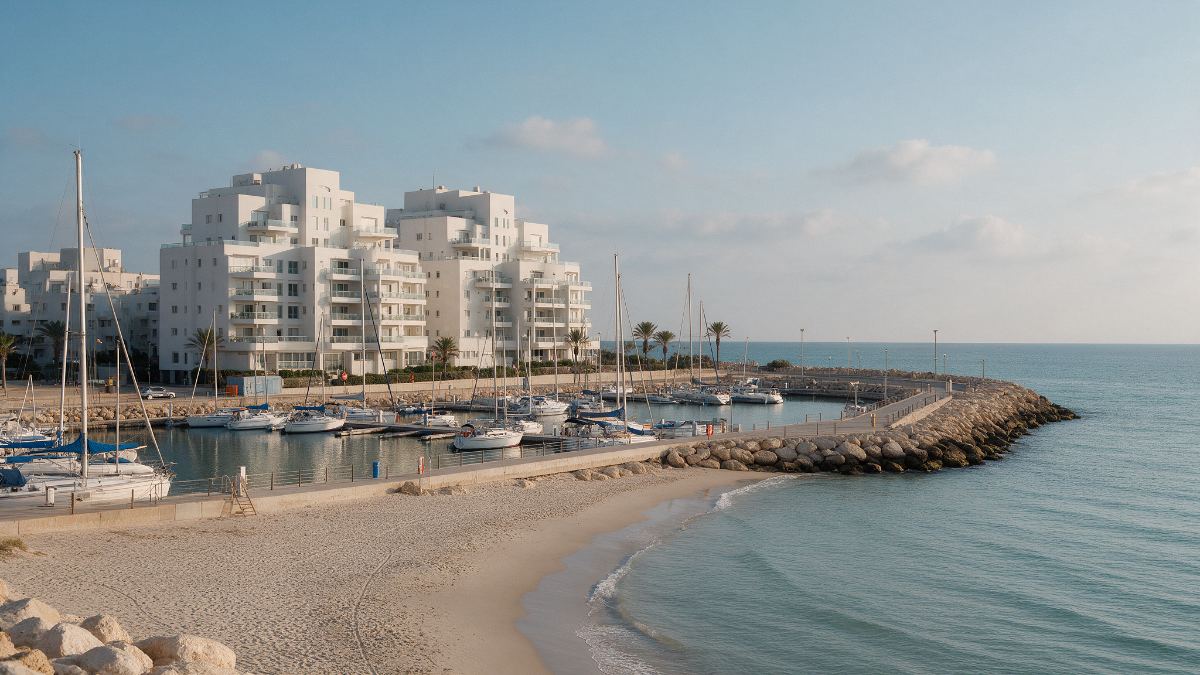
Buying an apartment in Ashkelon: prices by neighbourhood, the Gaza question, new builds and what you need to know
Ashkelon is the cheapest seafront city in Israel: an average apartment costs about ₪1.64 million, roughly 45% less than in Netanya and a third less than in Ashdod, twenty minutes up the coast. It is also the large Israeli city closest to Gaza, 13 km from the border, and that shapes the market more than anything else: buyers now pay a clear premium for buildings with a safe room in every apartment. French olim settle in Barnea, Afridar and around the Marina, Russian-speaking families have been a pillar of the city since the 1990s, and young Israeli couples priced out of the centre fill the new neighbourhoods of Agamim and Ir HaYain. This guide gives the real ranges by neighbourhood, the facts on security, and the budget by status.
The short answer
The average apartment in Ashkelon sold for ₪1.64 million in Q1 2026 (CBS), down 3.2% in a year, and ₪1.72 million in Q2 (−2.4%): the only large coastal city where prices are still slipping. The square metre ranges from ₪11,000–16,000 in the older blocks of Shimshon, Givat Zion and Ramat Eshkol to ₪15,500–19,000 in the new neighbourhoods of Agamim and Ir HaYain, ₪16,000–21,000 in Barnea and Afridar, and ₪28,000–35,000 in the new Marina towers facing the sea. A new 4-room apartment costs about ₪1.65M to ₪1.8M: below the ₪1,978,745 threshold, a resident or a new immigrant buying an only home pays no purchase tax, a non-resident pays 8% (144,000 ₪ on 1,800,000 ₪). The discount has a cause, the proximity to Gaza, and a practical answer: buy in a building with a safe room (mamad) in every apartment.
The figures to remember, November 2026
- Average price (CBS, Q1 / Q2 2026)
- ₪1.64M / ₪1.72M
- Change in a year
- −3.2% / −2.4%
- ₪/m², older stock → Marina towers
- 11,000–35,000
- New 4 rooms, Agamim / Ir HaYain
- ₪1.65–1.8M
- Gross rental yield
- 2.8–3.5%
- Purchase tax on 1,800,000 ₪, resident / oleh / non-resident
- 0 ₪ / 0 ₪ / 144,000 ₪
Prices by neighbourhood (order of magnitude, 2026)
Ashkelon, about 167,000 residents (CBS, end of 2024), stretches along the coast between the Nitzanim dunes in the north and the Rutenberg power station in the south. Its map reads in three layers: the seafront (the Marina, Barnea, the western edge of Afridar), the 1950s–1970s neighbourhoods inland (Migdal, the historic core, Shimshon, Givat Zion, Ramat Eshkol), and the new neighbourhoods of the 2010s–2020s to the east and south (Agamim, Ir HaYain, Ramot Karmim). Price follows three criteria: distance to the sea, age of the building, and whether each apartment has its own safe room.
| Neighbourhood | ₪/m² resale | ₪/m² new / recent | Profile |
|---|---|---|---|
| Marina and first-line seafront | 20,000–28,000 | 28,000–35,000 | Towers of 20+ storeys facing Delila and Bar Kochba beaches, opposite the Marina mall. Dimri Yama units sold around ₪28,000/m², a 20th-floor sea-view 5-room at ₪4.37M (≈ ₪33,000/m²) to US buyers. Pieds-à-terre, French and American buyers. |
| Barnea | 16,000–20,000 | 20,000–26,000 | The north, near the sea: villas, towers and 1990s–2010s buildings. Recent deals: a 5-room of 125 m² at ₪3.2M (August 2026), a record villa at ₪6.46M (November 2025). Strong French presence. |
| Afridar | 15,000–19,000 | 20,000–25,000 | Founded in 1951 by South African immigrants, between the city centre and the sea; leafy streets, shops, old public housing to be rebuilt. A 4-room of 121 m² sold for ₪2.22M in summer 2026. |
| Ir HaYain (northeast) | 15,000–17,500 | 16,500–19,500 | The big new neighbourhood: about 11,000 homes planned for 40,000 residents, 400+ deals in a year, median ₪16,800/m² (down from ₪18,600). Young couples, deliveries until 2030. |
| Agamim (south) | 15,500–18,000 | 17,000–20,000 | Built since 2015, 3,100 homes planned, about 1,000 delivered; buildings up to 13 storeys, 4–5 rooms. Average ₪17,000/m²; 4 rooms ≈ ₪1.65M, 5 rooms ≈ ₪1.98M. |
| Ramot Karmim, Neve Ilan, Neot Ashkelon | 14,000–17,500 | 17,000–19,000 | 1990s–2010s family neighbourhoods in the north and east, schools, mostly buildings with mamad; less seafront demand, steady local resale. |
| Shimshon (Atikot), Givat Zion, Ramat Eshkol, Migdal | 11,000–16,000 | — | 1950s–1970s blocks, often without a mamad or elevator; the entry price of the city (3 rooms ≈ ₪1–1.2M), several pinui-binui plans under way. Large Russian-speaking population since the 1990s. |
The price per m² is quoted on gross area (walls, balcony, sometimes a share of the common areas): a 4-room apartment listed at 105 m² offers about 85–90 m² of usable space, some 915–970 sq ft (see gross vs net square meters). Note that Israelis count rooms, not bedrooms: a 4-room apartment has three bedrooms, one of which is often the mamad. To compare Ashkelon with the rest of the country, see Israel real estate prices city by city.
Who buys where, and why
Three groups make the Ashkelon market. French-speaking olim first: the city has drawn families from France for twenty years, settled mostly in Barnea, around the Marina and in Afridar, with French-speaking synagogues, shops and agents. Their budgets split in two: a 4–5 room apartment near the sea between ₪1.8M and ₪2.6M to settle, or a sea-view pied-à-terre in a Marina tower between ₪2.5M and ₪4M, used for the holidays and rented the rest of the year. Russian-speaking Israelis next, present since the aliyah of the 1990s in Shimshon (Atikot), Ramat Eshkol and Givat Zion, and now in the newer northern neighbourhoods: second-generation families trade an older 3-room for a new 4–5 room with a mamad in Ir HaYain or Agamim. Israelis priced out of the centre, last: couples from Ashdod, Rehovot or Gush Dan who get a new 5-room for the price of an old 3-room in Rishon LeZion, and buyers from the Dira BeHanacha (subsidised housing) lotteries, whose units in Ir HaYain traded around ₪11,500/m², two thirds of the market price.
Foreign buyers, mainly French and some American, are concentrated at the top of the market: the Marina and the seafront of Barnea. That segment depends the most on the perception of security abroad, and it is also where resale takes the longest when the news from Gaza turns bad. For a buyer living abroad, the practical steps (power of attorney, bank account, wires) are in buying property in Israel from abroad.
Gaza, safe rooms and what it does to prices
The facts first. Ashkelon is about 13 km north of the Gaza Strip; when the Home Front Command sounds an alert, residents have about 30 seconds to reach a protected space. The city has been within rocket range since the 2000s and was hit hard in May 2021 and from October 2023, when it absorbed a large share of the rockets fired in the first weeks of the war. The Barzilai medical center has had a rocket-proof emergency room since 2018. Since the ceasefire of October 2025 the city has lived through a calmer period, but the truce remains fragile and nobody can promise it will hold: buy as if alerts can return.
What that means for a purchase:
- The mamad is the first criterion. Since the early 1990s every new apartment in Israel must include a reinforced safe room. In Ashkelon, practically everything built in Barnea, Agamim, Ir HaYain and the Marina has one; the 1950s–1970s blocks of Shimshon, Givat Zion, Ramat Eshkol or Migdal usually rely on a shared shelter or the stairwell. In 2023 the mayor estimated that about 40,000 residents had no adequate protected space. The gap shows in prices and in how fast a property rents.
- Buyers moved to new builds. Since the war began, local demand has shifted from older apartments to recent ones with a mamad (ICE, November 2025; Bizportal, August 2026). The 4-room new-build in Agamim at ₪1.65M is therefore easier to resell than an older 4-room at ₪1.3M, even if the second looks like a bargain.
- A protection plan for older buildings. The city deposited in May 2023 a master plan that shortens permits for adding safe rooms (per apartment, per floor or per building) to existing blocks. Before buying an older unit, ask whether the building has a protection project, a TAMA 38 or a pinui-binui under way; it can add value but also years of works.
- A tax credit for residents. Ashkelon was added to the localities near the Tkuma region: residents get a 7% income-tax credit on income up to ₪146,640 a year (about ₪10,000 a year per earner), for tax years 2026 to 2029 (law published 31 March 2026). It counts for an oleh who will work in Israel, not for a non-resident.
- Insurance and damage. War damage to a building is compensated by the state through the Property Tax Fund (Mas Rechush), not by your home insurer; the bank will still require building insurance for the mortgage. What happens to repayments in wartime is explained in what happens to my mortgage during a war.
The effect on prices is measurable but limited: the CBS average fell 3.2% over the year to Q1 2026 while the national average rose, and the median price per m² in Ir HaYain lost about 10% in a year. It is not a collapse: new-build sales rose 128% in February–April 2026, to 367 units (CBS), helped by developers’ 20/80 schedules. For a long-term owner, the discount on Ashkelon is the price of the risk; for someone who would be anxious living with sirens, no discount is worth it.
New neighbourhoods and urban renewal
Ashkelon is one of the cities that builds the most in Israel relative to its size, and new stock comes from two directions. Ir HaYain (“Wine City”), in the northeast, is the largest project: about 4,200 dunams, 11,000 homes and 40,000 residents planned, 27 developers, units for sale on Ariel Sharon, HaYotzrim, Doryf and Shaanin streets from about ₪1.68M, with deliveries from 2027 to 2030. Schools are opening one after another (state primary on HaYotzrim since 2022, two more since 2024, a 24-classroom school under construction), but parks and shops lag behind the residents, and a planned main boulevard will carry heavy traffic through the middle of the neighbourhood. Agamim, in the south, is further along: lived in since 2015, new primary schools and a municipal pool, a 160-dunam park with a lake planned to the south, but the train station is far.
The second source is urban renewal. In 2026 the city finally moved from talk to plans: the national committee approved the first pinui-binui in Givat Zion (Ehud HaTehiya compound, about 1,030 homes replacing 114), and in July 2026 discussed the deposit of a plan for northern Afridar with 2,407 homes in 24 buildings of 9 to 32 storeys replacing 402 public-housing apartments. Other compounds (Bar Kochba, Givati, the Histadrut compound on Shai Agnon) are waiting for owners’ signatures, and Shimshon (Atikot) has not started. Buying an old apartment in a block slated for pinui-binui is a bet on 8 to 12 years; the mechanism is in pinui-binui and TAMA 38.
For the off-plan buyer the rules are national: Sale Law bank guarantee on every instalment, at most 40% of the price indexed to the construction cost index, delays of 6 to 12 months common (see buying off-plan from a developer). In Ashkelon supply exceeds demand, so the balance of power favours the buyer: 20/80 schedules, a free parking space or a discount at the end of a project are negotiable.
Look at the delivery year as much as the price: Bizportal noted gaps of more than ₪4,000/m² in Ir HaYain between buildings delivered a year apart, about ₪500,000 on an average apartment. Ask the developer for comparable deals in the same street, not only the brochure price.
Buying in Ashkelon by status
Ashkelon is the coastal city where the purchase-tax threshold matters most: most apartments sell below ₪1,978,745, the ceiling of the 0% bracket for a resident or an oleh buying an only home. The three profiles below take a new 4-room apartment at 1,800,000 ₪.
Resident, only home
tax 0%- Financing up to 75%.
- On 1,800,000 ₪: mas rechisha 0 ₪.
- Loan 1,350,000 ₪, payment ≈ 7,697 ₪ / month over 25 years.
Non-resident
tax 8%- Financing 50% as a rule.
- On 1,800,000 ₪: mas rechisha 144,000 ₪.
- Cash required ≈ 1,074,000 ₪ including fees.
New immigrant (oleh)
tax 0%- Financing up to 75%.
- On 1,800,000 ₪: mas rechisha 0 ₪.
- Saving of 144,000 ₪ compared with a non-resident.
The oleh rate applies to an only home bought between one year before and seven years after aliyah, for purchases until 15 January 2028; above ₪1,978,745 an oleh pays only 0.5% (see buying as a new immigrant). A non-resident who buys first and makes aliyah within two years can claim back the difference. For financing, banks lend up to 75% to a resident or an oleh buying a first home, 50% to a non-resident (mortgage for new olim, mortgages for non-residents).
Breakdown by bracket
| Bracket | Rate | Tax |
|---|
Brackets of 16 January 2025, frozen until 15 January 2028 (Arrangements Law). A non-resident is taxed as an additional-home buyer unless they become an Israeli resident within two years of the purchase. Payment is due within 60 days of signing.
Two worked budgets: the Marina from abroad, Agamim as an oleh
| Price | 2,900,000 ₪ |
| Purchase tax, non-resident (8%) | 232,000 ₪ |
| Lawyer (0.5 to 1% + VAT) | ≈ 25,500 ₪ |
| Agency (2% + VAT) | ≈ 68,500 ₪ |
| Mortgage broker, appraisal, bank fees, insurance | ≈ 17,000 ₪ |
| Translations, power of attorney, apostille, wires | ≈ 6,000 ₪ |
| Total cost | ≈ 3,249,000 ₪ (+ 12.0%) |
| Mortgage at 50% | 1,450,000 ₪ → ≈ 8,267 ₪ / month over 25 years |
| Cash to plan for | ≈ 1,799,000 ₪ (≈ $569k) |
The same apartment bought by a resident as an only home would carry 40,538 ₪ in tax, by an oleh 4,606 ₪. At the Marina, add the building charges (vaad bayit) of the towers, which are much higher than in a standard building once there is a doorman, a pool and a gym; ask for the last statements and the reserve fund before signing.
| Price | 1,950,000 ₪ |
| Purchase tax, oleh (0% up to ₪1,978,745) | 0 ₪ |
| Lawyer (0.5 to 1% + VAT) | ≈ 17,500 ₪ |
| Agency (2% + VAT) | ≈ 46,000 ₪ |
| Mortgage broker, appraisal, bank fees, insurance | ≈ 14,000 ₪ |
| Total cost | ≈ 2,027,500 ₪ (+ 4.0%) |
| Mortgage at 75% | 1,462,500 ₪ → ≈ 8,338 ₪ / month over 25 years |
| Cash to plan for | ≈ 565,000 ₪ (≈ $179k) |
The same 5-room apartment would cost a non-resident 156,000 ₪ in tax. That is the Ashkelon arithmetic: for the price of a 3-room apartment in Netanya, an oleh family gets a new 5-room with a safe room and pays no purchase tax. Monthly payments are calculated at an average rate of about 4.75%, with the prime at 4.75% and the Bank of Israel rate at 3.25%; your own mix of tracks will differ (mortgage calculator).
Renting out in Ashkelon: rents and yield
| Property | Price | Rent / month | Gross yield |
|---|---|---|---|
| Older 3 rooms, Shimshon or Givat Zion | ₪1,100,000 | ₪3,000–3,500 | 3.3–3.8% |
| New 4 rooms with mamad, Ir HaYain or Agamim | ₪1,700,000 | ₪4,500–5,000 | 3.2–3.5% |
| New 5 rooms, Agamim or Ir HaYain | ₪1,950,000 | ₪5,000–5,500 | 3.1–3.4% |
On the CBS averages, a 4-room apartment yields about 2.9% gross, one of the better ratios on the coast but no windfall. Demand comes from Barzilai hospital, the Ashkelon Academic College, the industrial zone and the desalination plant, families who rent for a year before buying, and soldiers and staff of the region. Older units without a mamad rent for less and empty faster after a round of fighting. The Marina towers yield less than the table because of their price, but they are the most liquid segment for a foreign buyer. Rent up to ₪5,654 a month (2026 threshold) is tax-exempt for an individual: most Ashkelon rents sit below it (see rental income tax and rental yield by city).
Transport, schools and daily life
Transport. Ashkelon station is on the coastal line: about 64 minutes to Tel Aviv Savidor Center, 11 stops, ₪27 (August 2026), and a line east to Sderot, Netivot and Beer Sheva. By car, road 4 leads to Ashdod in 20 to 25 minutes and to Tel Aviv in 50 minutes to 1 h 15; Ben Gurion airport is about an hour away. Most residents of Ir HaYain and Agamim drive: the station is far from both. Schools and services. The new neighbourhoods are opening state and state-religious schools as they fill; Barzilai is the regional hospital, the Academic College has several thousand students. Lifestyle. The beaches (Delila, Bar Kochba, the Marina), the National Park with its Canaanite and Roman ruins, and prices that let a family keep a car and a larger apartment: that is what keeps Ashkelon residents in the city despite the sirens.
Professionals on the ground
Ashkelon’s professionals work in Hebrew, French and Russian, and in English at the top of the market: agencies in Barnea, at the Marina and in the new neighbourhoods, developers active in Ir HaYain and Agamim, mortgage brokers used to oleh and non-resident files, real estate lawyers who check the Tabu extract, building permits and the protected space against what is actually built. We select them on three criteria: real estate specialisation, independence from sellers and developers, and experience with remote transactions. Usual fees and checks are in the real estate lawyer in Israel.
Frequently asked questions
How much is an apartment in Ashkelon in 2026?
The CBS average was ₪1.64 million in Q1 2026 (−3.2% year on year) and ₪1.72 million in Q2 (−2.4%), about $520,000 to $545,000. A new 4-room apartment in Agamim or Ir HaYain trades around ₪1.65M to ₪1.8M, a 4-room in Barnea or Afridar between ₪1.7M and ₪2.3M, an older 3-room in Shimshon or Givat Zion around ₪1M to ₪1.2M, and a sea-view 4-room in a Marina tower ₪3M to ₪4M.
Is Ashkelon safe to live in, given how close it is to Gaza?
Ashkelon lies about 13 km north of the Gaza Strip and has roughly 30 seconds of warning when a rocket alert sounds. Life is organised around that: every apartment built since the early 1990s has its own reinforced safe room (mamad), the Iron Dome system covers the city, and alerts were frequent in 2023–2024 before the October 2025 ceasefire brought a calmer, still fragile, period. The practical rule for buyers: favour a building with a mamad in each apartment; about 40,000 residents of older blocks had no adequate protected space according to the mayor in 2023.
Why are Ashkelon prices falling when Israel’s average is rising?
Two reasons. Security: since October 2023 part of the demand from outside the city has hesitated, and local buyers have moved from older stock to new buildings with safe rooms. Supply: Ir HaYain alone plans about 11,000 homes and Agamim 3,100, so developers compete for buyers. The median price per m² in Ir HaYain fell from about ₪18,600 to ₪16,800 in a year (Bizportal, August 2026), even as new-build sales jumped 128% in February–April 2026 (CBS).
Where do French speakers buy in Ashkelon?
Mainly in Barnea, in the north near the sea, around the Marina towers and in Afridar, the historic seaside neighbourhood in the centre-west. Families looking for a new 4–5 room apartment with a safe room under ₪2M increasingly look at Agamim and Ir HaYain. Russian-speaking families are present across the city, especially in Shimshon (Atikot), Ramat Eshkol and the newer northern neighbourhoods.
What rental yield can I expect in Ashkelon?
Between 2.8 and 3.5% gross on a year-round lease. The CBS average rent for a 4-room apartment was ₪4,031 in Q2 2026, against an average 4-room price of ₪1.66M, about 2.9%. A new 4–5 room in Agamim or Ir HaYain rents for around ₪5,000; an older 3-room bought around ₪1.1M rents for ₪3,000–3,500, which yields more but lets more slowly without a safe room.
How long from Ashkelon to Tel Aviv?
About 64 minutes by train from Ashkelon station to Tel Aviv Savidor Center, with 11 stops and a ₪27 fare (Bizportal, August 2026). By car on road 4, allow 50 minutes to 1 h 15 depending on traffic; Ashdod is 20 to 25 minutes away and Ben Gurion airport about an hour.
How we work
Every amount, bracket and rate on this page is checked against the official source listed at the bottom and dated. When a schedule or rate changes, the page is updated within days. Our methodology.
Sources
- Central Bureau of Statistics – average apartment prices by city, Q1 and Q2 2026 (via Nadlan Center, 15 May and 14 August 2026)
- Bizportal – Ir HaYain: price per m² down about 10% in a year, 2 August 2026
- Bizportal – Agamim neighbourhood, deals and prices, 21 August 2026
- Globes – Apartments sold and rented (Ashkelon deals), 2 August 2026
- Globes – Marina, Dimri Yama tower deal, 20 April 2025
- Mako – new-build sales by city, CBS February–April 2026
- Bizportal – Afridar pinui-binui plan, 2,407 homes, 5 July 2026
- Nadlan Center – Ashkelon protection master plan, 9 May 2023
- Malam Payroll – 2026 list of tax-benefit localities (Ashkelon 7%), April 2026
- Israel Tax Authority – purchase tax (mas rechisha) brackets 2026
- Ashkelon Municipality
Your Ashkelon project, with the right people
Agency, developer, mortgage broker or lawyer: tell us the neighbourhood (Barnea, Marina, Afridar, Agamim, Ir HaYain…), budget and timeline, and we pass it to a professional who works Ashkelon every day, in English, French or Russian.