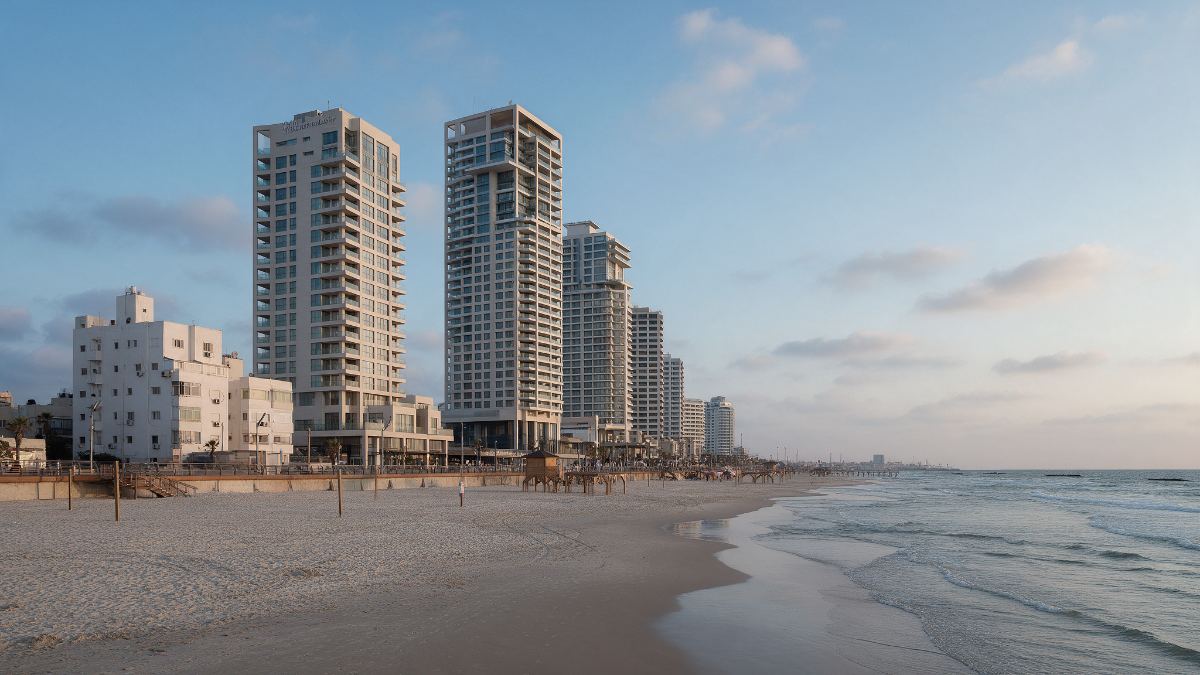
Buying an apartment in Bat Yam: 2026 prices by neighbourhood, seafront towers and urban renewal
Bat Yam is the seafront next door to Tel Aviv: a dense city of about 130,000 people that begins where Jaffa ends, with a 3.2 km promenade, six beaches and the Red Line light rail running north into central Tel Aviv. It is also one of Israel’s biggest urban renewal sites, ranked second in the country for pinui-binui permits in 2025, and one of the few central-Israel cities where prices fell over the past year (−2.5%). For a buyer that means a market with supply, discounts and room to negotiate. This guide gives real prices by neighbourhood, what is being built, the security questions to ask, and what the purchase costs as a non-resident, an oleh or a resident.
Bat Yam in four figures
The median square metre on declared deals is ₪29,054 (Tax Authority, 12 months to June 2026), with neighbourhood ranges from about ₪23,000 to ₪40,000; prices are −2.5% over a year (CBS, Q1 2026); gross rental yields are 3 to 3.8%; and the city has about 129,500 residents on 8 km², one of the highest densities in Israel. A 3-room sells for a median ₪1.78M, a 4-room ₪2.5M. On a new 3-room at ₪2,600,000, a non-resident pays ₪208,000 of purchase tax, a resident buying their only home ₪25,538, a new immigrant ₪3,106.
Prices by neighbourhood (observed ranges, 2026)
Bat Yam is compact: about 3 km along the sea and 3 km inland. Three things set the price. The distance to the sea comes first: the towers on the front line and in Park HaYam trade at the top of the market. Then the age of the building: about 73% of the apartments sold last year were in buildings put up before 1980, mostly four-storey blocks without an elevator or a safe room. Finally, the renewal status: a block inside an approved pinui-binui compound sells above an identical one that is not.
| Neighbourhood | ₪/m² resale | ₪/m² new | Profile |
|---|---|---|---|
| Park HaYam (southwest) | 28,000–34,000 | 31,000–37,000 | The city’s flagship: towers of 20 to 45 floors between the beach and Begin Road, about 1,900 occupied units and 4,000 more planned. Median about ₪31,200 per m² over the past year; front-line, high-floor listings ask ₪40,000–44,000. |
| Seafront and northwest (Ben Gurion Boulevard) | 27,000–34,000 | 32,000–38,000 | Older towers and 1970s-90s buildings along the promenade, closest to Jaffa: pieds-à-terre, sea views, strong short- and long-term rental demand. |
| Centre (Balfour, Rothschild, HaAtzmaut, Yoseftal) | 25,000–31,000 | 30,000–35,000 | Shopping streets, the market and the light rail: 1960s-80s stock, renovated units, and the big North Bat Yam renewal plan around the Ha’Atzmaut station. |
| Ramat HaNasi (west) | 24,000–30,000 | 29,000–34,000 | Residential district near the Yoseftal station, several large compounds under renewal (including Almog’s 964-unit “29 November” project). |
| Ramat Yosef, Amidar, Vatikim (east and south) | 23,000–28,000 | 28,000–33,000 | The city’s entry price, a few percent below the city average: older housing blocks, families, many buildings in the renewal queue. |
By size, the declared-deal medians tell the story more clearly than any average: a 3-room in a pre-1980 building sold for ₪1.74M (62 m²), the same in a post-2000 building ₪2.51M (78 m²); a 4-room ₪2.08M in the old stock against ₪3.11M in the new. Israeli listings quote gross area (walls, balcony, a share of common parts), and in towers the common areas (lobby, pool, gym) can add 10% to the area you pay for (see gross vs net square meters). Bat Yam against the other cities: Israel real estate prices city by city.
Who buys where, and why
Bat Yam is not an Anglo enclave, and English-speaking buyers here are mostly investors and pied-à-terre buyers who want the Tel Aviv beachfront lifestyle at a discount, or young olim who work in Tel Aviv and want the sea. Community infrastructure in English (synagogues, schools, services) is thinner than in Raanana or Modiin, but Jaffa and south Tel Aviv are minutes away. The city’s own buyers are Israelis priced out of Tel Aviv, Ramat Gan and Givatayim, and a large Russian-speaking community that settled in the city’s inland districts from the 1970s and especially the 1990s. French buyers, who have long favoured Netanya, increasingly look at Bat Yam as a cheaper seafront option close to Tel Aviv.
Four profiles dominate. The young couple working in Tel Aviv: a 3-room near the light rail for ₪1.6M to ₪2.2M, often in an older building with renewal potential. The family upgrading: a new 4-5 room in a pinui-binui project with a safe room and parking, ₪2.8M to ₪3.6M. The pied-à-terre buyer from abroad: a 3-4 room in a seafront or Park HaYam tower with a pool and a doorman, ₪2.4M to ₪4M, the price of a 2-3 room in central Tel Aviv. The renewal investor: an old apartment inside a compound already approved for pinui-binui, bought to be swapped for a new one years later.
For a buyer in the US, the UK, Canada or Australia, Bat Yam’s appeal is the combination of the sea, a 20-minute ride to central Tel Aviv and a market where developers negotiate. The steps for buying without living in Israel are in buying property in Israel from abroad, with country specifics in buying from the USA and buying from the UK.
Towers and urban renewal: where the new homes come from
Bat Yam has no free land, so new homes come from two sources. The first is Park HaYam, a new quarter of 20- to 45-storey towers in the southwest, built partly around a rehabilitated former waste hill, where about 1,900 apartments are occupied and over 4,000 more are planned, for some 15,000 residents by 2040. Prices there rose early, before 2022, then stalled: the typical apartment fell from about ₪3.77M in June 2025 to ₪3.26M in June 2026 as new owners resold and phases competed with each other. In late 2025 developers were offering a ₪200,000 discount in one project and 15/85 or 10/90 payment schedules in others.
The second is pinui-binui, at a scale few cities match. In 2025 Bat Yam ranked second in Israel, behind Jerusalem, with permits for 1,766 units in three plans (Government Authority for Urban Renewal). The pipeline is bigger still: in May 2025 the national committee for preferred housing advanced a plan for about 4,600 new units in North Bat Yam, replacing some 1,600 existing ones over 16 hectares around the light rail’s Ha’Atzmaut station; in Ramat HaNasi, Almog’s “29 November” compound will replace 224 apartments with 964 in towers of 25 to 37 floors, and an earlier plan near the Yoseftal station replaces 424 apartments with 1,728. The smaller route, building-by-building renewal (TAMA 38 and its successors), has practically stopped: one permit request in 2025, against 16 in 2024, and no local replacement plan yet.
The national rules apply to every off-plan purchase: a bank guarantee under the Sale Law for each payment, indexation to the construction cost index on at most 40% of the price for contracts since July 2022, delays of 6 to 12 months common, with compensation from the second month. In pinui-binui, add the residents’ signatures and permits: 4 to 6 years from signing to keys is normal on a project already permitted, much longer on one that is not. Details: buying off-plan from a developer and pinui-binui and TAMA 38.
Buying in Bat Yam by status
Non-resident
tax 8%- Financing 50% as a rule.
- On ₪2,600,000: mas rechisha ₪208,000.
- Loan up to ₪1,300,000, payment ≈ ₪7,337 over 25 years.
Resident, only home
tax 0 → 5%- Financing up to 75%.
- On ₪2,600,000: mas rechisha ₪25,538.
- Loan up to ₪1,950,000, payment ≈ ₪11,005 over 25 years.
New immigrant (oleh)
tax ≈ 0.1%- Financing up to 75%.
- On ₪2,600,000: mas rechisha ₪3,106.
- Saving of ₪204,894 compared with a non-resident.
A resale 3-room at the city median of ₪1,780,000 sits below the ₪1,978,745 threshold: a resident buying their only home pays ₪0, an oleh likewise nothing, while a non-resident or an investor with another property pays ₪142,400. The oleh schedule covers purchases signed from one year before aliyah to seven years after it, until 15 January 2028; a non-resident who becomes resident within two years of buying is reclassified and claims back the difference. Brackets and cases are in the purchase tax in 2026; aliyah benefits in buying as a new immigrant.
Breakdown by bracket
| Bracket | Rate | Tax |
|---|
Brackets of 16 January 2025, frozen until 15 January 2028 (Arrangements Law). A non-resident is taxed as an additional-home buyer unless they become an Israeli resident within two years of the purchase. Payment is due within 60 days of signing.
Full budget: a new 3-room tower apartment in Park HaYam
| Price | ₪2,600,000 |
| Indexation of at most 40% of the price (legal cap) to the construction cost index, ≈ 3% a year over 2 years | ≈ ₪62,000 |
| Mas rechisha (8%) | ₪208,000 |
| Buyer’s lawyer (0.5 to 1% + VAT) + capped share of the developer’s legal fees | ≈ ₪25,000 |
| Mortgage broker, appraisal, bank fees, insurance | ≈ ₪18,000 |
| Translations, power of attorney, apostille, wires | ≈ ₪6,000 |
| Total cost | ≈ ₪2,919,000 (+ 12.3%) |
| Mortgage at 50%, funded at delivery | ₪1,300,000 → ≈ ₪7,337 / month over 25 years |
| Cash to plan for | ≈ ₪1,619,000 (≈ $512,000) |
No agency fee on a new build bought from the developer: that is 2% + VAT saved compared with a resale. In exchange, indexation to the madad is the line buyers forget; the law caps the indexed base at 40% of the price (never the 20% paid at signing) and stops it at the contractual delivery date, and in a buyer’s market like Bat Yam you can often negotiate a lower share or an indexation holiday. Ask too for the monthly service charges in writing: in towers with a lobby, pool and gym they are a real cost against the rent. The same apartment bought by an oleh carries ₪3,106 of tax instead of ₪208,000, with 75% financing.
Transport, schools, security: the Bat Yam realities
Transport. The Red Line of the Tel Aviv light rail, open since August 2023, starts at HaKomemiyut in Bat Yam and runs through Jaffa and central Tel Aviv to Petah Tikva, every few minutes at peak; central Tel Aviv is about 20 minutes away. Bat Yam also has two Israel Railways stations, Yoseftal and Komemiyut, opened in 2011. The M3 metro line, whose public opening is scheduled for 2037, will pass through southern Bat Yam and meet the Red Line at Yoseftal. Streets near the stations have already priced in some of that access; check whether your street is inside a future works zone.
Schools and services. Bat Yam’s high schools post strong results for a city with modest incomes: 86.3% of students were eligible for the bagrut in 2017, against 68.2% nationally. Hospitals and universities are in Tel Aviv and Holon, 10 to 25 minutes away.
Security. On 15 June 2025 an Iranian ballistic missile hit residential buildings in Bat Yam, killing nine people; about 60 buildings were damaged, several had to be demolished and hundreds of residents were displaced. A mamad has been mandatory in new buildings since 1992, but most of the city’s stock is older and relies on a shared shelter in the basement or nearby. Check where the protected space is and how long it takes to reach it; a renewal project that adds safe rooms adds value. For remote owners: what happens to my mortgage in a war.
The sea, and its cost. Salt air wears façades, windows and air-conditioning units on the first lines quickly. Ask the vaad bayit (building committee) about planned works and the reserve fund, and check for unpermitted additions in 1950s-70s blocks (closed balconies, rooftop rooms, split apartments) before you sign.
Rental yield: decent in the old stock, thin in the towers
Rents are high for the price level because Bat Yam rents to people who work in Tel Aviv. Yad2 asking rents in September 2026 were ₪5,650 for a 3-room, ₪6,400 for a 4-room and ₪8,950 for a 5-room, with about 1,250 apartments on offer. Against median deal prices that gives gross yields of 3.8%, 3.1% and 3.0%. The sweet spot is a small older apartment near the light rail; the weakest is a large new tower unit, where Park HaYam yields come out around 2.9% before service charges. A non-resident is taxed on the rent, often under the 10% flat-rate track on gross rent: see rental income tax in Israel and rental yield by city.
Professionals on the ground
In Bat Yam and neighbouring Holon and Jaffa you will find real estate lawyers who handle renewal contracts and Israel Land Authority leases, mortgage brokers used to non-resident and oleh files, agencies that know which blocks are in which renewal compound, and developers’ sales teams for the seafront and Park HaYam towers, many of them working in English. We select them on three criteria: real estate specialisation, independence from sellers and developers, and experience with remote transactions. What a lawyer checks and charges is in the real estate lawyer in Israel.
Nearby and for comparison: Tel Aviv, next door and roughly twice the price per m²; Ashdod, seafront towers and new builds further south; Netanya, the sea and an established Anglo community; Haifa, the cheapest big city on the sea; or all the cities we cover.
Frequently asked questions
How much does an apartment cost in Bat Yam in 2026?
On the 1,178 deals declared to the Tax Authority between July 2025 and June 2026, the median was ₪1.78M for a 3-room, ₪2.5M for a 4-room and ₪3.6M for a 5-room. A 4-room in a pre-1980 building sold for a median ₪2.08M; a 4-room built after 2000, ₪3.11M. In the Park HaYam towers, 4-rooms closed at a median of about ₪3.33M over the past year.
How much does a square metre cost in Bat Yam?
The median of all declared deals over the 12 months to June 2026 is ₪29,054 per m². By neighbourhood, observed ranges run from about ₪23,000 in the older eastern and southern districts to ₪40,000 and more for high floors facing the sea; Park HaYam’s median is about ₪31,200. Next door in Tel Aviv the same square metre costs ₪45,000 to ₪90,000.
Why are prices falling in Bat Yam?
Supply. Thousands of tower and pinui-binui apartments are on the market at once, many residents of newly delivered buildings are reselling, and developers compete with discounts and light payment schedules. The CBS shows −2.5% over a year in Q1 2026; in Park HaYam the typical price fell about 13% between June 2025 and June 2026. It is a buyer’s market: negotiate.
Is it worth buying an old apartment slated for pinui-binui?
It is the classic Bat Yam strategy: buy a 3-room in a 1960s-70s block and receive, years later, a larger new apartment with an elevator, a safe room and parking. Bat Yam pushes large compound projects (thousands of units around the light rail stations) and TAMA 38 has practically stopped there, so the timeline is long: 5 to 10 years from signatures to keys is common. Buy only after your lawyer has checked the plan and permit status and the developer’s solidity.
Was Bat Yam hit during the war with Iran?
Yes. On 15 June 2025 an Iranian ballistic missile struck residential buildings in Bat Yam, killing nine people; about 60 buildings were damaged and several had to be demolished. The lesson for buyers is practical: about seven in ten apartments sold in the city are in pre-1980 buildings, which rely on shared shelters rather than an in-apartment safe room (mamad). A mamad is now a real selling point.
What rental yield can I expect in Bat Yam?
About 3 to 3.8% gross. Yad2 asking rents in September 2026 were ₪5,650 for a 3-room, ₪6,400 for a 4-room and ₪8,950 for a 5-room; on median deal prices that gives 3.8%, 3.1% and 3.0%. Small older apartments near the light rail do best; new towers with high service charges do worst (about 2.9% in Park HaYam).
How we work
Every amount, bracket and rate on this page is checked against the official source listed at the bottom and dated. When a schedule or rate changes, the page is updated within days. Our methodology.
Sources
- Central Bureau of Statistics – price changes by city, Q1 2026 (via Buyitinisrael, 15 May 2026)
- Klika Nadlan – Bat Yam 2026: 1,178 Tax Authority deals (Jul 2025–Jun 2026), medians by build year, Yad2 rents
- Bizportal – Park HaYam: deals, median per m², −13% in a year (6 Aug 2026)
- ice.co.il – Park HaYam: new-project prices, deals and developer incentives (30 Dec 2025)
- Klika Nadlan – Government Authority for Urban Renewal, 2025 summary (31 May 2026)
- Nadlan Center – building-renewal permit requests in 2025 (2 Jun 2026)
- The Jerusalem Post – North Bat Yam renewal plan: 4,600 units around the Ha’Atzmaut station (5 May 2025)
- The Jerusalem Post – Almog’s “29 November” compound in Ramat HaNasi (16 Apr 2025)
- The Canadian Jewish News – Iranian missile strike on Bat Yam (June 2025)
- Israel Tax Authority – mas rechisha brackets 2026
- Bat Yam Municipality – urban renewal
Your Bat Yam project, with the right people
Agency, developer, mortgage broker or lawyer: tell us the area (seafront, Park HaYam, the centre, a specific renewal compound), your budget and timeline, and we pass it to an English-speaking professional who works Bat Yam every day.