Buying an apartment in Eilat: prices by neighbourhood, the VAT exemption and holiday homes
Eilat is the only city in Israel where a new apartment is sold without VAT, where residents who work locally get 10% off their income tax, and where a 3-room flat a few minutes from the Red Sea still trades for ₪1.1M to ₪1.7M. It is also 350 km from Tel Aviv, served by an airport 18 km out of town, dependent on tourism, and within range of Houthi drones. This guide sorts out what the free-trade zone really changes for a buyer, gives price ranges by neighbourhood from recorded deals, and explains how holiday-home owners, investors and future residents should approach the market.
Eilat in four figures
₪12,000 to ₪31,000 per m² depending on the neighbourhood and the age of the building (recorded deals 2024–2026); average apartment price of about ₪1.65M to ₪1.75M; 0% VAT on the sale of a new apartment, against 18% everywhere else; about 56,000 residents (CBS, 2024), 350 km from Tel Aviv. A small, tourism-driven market where most buyers are Israelis from the centre and the north looking for a holiday home or a "safe" second address, plus local families moving into the new northern neighbourhoods.
What the VAT-free zone changes, and what it does not
Eilat has been a free-trade zone since 1985. Most visitors know it for duty-free shopping, but for a property buyer three separate mechanisms matter, and they are often confused.
1. The sale of real estate is VAT-exempt. Section 5(d) of the Eilat Free Trade Zone Law exempts from VAT "the sale of real estate located in the Eilat area", defined as the city’s municipal boundaries. Unlike the rules on goods, it does not depend on the seller or the buyer being an Eilat resident: a Tel Aviv developer selling to a buyer from Paris or New York is exempt as long as the land is inside the city. The courts have read the boundary strictly: Kibbutz Eilot, a kilometre north, lost its case in the Beersheba District Court (2010) and in the Supreme Court (2012). For a resale between private individuals, nothing changes, since there is no VAT on a private sale anywhere in Israel. The exemption matters for new builds.
2. Services supplied in Eilat by an Eilat business are VAT-exempt. The Tax Authority confirmed it in a 2014 professional decision (4587/14): a dealer resident in the Eilat area who supplies a service in the area charges no VAT, to residents and non-residents alike. For a buyer, that means a lawyer, an agent, an appraiser or a contractor based and working in Eilat bills without the 18% VAT, while the same service from a Tel Aviv office is billed with it. On a ₪2.3M purchase, that is the difference between about ₪19,000 and ₪23,000 in legal fees.
3. Residents get an income-tax reduction. Section 11 of the same law grants individuals living in Eilat a 10% reduction on taxable income from work earned in the Eilat area, up to ₪268,560 of income in 2026, or up to ₪26,856 of tax saved per earner per year. It does not apply to rental income, investment income or a salary earned elsewhere, and it requires real residence: the Tax Authority checks the centre of life, and the municipality issues the residence certificate.
What the free-trade zone does not change: the purchase tax (mas rechisha) follows the national brackets, 8% from the first shekel for a non-resident or a second home; the Bank of Israel’s loan-to-value limits are the same (75% for a first home, 50% for investors and non-residents); capital gains tax on resale (mas shevach) follows the national rules; arnona is set by the municipality like anywhere else.
Does the exemption show up in prices? Partly. Outside Eilat, about ₪351,000 of a ₪2.3M new-build price is VAT. In Eilat that line does not exist, but the price is set by what buyers pay, not by cost plus tax: new builds trade at ₪20,000 to ₪31,000 per m², more than Beer Sheva or Dimona, about as much as the North Sharon. The honest reading is that the exemption makes building in Eilat viable despite high construction costs (materials trucked 350 km, labour, seismic standards) and leaves buyers a better price than the same apartment would carry with VAT, without making Eilat cheap.
Prices by neighbourhood (observed ranges, 2024–2026)
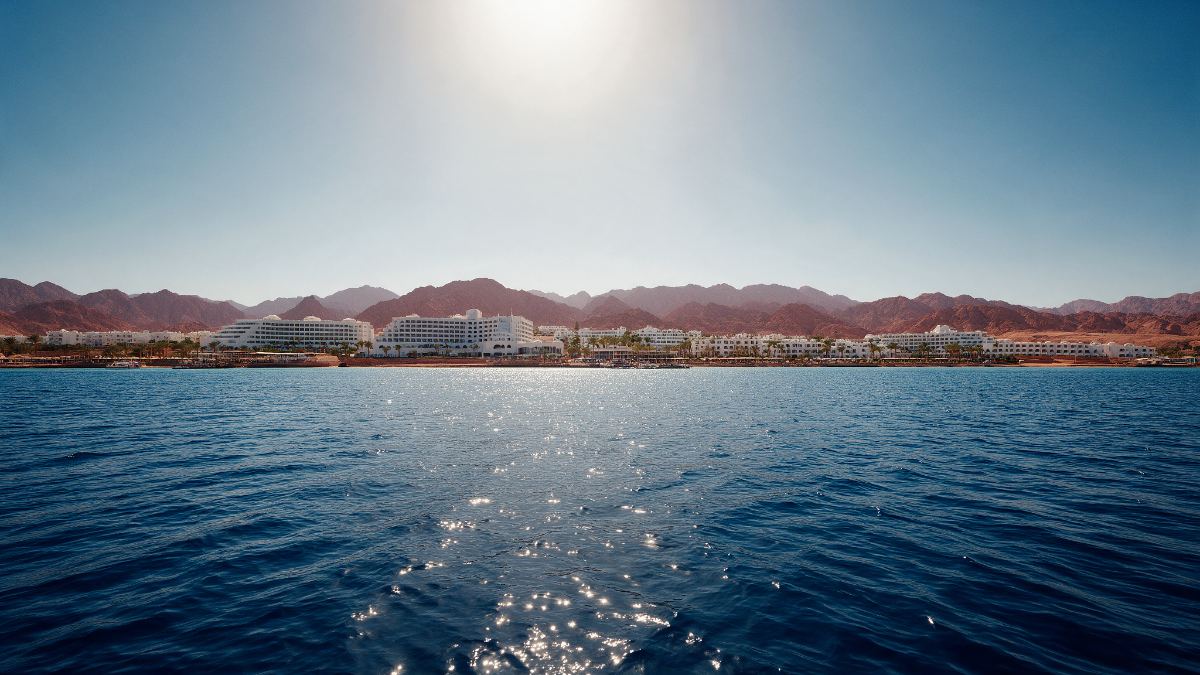
Eilat climbs from the Gulf towards the mountains: the hotel strip and the North Beach on the sea, the 1960s-80s neighbourhoods on the first slopes, the newer districts of Shachamon and Rova HaSade higher up and to the north, and Shifulei HaHar under construction at the foot of the mountains. The newer and higher, the more expensive; sea views add a premium, especially in Shachamon.
| Neighbourhood | ₪/m² resale | ₪/m² new | Profile |
|---|---|---|---|
| Shachamon | 17,000–24,000 | 23,000–31,000 | The upscale north-west: villas, 8-floor buildings and towers up to 20 floors, many with sea views; about 19,600 residents. Garden apartments sold at ₪29,800–31,500 per m² in 2025, a cottage at ₪6.5M (≈ ₪32,800 per m²), the city’s record for a decade. |
| Rova HaSade (former airport) | — | 22,000–28,000 | The new district on the old city airport, closed in 2019: about 1,600 homes and 2,750 hotel rooms planned, central location. Part of the land went to reduced-price programmes for eligible Israelis. |
| Shifulei HaHar | — | 20,000–28,000 | New northern neighbourhood towards Eilot, about 2,680 homes, low density, desert views, first deliveries from 2027. Boutique projects with a pool sold at ₪23,000–24,000 per m², small 3-rooms near ₪28,000. |
| North Beach, hotel area, lagoon | 19,000–25,000 | — | Holiday apartments and serviced residences near the promenade; a 3-room of 78 m² from 2018 sold for ₪1.66M in 2026. Check the planning designation: some buildings are hotel apartments with their own rules. |
| Mitzpe Yam | 12,500–19,000 | ≈ 20,000 | Next to Shachamon, early-1990s buildings and cottages; 4-rooms of 75-105 m² at ₪1.3M to ₪2.1M in 2026. |
| Ganim A and B | 12,000–17,000 | 24,000–27,500 | Garden neighbourhoods of the late 1980s and early 1990s, ground-floor apartments and villas; a few small new buildings sold above ₪24,000 per m² in 2024-2025. |
| Amdar, Bneh Beitcha (south) | 4-room ≈ ₪2M | Near the southern beaches and hotels, self-built houses and a TAMA 38 project; about 315 homes under construction or planned; weak public transport. | |
| Ofir, Arava, HaDekel, Tzofit, Yaelim, Urim, centre | 14,000–20,000 | — | 1960s-80s blocks, the city’s entry price: 3-rooms of 60-75 m² at ₪1M to ₪1.3M. The pinui-binui pipeline is here (Yaelim, Tzofit, Barnea in HaDekel, Paran in Arava). |
In Israel the price per m² is quoted on gross area (walls included, often the balcony and a share of common areas): a listing at 100 m² is about 85-90 m² of usable space in the US or UK sense (900-970 sq ft). In Eilat, ask whether the figure includes a roof terrace or a covered pergola, which are common and sometimes unregistered (see gross vs net square meters). Eilat against the other cities: Israel real estate prices city by city.
Who buys in Eilat, and why
Eilat is not Netanya or Raanana: there is no large English-speaking community, no Anglo synagogue network, and foreign buyers are a small minority. Most transactions involve four kinds of Israeli buyer, and understanding them tells you what will resell.
Holiday-home buyers from the centre and the north, who want a 3-room apartment for weekends and holidays, and since 2023 a second address far from the northern border and the Gaza envelope. Bizportal (August 2026) lists this "safe house" demand among the drivers of prices, along with the VAT exemption. Investors, who buy small units to let to tourists or to the city’s hotel and service workers. Local families moving up from the older blocks to Shachamon, Rova HaSade or Shifulei HaHar, for whom the 10% income-tax reduction is part of the budget. And retirees and remote workers attracted by the winter climate, with the summer heat (often above 40°C) as the trade-off.
For an English-speaking buyer, Eilat makes sense in two cases: a holiday apartment you will use between November and April, when the rest of Israel is cold and wet, or a move by a family whose work is in Eilat (tourism, hospitality, diving, the hospital, the port, remote work). It is a poor choice for aliyah if you need English-language schools, community institutions or quick access to Tel Aviv or Jerusalem.
Holiday homes and short-term lets: the local rules
Eilat is the Israeli city where short-term letting is most part of the economy. AirROI counted about 1,180 active listings over November 2025 to October 2026, with an occupancy rate of 27.7% and average revenue of about ₪91,700 a year per listing; the average is pulled up by villas with pools, and a standard 3-room earns well below it. Seasonality is the opposite of the coast: August earns about 3.8 times January, and the winter holidays fill the city with Israelis rather than foreign tourists.
What applies, in practice:
- No licence, but no right either. Israel has no registration or licence for short-term rentals. An apartment permitted for residential use is not permitted for hotel-type use, and courts elsewhere (Tel Aviv 2025, Hadera 2024) have granted injunctions when neighbours or the planning committee objected. Some Eilat projects are built as hotel or serviced apartments, with an operator and their own rules: check the planning designation (taba) and the permit.
- The building decides. Registered bylaws (takanon) can forbid letting by the night, and a new tower often does. Ask for them before you sign, and ask the vaad bait how it handles guests, the pool and the lifts.
- Tax: a business, not rent. The Tax Authority treats short-term letting as business income: no ₪5,654 monthly exemption and no 10% flat rate for residential rent, the progressive brackets on the net profit instead. It opened a criminal investigation in June 2025 into an Eilat villa owner suspected of not declaring about ₪1.3M over ten years.
- VAT: it depends who you are. A service supplied in Eilat by an Eilat-resident business is VAT-exempt (decision 4587/14). An owner living in Tel Aviv or abroad who lets nightly is not obviously in that position: get an accountant’s written opinion before you assume 0%.
- Arnona. Ask the municipality how the unit is classified, and whether letting it changes the rate, before you build your yield on it.
The safer middle road is the furnished medium-term let (a few months, to workers or families relocating to Eilat), which stays a residential lease, combined with personal use in winter. The full rules are in short-term rentals and Airbnb in Israel.
New neighbourhoods in the north, urban renewal in the centre
Eilat still has land, which is rare in Israel. The new stock comes from three places. Shachamon, built since the 1990s, keeps adding projects in its east and north-west (about 930 homes on the market or under construction in 2024, around eleven developers). Rova HaSade, on the old airport closed in March 2019, mixes housing, hotels and retail in the middle of the city. Shifulei HaHar, at the foot of the mountains towards Kibbutz Eilot, was sold in Israel Land Authority tenders between 2022 and 2024 and plans about 2,680 homes next to a future golf course. Further out, the plans include a district on the former salt ponds (about 3,600 homes) and one on the naval base by the Gulf (about 1,750 homes and 750 hotel rooms).
In the older neighbourhoods, pinui-binui has started: the Southern District Committee approved the first plan for deposit in September 2025 in Yaelim (75 old apartments replaced by 216, including a tower of up to 29 floors), followed by plans in Tzofit (92 → about 400) and two other sites of 118 → 454 and 104 → 500 homes, with Barnea (HaDekel) and Paran (Arava) at the District Committee. The towers are tall because many older buildings sit in a seismic risk zone along the Rift. These are long projects: buying into one is a bet on a decade, not a delivery date (see pinui-binui and TAMA 38).
Off-plan, the usual protections apply: Sale Law bank guarantee on every payment, indexation of at most 40% of the price to the construction cost index for contracts since July 2022, and compensation for late delivery. Some Eilat developers advertise 15/85 schedules with the price fixed at signing and no indexation; read the contract, not the brochure.
The VAT exemption covers the land and the building inside the city limits. A project marketed "near Eilat" or in the Eilot regional council is not covered. Ask the lawyer to confirm the parcel (gush and helka) is within Eilat’s municipal boundaries.
Buying in Eilat by status
Resident, only home
tax 0 → 3.5%- Financing up to 75%.
- On ₪2,300,000: mas rechisha ₪11,244.
- If you live and work in Eilat: up to ₪26,856 a year less income tax per earner.
Non-resident, or Israeli buying a holiday home
tax 8%- Financing 50% as a rule.
- On ₪2,300,000: mas rechisha ₪184,000.
- No VAT on a new build, but no income-tax benefit.
New immigrant (oleh)
tax ≈ 0.1%- Financing up to 75%.
- On ₪2,300,000: mas rechisha ₪1,606.
- Saving of ₪182,394 compared with a non-resident.
The free-trade zone helps everyone on the VAT, but only residents on income tax. For a non-resident buying a holiday apartment, the purchase tax at 8% from the first shekel is the biggest single cost after the price, exactly as in Tel Aviv. An Israeli who already owns a home and buys in Eilat pays the same 8% on a "dira nosefet": the VAT saving on a new build does not offset it. An oleh buying a first home within a year before or seven years after aliyah pays almost nothing up to ₪6M; the full brackets are in Israel’s purchase tax and the other benefits in buying as a new immigrant.
Breakdown by bracket
| Bracket | Rate | Tax |
|---|
Brackets of 16 January 2025, frozen until 15 January 2028 (Arrangements Law). A non-resident is taxed as an additional-home buyer unless they become an Israeli resident within two years of the purchase. Payment is due within 60 days of signing.
Full budget: a new 4-room apartment, non-resident buyer
| Price (no VAT: Eilat Free Trade Zone Law, s. 5(d)) | ₪2,300,000 |
| Indexation of at most 40% of the price to the construction cost index, ≈ 3% a year over 2 years | ≈ ₪56,000 |
| Mas rechisha (8%) | ₪184,000 |
| Buyer’s lawyer based in Eilat (≈ 0.6%, no VAT) + capped share of the developer’s legal fees | ≈ ₪19,000 |
| Mortgage broker, appraisal, bank fees, insurance | ≈ ₪16,000 |
| Translations, power of attorney, apostille, wires | ≈ ₪6,000 |
| Total cost | ≈ ₪2,581,000 (+ 12.2%) |
| Mortgage at 50%, funded at delivery | ₪1,150,000 → ≈ ₪6,490 / month over 25 years |
| Cash to plan for | ≈ ₪1,431,000 (≈ $453,000) |
Three Eilat-specific lines. The price carries no VAT, which outside Eilat would be about ₪351,000 of the same price. A lawyer based outside Eilat would bill about ₪23,000 with VAT instead of ₪19,000. And the purchase tax is untouched: ₪184,000 for a non-resident, against ₪11,244 for a resident buying a first home and ₪1,606 for an oleh. Furnishing and air-conditioning for a holiday let (₪60,000 to ₪120,000 for a 4-room) come on top. The same apartment bought by a resident family with 75% financing needs a loan of ₪1,725,000, about ₪9,736 a month over 25 years. Run your own figures with the purchase tax calculator and the mortgage calculator.
Distance, Ramon airport, security: the realities
Distance. Eilat is about 350 km from Tel Aviv and 310 km from Jerusalem, four hours or more by road via Route 90 or Route 12. There is no train: the northern section of the Eilat railway is still in early planning and the southern extension is estimated at about ₪30 billion. Buyers who expect to "pop down for the weekend" from the centre usually fly.
Ramon airport. The city airport closed in March 2019 and its land is becoming Rova HaSade. Flights now use Ramon International Airport at Timna, 18 km north, opened in January 2019: about 25 minutes by car, close to an hour by public transport. Domestic flights to Tel Aviv and Haifa are run by Arkia, Israir and airHaifa; international low-cost traffic has been irregular since 2023. On 7 September 2025 a Houthi drone hit the passenger terminal, injuring two people.
Security. Since late 2023 Eilat has been a target of drones and missiles from Yemen, intercepted for the most part, with further attacks claimed in March 2026. The port, cut off by the Red Sea blockade, declared bankruptcy in July 2024, and the mayor reported unemployment rising from 3.4% to 14% in 2024 as tourism collapsed. For a buyer, that means a mamad (safe room) is not optional, older blocks without one are harder to let and to sell, and the local economy is more cyclical than the centre’s.
Services. Yoseftal, the only hospital, has a chronic shortage of specialists despite state incentives, and for several specialities patients travel to Beer Sheva. Schooling is in Hebrew; check the options for English-speaking children before you move. The outlet and the VAT-free shops draw about 150,000 visitors on weekends, and a new central bus station with a 29,000 m² mall is being built.
Rental yield: yearly lease versus holiday let
On a yearly lease, rents in November 2026 average about ₪4,760 a month for a 3-room and ₪6,460 for a 4-room (Realta listings), from about ₪3,500 in Arava, Ofir or Yaelim to ₪7,500 and more in Shachamon. Set against recorded prices, that gives a gross yield of about 3 to 3.5% on new apartments and up to about 4% on small older units (our calculation from Madlan deals and Realta rents). Bizportal puts the city average near 3%. Deduct the vaad bait, maintenance in a harsh climate (air-conditioning, waterproofing) and, for a pool building, higher charges.
Holiday letting can do better in gross terms, but with 27.7% average occupancy, a manager at 15 to 25% of revenue plus cleaning, business taxation and the security risk, the net often ends up close to a well-run yearly lease. Model both before you buy; the tax side is in rental income tax in Israel.
Professionals on the ground
Eilat has a smaller professional market than the centre, and fewer English-speaking specialists. Two practical points: an Eilat-based lawyer or agent bills without VAT, and a local appraiser knows which buildings have unregistered additions or seismic issues. For a remote purchase, many buyers pair a local agent with a lawyer experienced in non-resident files and powers of attorney, wherever that lawyer is based. We select professionals on three criteria: real estate specialisation, independence from sellers, and experience with buyers who do not live in Eilat.
To compare: Tel Aviv, Jerusalem, Ashdod, Beer Sheva.
Flying in for viewings in Eilat? Whether you land at Ramon Airport or drive down from the centre, the rental rules are specific to the city. Prices and insurance, on our sister site ChulGuide: car rental in Eilat.
Frequently asked questions
Is a new apartment in Eilat really VAT-free?
Yes. Section 5(d) of the Eilat Free Trade Zone Law (1985) exempts from VAT the sale of real estate located within the city’s municipal boundaries, whoever the seller and whoever the buyer. The courts have read it strictly: land just outside the city, such as Kibbutz Eilot, does not qualify (Supreme Court, 2012). Purchase tax, the mortgage rules and arnona are not affected.
Does the VAT exemption mean new builds in Eilat are 18% cheaper?
No. The exemption lowers the developer’s tax bill, but the selling price is set by the local market: new builds trade around ₪20,000 to ₪31,000 per m², above most of the Negev and close to the North Sharon. Outside Eilat, about ₪351,000 of a ₪2.3M new-build price is VAT; in Eilat that line does not exist, which is one reason developers can build there at all.
What is the average price of an apartment in Eilat in 2026?
About ₪1.65M to ₪1.75M across all stock (Madlan, November 2026; Bizportal, August 2026). An older 3-room in Ofir or Arava sells for ₪1M to ₪1.3M; a new 4-room in Rova HaSade or Shachamon for ₪2.1M to ₪2.6M; villas in Shachamon reached ₪6.5M in 2025, the city’s record for a decade.
Can I let my Eilat apartment on Airbnb?
Many owners do: about 1,180 active listings in 2025–2026. But there is no licence, an apartment permitted for residential use is not permitted for hotel use, and a building’s bylaws can forbid it. The Tax Authority treats short-term letting as a business, and opened a criminal investigation into an Eilat villa host in 2025. Check the permit, the bylaws and the tax set-up before you buy for that purpose.
Who gets the Eilat income-tax benefit?
Individuals who actually live in Eilat (their centre of life) get a 10% reduction on taxable income from work earned in the Eilat area, up to ₪268,560 of income a year in 2026, so at most ₪26,856 a year. Rental income, interest and income earned elsewhere do not count. A holiday-home owner who lives in Tel Aviv or abroad does not get it.
Is it hard to resell in Eilat?
Slower than in the centre. The market is small (962 recorded purchases in 2024, 808 in 2023), buyers are mostly Israeli, and demand swings with tourism and security. Liquid units are 3-4 room apartments with a mamad and parking in Shachamon, Rova HaSade and Mitzpe Yam; plan for several months to sell.
How we work
Every amount, bracket and rate on this page is checked against the official source listed at the bottom and dated. When a schedule or rate changes, the page is updated within days. Our methodology.
Sources
- Eilat Free Trade Zone Law (Exemptions and Discounts from Taxes), 5745-1985, s. 5(d) — Supreme Court, Kibbutz Eilot v. VAT Director, CA 3067/11 (Capitax summary, 20 Nov 2012)
- Bizportal – VAT exemption on Eilat real estate does not extend to Eilot, Beersheba District Court (18 Jan 2011)
- Israel Tax Authority, professional decision 4587/14 – services supplied in Eilat by an Eilat dealer are VAT-exempt (Capitax)
- Capitax – 2026 tax figures: Eilat resident reduction 10% up to ₪268,560 (April 2026)
- Bizportal – Eilat, the southernmost city, competing with central prices: average ₪1.75M, records in Shachamon, urban renewal (3 Aug 2026)
- Madlan – Eilat: average price, rents and recorded transactions (November 2026)
- Calcalist – Shifulei HaHar tender results; Shachamon and Mitzpe Yam price per m² (18 Dec 2023)
- Bizportal – target-price tender in Shifulei HaHar, prices of the Cyan project (20 Jun 2024)
- Nadlan Center – Shachamon neighbourhood index and Eilat’s future districts (26 Mar 2024)
- Nadlan Center – Amdar neighbourhood index; Eilat deals 2023–2024 (7 Mar 2025)
- Realta – Eilat rents by neighbourhood and size (November 2026)
- AirROI – Eilat short-term rental data, Nov 2025–Oct 2026
- Bizportal – Tax Authority investigation into an Eilat villa host (12 Jun 2025)
- Ramon Airport – opening (Jan 2019), distance, drone strike of 7 Sep 2025
Your Eilat project, with the right people
Agency, developer, mortgage broker or lawyer: tell us the neighbourhood, budget, timeline and whether it is a home, a holiday apartment or an investment, and we pass it to a professional who works Eilat every day.