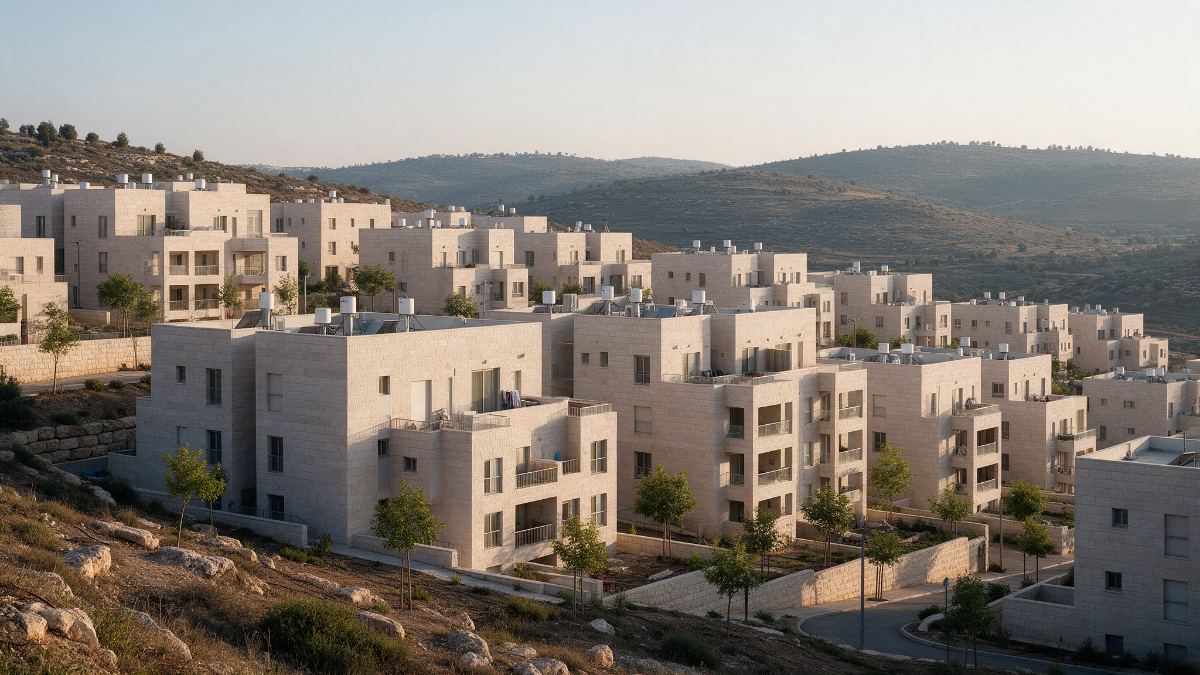
Buying an apartment in Beit Shemesh: prices by neighbourhood, Ramat Beit Shemesh, new builds and what to check
Beit Shemesh is where religious Anglo families land when Jerusalem stops adding up. Thirty minutes from the capital by car, an average apartment about 20% cheaper, whole neighbourhoods where the shul, the school run and the grocery all work in English, and a city that has grown faster than any other large Israeli city since 2017. It is also a majority-Haredi city with very different neighbourhoods a few hundred metres apart, a train that no longer runs to Jerusalem and a building programme that will add tens of thousands of homes. This guide gives the real price ranges by neighbourhood, what is being built, and how to buy depending on your status.
Beit Shemesh in four figures
An average apartment at 2,478,400 ₪ (≈ $784,000, CBS, Q1 2026), +3.1% in a year; ₪15,000 to ₪28,000 per m² depending on the neighbourhood, from the old town to the new buildings of Mishkafayim; about 20% below the Jerusalem average; around 180,000 residents, growing 5 to 7% a year, with an approved policy plan for up to 500,000. A 3.5–4 room apartment averages 2,455,900 ₪, a 4.5–5 room 3,095,900 ₪. The market is driven by large religious families, Haredi and Anglo, and by Israelis who can no longer afford Jerusalem.
Prices by neighbourhood (order of magnitude, 2026)
Beit Shemesh is two cities stuck together. The old town in the valley, built from the 1950s, with Givat Sharett, Sheinfeld and Nofei Aviv on the slopes to the west; and Ramat Beit Shemesh (RBS) on the hills to the south, built since the mid-1990s in lettered phases: Aleph, Bet, Gimmel, Dalet, then Neve Shamir and the extensions still on the drawing board. Prices follow three things: the community that lives in the neighbourhood, the age of the building, and whether you get a safe room (mamad), an elevator and parking.
| Neighbourhood | ₪/m² resale | ₪/m² new | Profile |
|---|---|---|---|
| Mishkafayim, Mem Gimmel (M3) | 21,000–26,000 | 24,000–28,000 | The upscale eastern edge of RBS Aleph, built from 2015: apartment blocks, duplexes and villas with views over the Judean foothills; Dati Leumi, Haredi and many Anglo families. 4 rooms ≈ ₪2.5–2.9M. |
| Ramat Beit Shemesh Aleph | 19,000–25,000 | 23,000–27,000 | About 25,000 residents, the historic heart of the Anglo religious community: dozens of English-speaking shuls, schools, shops, parks. Very little new stock; 5 rooms often ₪3.2–4.5M. |
| Neve Shamir | 20,000–24,000 | 22,000–26,000 | South of Mishkafayim, the main new-build neighbourhood: around 3,700 homes built or under way, 14 developers, area average about ₪23,000/m². New 4 rooms ≈ ₪2.3–2.6M; a boutique project asks ₪40,000/m². |
| Ramat Shilo | 18,000–22,000 | — | Small neighbourhood built from 2007 between RBS Aleph and the old town; mixed Dati Leumi and Haredi. |
| RBS Gimmel 1 and 2 (Kiryat Avi Ezri, Kiryat Ovadia) | 17,000–22,000 | 19,000–23,000 | Mostly Haredi, Lithuanian and Sephardi; large family apartments, some Anglo Haredi communities. |
| RBS Dalet, Ramat Avraham | 16,000–20,000 | 17,000–21,000 | Haredi neighbourhoods built in the 2010s-2020s (Shefa Chaim, Ayelet HaShachar). New 4 rooms in Ramat Avraham average ≈ ₪2.07M, about 10% under the city average. |
| RBS Bet | 15,000–19,000 | — | Mainly Hasidic; homogeneous community rules on dress and public space. |
| Sheinfeld, Nofei Aviv, Nofei HaShemesh, Givat Sharett | 16,000–22,000 | 22,000–25,000 | The older west side: Anglos since 1991, more houses and cottages (₪3.5–6.5M), a mixed religious and traditional population. Givat Sharett has a 3,500-home renewal plan. |
| Old town, Givat Savion, Ramat Lahi | 14,000–18,000 | 22,000–25,000 | The entry price: 1950s-80s blocks, often without a mamad, Israeli and 1990s-aliyah families; pinui-binui towers under way (Savion: ₪23,200/m² incl. VAT). |
In Israel the price per m² is quoted on gross area: walls included, often the balcony and a share of the common areas. A listing at 125 m² is 105-110 m² of usable space (about 1,150 sq ft). A "4-room" apartment is three bedrooms plus a living room; in RBS the typical 4-room is larger than in Jerusalem, 110 to 130 m² gross, which is why per-m² prices here look lower than the per-unit prices suggest (see gross vs net square meters). Beit Shemesh against the other cities: Israel real estate prices city by city.
Who buys where, and why
The first English speakers settled in Sheinfeld in 1991. From the late 1990s, Ramat Beit Shemesh Aleph became the main Anglo religious destination outside Jerusalem: families from New York, New Jersey, Baltimore, Toronto, London, Manchester and Johannesburg, mostly Orthodox, many of them working remotely or commuting to Jerusalem. Nefesh B’Nefesh counts "tens of thousands" of its olim in the city. Today that community runs many English-speaking shuls across RBS Aleph, kollels, youth movements, a dense network of doctors, therapists, accountants and lawyers who work in English, and it has spread east to Mishkafayim and Mem Gimmel and south to Neve Shamir, where most of the new buildings are.
Four logics overlap. Anglo olim families buy a 4-5 room apartment or a garden unit in RBS Aleph, Mishkafayim or Neve Shamir, within walking distance of their shul and the schools their children will attend. Haredi families, now the majority of the city, buy in RBS Bet, Gimmel, Dalet and Ramat Avraham, often in projects marketed to a specific community. Israeli families priced out of Jerusalem, religious and traditional, sell a 3-room in Kiryat HaYovel or Ramot and buy a new 4-room with a mamad here for roughly the same money. And investors from abroad, often buying for children who will make aliyah: in 2024 a group of modern Haredi families from New York and New Jersey bought 64 apartments in one urban renewal project in Givat Savion.
The practical consequence: in Beit Shemesh the street matters more than the neighbourhood name. Some buildings and blocks are homogeneous (Hasidic, Lithuanian, Dati Leumi, Anglo Haredi), with shuls, schools and expectations to match, and a buyer who does not fit will feel it. Before you sign, walk the street on a Shabbat, ask which shul the building belongs to and which schools the neighbours use. Local politics also matter: since March 2024 the city has been run by a Haredi mayor, Shmuel Greenberg (Degel HaTorah), who succeeded Aliza Bloch, and the municipality weighs heavily on how the new neighbourhoods are planned and for whom.
New neighbourhoods and urban renewal
Beit Shemesh is one of the few cities near Jerusalem with land, and the state uses it. In June 2026 the Jerusalem District Committee approved the city’s BS/3000 policy plan: about 66,000 new homes, a housing stock of 111,000 units and a city that could reach 500,000 residents, with heavy rail, light rail and rapid buses. What that means for a buyer in 2026-2030, project by project:
- Neve Shamir: the current new-build market for non-Haredi and Anglo families. Around 3,700 homes built or in construction, 14 developers, deliveries continuing to 2028. Prices for a new 4-room: ₪2.3–2.6M.
- RBS Hey 2: the state land tender of June 2024 sold plots for about 2,720 homes, 80% of them as "Dira BeHanacha" discounted apartments for eligible first-time buyers (about 32% below market, from ₪1,577,000 for 100 m²), 20% at market price.
- Neighbourhood Vav 1, on the eastern slopes: about 2,600 homes, approved in November 2025; the appeal against it was rejected in October 2026, which clears the way for state tenders.
- The new central quarter, east of the Beit Jamal monastery on both sides of Route 38: about 16,000 homes, 400,000 m² of offices and shops, approved for deposit in September 2026. A long-term project (2030s), but it will change the map between the old town and RBS.
- Urban renewal in the old town: Golden Israel’s Givat Sharett plan (about 3,500 new homes replacing 486, towers up to 40 floors, approved December 2025), the Savion project in the Eden area (542 homes in 26-floor towers, sold at ₪23,200/m² incl. VAT in 2024), and the first pinui-binui demolitions in Ramat Lahi.
For the off-plan buyer, the rules are the national ones: a contract protected by the Sale Law (bank guarantee on every payment), part of the balance (at most 40% of the price) indexed to the construction cost index, 10/90 and 20/80 schedules that leave two or three years to arrange a mortgage or make aliyah, and delays of 6 to 12 months, common here as elsewhere since the construction labour shortage of 2023-2024. In Haredi-marketed projects, check the technical specification closely: kitchens and bathrooms are sometimes designed for specific kashrut and Shabbat needs (two sinks, Shabbat elevator) that suit you, or not.
A 25-floor tower is a new thing in Beit Shemesh. Building fees (vaad bayit) in the new high-rises, with several elevators, a lobby and sometimes a gym, are several times those of a four-storey RBS block: ask for the projected budget. Ask for the turnkey price including parking and storage, and the developer’s legal fees (capped by law at about ₪5,900 + VAT).
Buying in Beit Shemesh by status
Resident, only home
tax 0 → 5%- Financing up to 75% (70% if upgrading).
- On 2,500,000 ₪: mas rechisha ≈ 20,538 ₪.
- Loan up to 1,875,000 ₪, payment ≈ 10,582 ₪ over 25 years.
Non-resident
tax 8%- Financing 50% as a rule.
- On 2,500,000 ₪: mas rechisha 200,000 ₪.
- Loan 1,250,000 ₪, payment ≈ 7,055 ₪.
New immigrant (oleh)
tax ≈ 0.1%- Financing up to 75%.
- On 2,500,000 ₪: mas rechisha ≈ 2,606 ₪.
- Saving of 197,394 ₪ compared with a non-resident.
Beit Shemesh prices sit right where the oleh schedule bites hardest: 0% up to ₪1,978,745 and 0.5% up to ₪6,055,070, for a purchase made from one year before aliyah to seven years after it, until 15 January 2028. On a typical RBS apartment that is a few thousand shekels instead of two hundred thousand. Two traps: the date that counts is the contract signature, not delivery, and the benefit is for your only home in Israel. A parent buying for a child who will make aliyah pays the non-resident rate unless the apartment is registered to the child (see buying as a new immigrant).
Breakdown by bracket
| Bracket | Rate | Tax |
|---|
Brackets of 16 January 2025, frozen until 15 January 2028 (Arrangements Law). A non-resident is taxed as an additional-home buyer unless they become an Israeli resident within two years of the purchase. Payment is due within 60 days of signing.
Full budget: a 5-room resale in Ramat Beit Shemesh Aleph
| Price | 3,200,000 ₪ |
| Mas rechisha, oleh (0% up to ₪1,978,745, then 0.5%) | 6,106 ₪ |
| Agent (2% + 18% VAT) | 75,520 ₪ |
| Buyer’s lawyer (≈ 0.6% + VAT) | ≈ 23,000 ₪ |
| Mortgage broker, appraisal, bank fees, insurance | ≈ 18,000 ₪ |
| Total cost | ≈ 3,323,000 ₪ (+ 3.8%) |
| Mortgage at 75% | 2,400,000 ₪ → ≈ 13,545 ₪ / month over 25 years |
| Cash to plan for | ≈ 923,000 ₪ (≈ $292,000) |
The same apartment bought by a non-resident family that has not yet made aliyah: purchase tax 256,000 ₪ instead of 6,106 ₪, 50% financing (1,600,000 ₪, ≈ 9,030 ₪ a month), and about 1,979,000 ₪ of cash including translations and a power of attorney. An Israeli resident buying it as an only home pays 55,538 ₪. On resale stock in RBS, the agent’s fee is the line buyers underestimate: 2% + VAT is the norm, negotiable to 1.5% on larger deals; on a new build bought from the developer there is none, but the madad indexation replaces it. For the mortgage side, see mortgages for new olim and run your own figures in the mortgage calculator.
Transport, schools, security: the realities
Commuting. Beit Shemesh works for people who work from home, in Jerusalem’s western and southern employment zones, or in Beit Shemesh itself. By car it is 25 to 35 minutes to Jerusalem and 55 to 75 to Tel Aviv outside rush hour, via Route 38 (widened in recent years) and Highway 1; the morning queue at the Shimshon junction is a daily fact. The train station, in the northern industrial zone, has an hourly direct service to Tel Aviv; the historic line to Jerusalem has been out of service since the last IC3 trains were retired in January 2024, with no date for its return. Express buses run to Jerusalem in 40 to 60 minutes. A ₪1 billion local transport package was approved in November 2024, and the plan for the new north-east business district includes a second railway station on the Tel Aviv line.
Schools. The city has every religious stream: mamlachti dati (state religious), many Haredi networks, and fewer mamlachti (state secular) schools. RBS Aleph has the deepest choice of schools with Anglo pupils and staff, which is what usually decides the neighbourhood for families with children; ask about places before you buy, because some schools in fast-growing neighbourhoods fill up early.
Security. Beit Shemesh is not a frontier city: Gaza is about 45 km away and the city is not under the daily alerts of the south. The 2024-2025 missile attacks from Iran and Yemen did reach the whole centre of the country, and a mamad (safe room) is now what families ask for first. Everything built since 1992 has one; much of the old town and some early RBS blocks rely on a shared shelter, which weighs 5 to 10% on the price and on rentability.
Renting and rental yield
Rental demand is steady and local: olim renting for a year before they buy, young Haredi couples, and families waiting for a new build. The CBS average rent in Q2 2026 was ₪4,993 a month for a 3.5–4 room apartment and ₪6,810 for a 4.5-room or larger, which against the CBS average prices gives about 2.4% gross. New leases in the Anglo neighbourhoods are higher: about ₪6,600 for a 4-room in RBS Aleph, ₪5,500 in Neve Shamir, ₪6,400 for a 3-room in Mishkafayim, ₪8,000 to ₪12,000 for a house in Sheinfeld or Nofei Aviv. Bought at market price, a 4-room yields 2.7 to 3.2% gross, a little more in the old town, less for villas. Short-term letting is marginal here outside the holidays. Yields elsewhere: rental yield by city.
Professionals on the ground
Beit Shemesh has one of the densest English-speaking real estate ecosystems in Israel: agencies run by olim from the US, UK and South Africa who specialise in RBS Aleph, Mishkafayim and Neve Shamir, developers with English-speaking sales teams, mortgage brokers used to files with foreign income (Mizrahi-Tefahot has an English-speaking branch in town), and real estate lawyers trained abroad and admitted to the Israeli bar. Many agents represent both sides; your lawyer must not. We select professionals on three criteria: real estate specialisation, independence from sellers, and experience with remote transactions.
Comparing before you decide: Jerusalem, about 20% dearer on average, with Har Nof, Ramat Eshkol and Arnona for religious families; Modiin, the other Anglo family city, more expensive but on the Tel Aviv-Jerusalem train line; Ashdod, a large religious community by the sea for a similar budget; Netanya for the seafront. All the cities are on the city hub.
Frequently asked questions
What is the average price of an apartment in Beit Shemesh in 2026?
2,478,400 ₪ (≈ $784,000) across all sizes in Q1 2026, according to the Central Bureau of Statistics, up 3.1% in a year. A 3.5–4 room apartment averages 2,455,900 ₪ and a 4.5–5 room 3,095,900 ₪. That is about 20% below the Jerusalem average (3,096,200 ₪).
Which Beit Shemesh neighbourhoods do English speakers buy in?
Ramat Beit Shemesh Aleph first, the historic heart of the Anglo community since the late 1990s, then Mishkafayim and Mem Gimmel on its eastern edge and Neve Shamir to the south for newer buildings. In the older part of the city, Sheinfeld, Nofei Aviv, Nofei HaShemesh and Givat Sharett have had English speakers since 1991 and offer more houses and a more mixed population. RBS Bet, Gimmel and Dalet are mostly Haredi and suit families who belong to those communities.
Are prices in Beit Shemesh still rising?
Slowly. CBS shows +3.1% between Q1 2025 and Q1 2026, after a run that took the average 4-room apartment from ₪1.36M in 2017 to ₪2.27M in 2024, the strongest rise of any large city. Deal volume fell about 11% in 2025 (1,931 transactions against 2,186), and developers in Neve Shamir and the new Haredi neighbourhoods sell with 10/90 or 20/80 schedules.
Is Beit Shemesh cheaper than Jerusalem and Modiin?
Yes. The CBS average is 2,478,400 ₪ against 3,096,200 ₪ in Jerusalem, and a new 4-room in Neve Shamir sells for about ₪2.3–2.6M, where the same apartment costs ₪3.5M or more in most Jerusalem neighbourhoods and close to ₪3M in Modiin. The trade-off is the commute, a weaker job market in town and a city whose public life is largely shaped by its Haredi majority.
How do I get from Beit Shemesh to Jerusalem and Tel Aviv?
By car, 25 to 35 minutes to Jerusalem and 55 to 75 minutes to Tel Aviv outside rush hour via Route 38 and Highway 1. By train, there is an hourly direct service to Tel Aviv; the old line to Jerusalem has been out of service since January 2024. Express buses run to Jerusalem in 40 to 60 minutes.
What rental yield can I expect in Beit Shemesh?
The CBS average rent for a 3.5–4 room apartment was ₪4,993 a month in Q2 2026, which against the average price gives about 2.4% gross. New leases in RBS Aleph, Mishkafayim and Neve Shamir run higher, ₪5,500 to ₪6,700 for a 4-room, so a well-bought apartment yields 2.7 to 3.2% gross.
How we work
Every amount, bracket and rate on this page is checked against the official source listed at the bottom and dated. When a schedule or rate changes, the page is updated within days. Our methodology.
Sources
- Central Bureau of Statistics – Table 2.2, average prices of dwellings by city, Q1 2026 (Price Statistics Monthly 4/2026)
- Merkaz HaNadlan / Madlan – Ramat Avraham and Beit Shemesh prices and deal volume 2024-2025 (10 July 2026)
- Merkaz HaNadlan / Madlan – Neve Shamir neighbourhood index (20 Dec 2024)
- ice.co.il – Neve Shamir prices, area average ≈ ₪23,000/m² (27 Oct 2026)
- Globes – Savion urban renewal project, ₪23,200/m² (30 Sep 2024)
- Merkaz HaNadlan – RBS Hey 2 land tender, 2,720 units (17 June 2024)
- Merkaz HaNadlan – Neighbourhood Vav 1, 2,600 units, appeal rejected (18 Oct 2026)
- Merkaz HaNadlan – new central quarter, 16,000 units, approved for deposit (9 Sep 2026)
- Nefesh B’Nefesh – Beit Shemesh / RBS community guide
- Beit Shemesh railway station – service status
- Israel Tax Authority – mas rechisha brackets 2026
Your Beit Shemesh project, with the right people
Agency, developer, mortgage broker or lawyer: tell us the neighbourhood (RBS Aleph, Mishkafayim, Neve Shamir, Sheinfeld…), the budget and the timeline, and we pass it to an English-speaking professional who works Beit Shemesh every day.