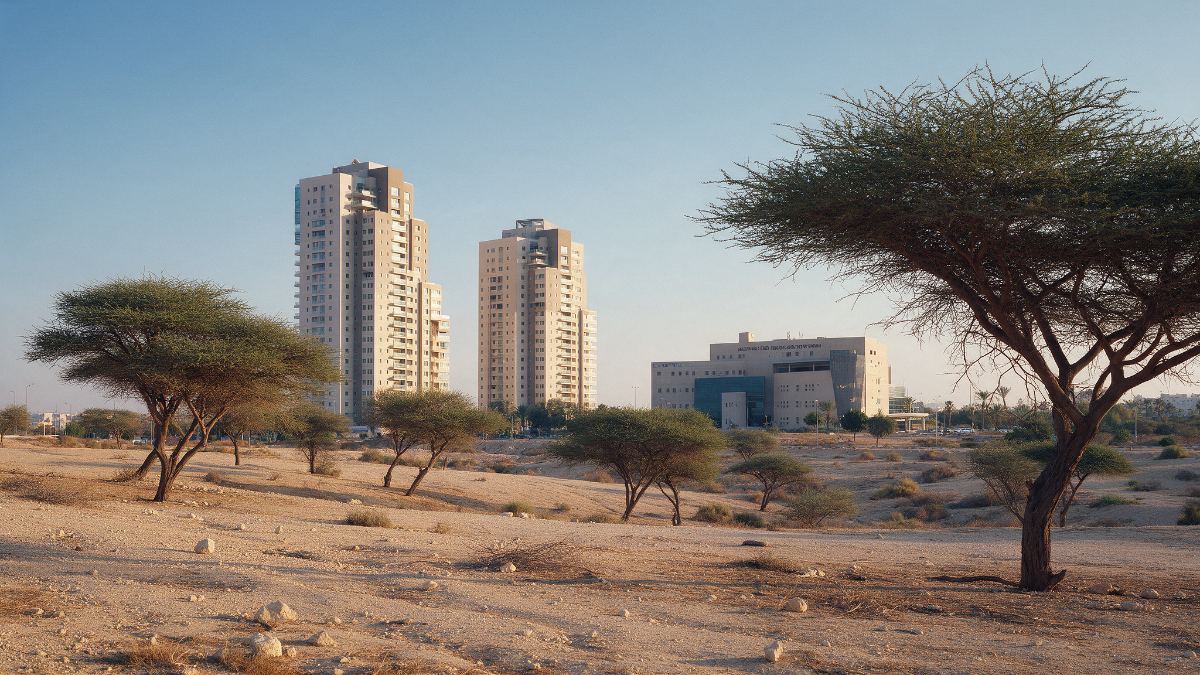
Buying an apartment in Beer Sheva: prices by neighbourhood, rental yield and what to know
Beer Sheva is the cheapest large city in Israel: the average apartment sold for about ₪1.24 million in early 2026, roughly half the national average and a quarter of Tel Aviv. Behind that price sits a city of about 225,000 people with Ben-Gurion University, Soroka Medical Center, a growing high-tech park and the biggest military relocation in the country’s history, as IDF technology and intelligence units move to the Negev. This guide gives real price ranges by neighbourhood, what students and soldiers rent, what is being built, and the security questions you should ask before buying.
Beer Sheva in four figures
₪9,000 to ₪18,000 per m² depending on the neighbourhood and the age of the building; an average apartment price of about ₪1.24 million (CBS, Q1 2026), the lowest of any large Israeli city; +0.6% in a year, a flat market with developers discounting new stock; about 225,000 residents and a metropolitan area of nearly 400,000. A 4-room resale in Ramot trades between ₪1.2 and ₪1.4 million; a small 3-room near the university, between ₪600,000 and ₪900,000. Gross rental yields of 3.5 to 5%, up to 6% on student units, are among the highest in the country.
Prices by neighbourhood (order of magnitude, 2026)
Beer Sheva has seventeen residential neighbourhoods, many of them still named after Hebrew letters (Alef, Bet, Gimel, Dalet…), plus the Old City and the Ramot area in the north-east. The price logic is simple: the older 1950s–1970s blocks in the lettered neighbourhoods are the cheapest in Israel, the 1990s–2000s neighbourhoods (Neve Ze’ev, Nahal Ashan, Ramot) sit in the middle, and the new stock in Rakafot, Pisgat Ramot, Sigaliyot and the park area is the top of the market. Proximity to the university and Soroka adds rental value more than resale value.
| Neighbourhood | ₪/m² resale | ₪/m² new | Profile |
|---|---|---|---|
| Ramot (A–D), Pisgat Ramot | 11,000–16,000 | 15,000–18,000 | The established upper-middle-class north-east: villas, cottages and low-rise buildings, next to the Ramot forest. 4-room resales between ₪1.2M and ₪1.4M in 2026; about 3,700 new homes planned in Pisgat Ramot. |
| Neve Noy | 11,000–15,000 | — | Next to Ben-Gurion University: houses and small buildings, faculty and students, the highest average rents in the city. |
| Rakafot, Kalaniyot | 13,000–15,500 | 12,000–16,000 | The northern entrance along the Reger axis. Kalaniyot is built; Rakafot is planned for about 4,000 homes, mostly plots for detached houses plus low-rise apartments and some target-price (mechir matara) units. |
| Sigaliyot, Park HaNahal, Neot HaDarim | 12,000–15,000 | 14,000–18,000 | Recent mid-rise buildings and towers with parking, mamad and sometimes a pool; new 4-rooms advertised around ₪1.55M to ₪1.8M. |
| Neve Ze’ev | 11,000–14,500 | 14,000–17,000 | Family neighbourhood built from the 1990s, with many households from the 1990s aliyah; larger apartments and cottages, a good rent-to-price balance. |
| Nahal Ashan (Neve Menachem), Neot Lon | 9,500–13,000 | 13,000–16,000 | Mid-market family areas; a 4-room of 119 m² sold for ₪1.17M in April 2026. |
| Dalet, Bet (university and Soroka) | 10,000–14,000 | — | 1950s–1970s blocks within walking distance of BGU, Soroka and Beer Sheva North station: small 3-rooms between ₪600,000 and ₪930,000, the investors’ and students’ market. |
| Old City, Civic Center | 9,000–13,000 | — | The historic centre under renovation, the municipal market, a few residential towers; small apartments and a still-patchy street life. |
| Alef, Gimel, Hey, Vav, Tet, Yud-Alef | 9,000–12,000 | — | The entry price of the city: 3-rooms sold between ₪570,000 and ₪800,000 in 2025–2026, often without an elevator or mamad; long-term urban renewal candidates. |
Prices per m² in Israel are quoted on gross area (walls included, often the balcony and a share of common areas), so a listing at 100 m² is about 85-90 m² usable (about 920-970 sq ft); the areas registered in official deal data can be smaller still, which inflates the per-m² figure of small old units (see gross vs net square meters). An Israeli “4-room” apartment has three bedrooms and a living room. Beer Sheva against the rest of the country: Israel real estate prices city by city.
A flat market with a long-term story
The CBS average barely moved in two years: ₪1.249M for 2024, ₪1.236M for 2025 and ₪1.241M in Q1 2026. Behind that stability, the new-build market went through a sharp slowdown. According to the Finance Ministry’s chief economist, only 361 new apartments were sold on the open market in Beer Sheva in the first ten months of 2025, against 844 in all of 2024, and developers have cut prices by more than 10% since the end of 2023, up to about 17% around Ramot (Bizportal, July 2026). For a buyer, that means negotiating power: payment schedules, discounts, parking thrown in.
The long-term case rests on four employers and one relocation. Ben-Gurion University has about 20,000 students, many of whom rent. Soroka Medical Center, the hospital of the whole Negev, is one of the city’s largest employers, and a second 600-bed hospital is planned for 2028. The Gav-Yam Negev high-tech park, linked to the university by a footbridge next to Beer Sheva North station, hosts companies such as Microsoft, Dell, Wix and Rafael and is designed for about 10,000 workers once complete. And the IDF move south: the C4I and cyber (ICT) campus at the high-tech park started receiving its first units in spring 2026, the Southern Command headquarters is planned there for about 6,300 soldiers, and the intelligence campus near Likit junction, built for about 14,000 personnel, is due to open in stages from late 2026. Rafael, Israel Aerospace Industries and Elbit are hiring engineers in the city.
The counterweights are real too. Beer Sheva remains one of the poorest large cities in Israel, residents do not get the income-tax benefit of nearby priority towns such as Ofakim or Dimona, the light rail is not expected before 2033, and a high-speed link to Tel Aviv (30–35 minutes) is a 2040 project. Many officers will choose the nearby suburbs (Omer, Lehavim, Meitar) over the city itself. Buy for rent and for use, not on the promise of a quick gain.
Who buys in Beer Sheva, and where
Four profiles make the market. Investors, Israeli and foreign, are the most visible: with ₪600,000 to ₪1 million they can buy an older 3-room near the university or Soroka, something impossible anywhere else in a large Israeli city. They let by the room to students or to medical residents, and accept older buildings in exchange for yield. Local families and upgraders move from the lettered neighbourhoods to Ramot, Neve Ze’ev, Nahal Ashan or a plot in Rakafot, where a cottage costs what a 3-room costs in central Israel. Career soldiers, defence-industry engineers and doctors arriving with the move south rent first, then buy a 4-5 room with a mamad and parking. And the Russian-speaking community, one of the largest in Israel, settled mainly with the 1990s aliyah: it is present across the city, with services, shops and professionals working in Russian, and its second generation is a large share of buyers in the newer neighbourhoods.
For English speakers, Beer Sheva is mainly an investment city rather than an Anglo community city like Beit Shemesh, Modiin or Raanana: there are English-speaking students and faculty at BGU and English-speaking doctors at Soroka, but few English-language services outside the university. That is precisely what keeps prices low. If you plan to live there, visit the neighbourhood at different hours, check the school catchment, and ask how long the walk to the shelter is.
New neighbourhoods: Rakafot, Pisgat Ramot and the park
Unlike coastal cities, Beer Sheva has land, and the Israel Land Authority keeps marketing it. Rakafot, at the northern entrance as an extension of Kalaniyot, is planned for about 4,000 homes: some 2,600 plots for detached houses, 750 terraced homes and about 800 apartments in buildings of up to six floors. Its 2024 target-price tender priced a 94 m² 4-room at about ₪844,000 for eligible buyers, against an appraised market value of about ₪1.13M. Pisgat Ramot, part of the planned innovation district between Ramot and the university, has about 3,700 homes, most of them already marketed. Around the Beer Sheva River Park, Sigaliyot, Park HaNahal and Neot HaDarim offer towers and mid-rise buildings with a pool, parking and a mamad.
In the old lettered neighbourhoods, urban renewal (TAMA 38, pinui-binui) moves more slowly than in the centre of the country: land values are low, so the extra apartments a developer can sell rarely pay for the rebuild. A building “in renewal” in Gimel or Yud-Alef is a long-term option, not a plan. For a new build, the usual Sale Law rules apply: a bank guarantee on every payment, part of the balance (at most 40% of the price) indexed to the construction cost index, and compensation from the second month past the contractual delivery date (see buying off-plan).
With unsold stock, Beer Sheva developers negotiate: 20/80 or 10/90 schedules, discounts of several percent, a parking space or kitchen upgrade included. Ask for the full price including parking and storage, compare it with recent resale deals in the same street on nadlan.gov.il, and have your own lawyer read the technical specification.
Security, transport and daily life
Security. Beer Sheva is about 40 km from the Gaza Strip. It was targeted by rockets in every Gaza conflict and by Iranian ballistic missiles in June 2025: Soroka’s surgical building was hit on 19 June and a residential building was struck on 24 June, killing five people. Iron Dome intercepts most rockets, and life in the city runs normally between rounds, but warning times are short (about a minute). The practical consequences for a buyer: prefer a building with a mamad (in-apartment safe room), or at least a shelter on the same floor or in the building; expect tenants to pay more for it; and check your home insurance covers war damage beyond the state compensation fund. Our guide on mortgages and the security situation covers what banks do during escalations.
Transport. Two train stations, Beer Sheva North–University (next to BGU, Soroka and the high-tech park) and Beer Sheva Central, put Tel Aviv about an hour to an hour and a quarter away; Route 6 and Route 40 connect the city by car. Inside the city, buses and cars rule: the planned 25 km light rail is not expected before 2033.
Daily life. Expect a hot, dry climate, long distances between neighbourhoods, and a quieter cultural life than Tel Aviv or Haifa, partly offset by the River Park (5,300 dunams, an artificial lake, a 12,000-seat amphitheatre), the university and the renovated Old City. Schools range widely by neighbourhood; Ramot, Neve Ze’ev and the newer areas are the usual choice for families.
Buying in Beer Sheva by status
Resident, only home
tax 0%- Financing up to 75%.
- On ₪1,350,000: mas rechisha ₪0; on a new ₪1,650,000: also ₪0.
- Loan of ₪1,012,500, payment ≈ ₪5,714 over 25 years.
Non-resident or investor
tax 8%- Financing 50% as a rule.
- On ₪1,350,000: mas rechisha ₪108,000.
- On a new ₪1,650,000: ₪132,000.
New immigrant (oleh)
tax 0%- Financing up to 75%.
- On ₪1,350,000: mas rechisha ₪0.
- Saving of ₪108,000 compared with a non-resident.
Beer Sheva is the city where the first bracket of the purchase tax does the most: almost every apartment sells below ₪1,978,745, so a resident buying an only home, or an oleh, pays no mas rechisha at all. An investor who already owns a home, or a non-resident, pays 8% from the first shekel; on the small budgets typical of Beer Sheva, that 8% is the largest cost after the price itself. A non-resident who becomes an Israeli resident within two years of the purchase can be reclassified as an only-home buyer and claim the difference back. Check the timing with your lawyer before signing, and see buying as a new immigrant.
Breakdown by bracket
| Bracket | Rate | Tax |
|---|
Brackets of 16 January 2025, frozen until 15 January 2028 (Arrangements Law). A non-resident is taxed as an additional-home buyer unless they become an Israeli resident within two years of the purchase. Payment is due within 60 days of signing.
Full budget: a 4-room resale in Ramot, bought to let
| Price | ₪1,350,000 |
| Mas rechisha (8%) | ₪108,000 |
| Agency fee (2% + 18% VAT) | ₪31,860 |
| Buyer’s lawyer (0.5 to 1% + VAT, minimum fees apply on small prices) | ≈ ₪12,000 |
| Mortgage broker, appraisal, bank fees, insurance | ≈ ₪12,000 |
| Translations, power of attorney, apostille, wires | ≈ ₪5,000 |
| Refresh before letting (paint, air-conditioning, appliances) | ≈ ₪20,000 |
| Total cost | ≈ ₪1,539,000 (+ 14.0%) |
| Mortgage at 50% | ₪675,000 → ≈ ₪3,810 / month over 25 years |
| Cash to plan for | ≈ ₪864,000 (≈ $273,000 / £203,000) |
| Rent, yearly lease | ≈ ₪4,500 / month → 4.0% gross on the price |
Two things stand out. First, transaction costs weigh more than in an expensive city: about 14% on top of the price for a non-resident, half of it purchase tax. The same apartment bought by an oleh or a resident as an only home would cost around ₪80,000 in fees instead of about ₪190,000. Second, the rent covers the mortgage comfortably: ₪4,500 a month against a payment of about ₪3,810, leaving room for the vaad bayit, maintenance, a vacant month and the management fee if you live abroad. Rent of up to the monthly exemption ceiling is tax-free for an Israeli resident, and non-residents usually opt for the 10% flat rate (see rental income tax).
Rental yield: students, doctors and soldiers
Beer Sheva has the highest gross yields of the large Israeli cities because rents fall much less than prices. In November 2026, median asking rents were about ₪2,800 for a 3-room, ₪3,700 for a 4-room and ₪5,600 for a 5-room (Realta, 1,400 listings). By neighbourhood, average rents ranged from about ₪2,500 in Dalet, where many listings are small units and rooms, to ₪4,400 in Neve Ze’ev, ₪4,800 in Ramot and over ₪6,000 in Neve Noy.
| Typical unit | Price | Rent / month | Gross yield |
|---|---|---|---|
| Old 3-room, Dalet or Bet, let to students | ₪650,000–900,000 | ₪2,800–3,800 | 4–6% |
| 4-room resale, Ramot or Neve Ze’ev | ₪1.2–1.4M | ₪4,200–4,800 | 3.8–4.7% |
| New 4-room, park area or Sigaliyot | ₪1.55–1.8M | ₪4,200–4,800 | 3.2–3.7% |
Student lets follow the academic year: leases start in August–October, turnover is high, and wear is faster; a local property manager is almost indispensable from abroad (see managing a property from abroad). Apartments divided into extra rooms yield more but must match the building permit: ask your lawyer to compare the plans with the reality before you buy. Families, medical residents and career soldiers sign longer leases and pay a premium for a mamad, parking and an elevator. All cities compared: rental yield by city.
Professionals on the ground
Beer Sheva is a local market: agencies know their own neighbourhoods and their own landlords, and much of the investor stock never reaches the big portals. Lawyers, mortgage brokers and agents working in Hebrew and Russian are easy to find; English-speaking ones exist but are fewer, and many investors use a Tel Aviv or Jerusalem lawyer with a local agent. We select professionals on three criteria: real estate specialisation, independence from sellers, and experience with remote transactions.
To compare: Ashdod, on the sea about an hour north, for about 70% more; Haifa, the other “cheap big city”, with the Technion and the sea; Jerusalem, about 1.5 hours away, at two and a half times the price; Tel Aviv, an hour by train, almost four times as expensive.
Frequently asked questions
What is the average price of an apartment in Beer Sheva in 2026?
About ₪1.24 million (≈ $393,000) according to the Central Bureau of Statistics for Q1 2026, up only 0.6% in a year. By size: about ₪850,000 for a 3-room, ₪1.29 million for a 4-room and ₪1.84 million for a 5-room. That is the lowest average of any large Israeli city, against ₪2.33 million nationally.
Which neighbourhoods are best for a rental investment in Beer Sheva?
For students and young doctors, the older neighbourhoods next to Ben-Gurion University and Soroka (Dalet, Bet, Neve Noy) let fastest and give the highest gross yields, often 4 to 6% on small apartments. For families and soldiers’ households, 4-room apartments in Ramot, Neve Ze’ev or Nahal Ashan let more slowly but more stably, at 3.5 to 4.5% gross.
Will the IDF move south push prices up?
It adds demand, but it has not moved the average yet: CBS prices were flat over the year to Q1 2026 while developers cut prices. The ICT campus at the high-tech park started receiving units in spring 2026 and the intelligence campus near Likit junction is due from late 2026 to 2027. Many soldiers serve on closed-base arrangements, and career personnel can choose Omer, Lehavim or Meitar. Treat it as support for rents, not a guaranteed capital gain.
Is Beer Sheva safe to buy in?
The city is about 40 km from Gaza and has been targeted by rockets in each Gaza conflict, and by Iranian missiles in June 2025 (Soroka was hit). Daily life is normal and Iron Dome intercepts most threats, but the warning time is short, so a mamad (in-apartment safe room) matters for your own use and for tenants. Buildings from before 1992 usually have only a shared shelter.
How much purchase tax do I pay in Beer Sheva?
As a resident buying an only home, usually nothing: the 0% bracket goes up to ₪1,978,745, above most Beer Sheva prices. A new immigrant (oleh) also pays nothing below that threshold. A non-resident or an investor buying an additional home pays 8% from the first shekel: ₪108,000 on a ₪1,350,000 apartment.
Can a foreigner get a mortgage for an apartment in Beer Sheva?
Yes, usually up to 50% of the price or appraisal for a non-resident, 75% for an oleh or a resident buying an only home. On a small budget, banks look closely at the borrower’s income and at the minimum loan size; a broker who works with non-resident files avoids wasted applications.
How we work
Every amount, bracket and rate on this page is checked against the official source listed at the bottom and dated. When a schedule or rate changes, the page is updated within days. Our methodology.
Sources
- Central Bureau of Statistics – average dwelling prices by city and size, Price Statistics Monthly 4/2026 (Q1 2026)
- Bizportal – Ramot, Beer Sheva: deals, rents and developer discounts (1 July and 3 August 2026)
- Bizportal – Neighbourhood Dalet, the investors’ favourite (22 May 2026)
- Ynetnews – weekly second-hand deals including Beer Sheva (26 April and 3 May 2026)
- Realta – Beer Sheva rents by neighbourhood and room count (November 2026)
- The Times of Israel – Beersheba readies for a “golden age” (29 August 2025)
- The Jerusalem Post – The IDF is moving south: Rakafot and Pisgat Ramot (30 March 2025)
- Walla – first units move into the IDF ICT campus in Beer Sheva (3 May 2026)
- Israel Tax Authority – mas rechisha brackets 2026
Your Beer Sheva project, with the right people
Agency, developer, mortgage broker or lawyer: tell us the neighbourhood, budget and whether you will live in it or let it, and we pass it to an English-speaking professional who works Beer Sheva every day.